The Death of the Middleman: 2026 Book Marketing Strategies for the Independent Author

A definitive white paper on the shift to direct sales, AI-driven discovery, and the renaissance of human connection in 2026 book marketing.
The Sovereign Author: Direct-to-Consumer (DTC) Ecosystems
For over a decade, the 'retailer-first' mentality dominated indie publishing. Authors spent thousands driving traffic to rented land—Amazon, Apple, and Kobo—where they possessed no customer data, no retargeting pixel, and no pricing autonomy. The paradigm has now inverted. The primary mandate for 2026 is the construction of a sovereign sales ecosystem.
This is not merely about higher margins, though the jump from 70% to 90%+ royalties is significant. It is about insulation from algorithm volatility. When an author sells directly through platforms like Shopify or BookBaby Bookshop, they transition from a supplier to a retailer. This shift requires a fundamental restructuring of marketing funnels, moving away from 'rank boosting' campaigns toward 'customer acquisition' models similar to e-commerce brands.
The data supports this migration. Authors who control their transactional environment report higher average order values (AOV) via upsells—bundling the ebook, audiobook, and a digital course in a single transaction—capabilities that are impossible on closed retailer gardens. The direct model also facilitates the sale of 'special editions,' a trend we will explore later.
However, this freedom comes with a technical tax. You are no longer just a writer; you are a store manager. This necessitates a grasp of sales tax compliance, digital file delivery, and customer support. The 'set it and forget it' days of KDP Select are being replaced by active storefront management.
Customer Data is the New Gold Standard
The most dangerous metric in publishing is 'Unknown Sales.' When Amazon sells your book, you know that it sold, but you do not know who bought it. You cannot email them about the sequel. You cannot ask them specifically for a review. You cannot create a lookalike audience based on their profile.
Owning the reader relationship solves this. By routing traffic to your own domain, every transaction builds your proprietary asset: the email list. As noted in recent trends by MIBLART, email marketing remains the highest ROI activity for authors, but its power is exponentially increased when paired with purchase history data collected via direct sales.
- Upsell Capabilities: Offer the audiobook at checkout for a discount, increasing AOV instantly.
- Bundling: sell the entire backlist series as a single high-ticket item ($50+) rather than $4.99 piecemeal sales.
- Retargeting: Use the pixel data from your store to run hyper-efficient Meta ads.
From SEO to GEO: The AI Discovery Engine
Search Engine Optimization (SEO) is being cannibalized by Generative Engine Optimization (GEO). In 2026, readers are less likely to type 'best sci-fi books 2026' into Google and scroll through ten blue links. Instead, they are asking AI models (like ChatGPT, Claude, or Perplexity) specific questions: 'Give me a sci-fi book with a female protagonist that explores consciousness, similar to Ursula K. Le Guin.'
This shift fundamentally alters discoverability. Being 'rankable' for keywords is less important than being 'cited' by the Large Language Model (LLM) training data. If your book's metadata, reviews, and digital footprint are not structured to be ingested and understood by these models, you become invisible to the high-intent searcher.
The implications for book marketing are stark. The goal is now to create a 'semantic footprint' around your author brand. This involves ensuring your book is mentioned in high-authority contexts that LLMs trust—Wikipedia, major media outlets, and reputable genre blogs—rather than just spamming keyword-stuffed descriptions.
Optimizing for the Machine Mind
How do you optimize for a black box? The strategy revolves around 'Entity Authority.' You must establish your book as a distinct, recognizable entity on the web. This means consistent metadata across all platforms and generating 'social proof' that feeds the AI's understanding of your genre relevance.
Additionally, authors must treat their own websites as knowledge graphs. Clear, structured data (Schema markup) that explicitly tells search bots 'Book A is part of Series B written by Author C' helps these engines connect the dots. The cleaner your data, the more likely an AI is to recommend you.
The Audio Renaissance: AI Narration at Scale
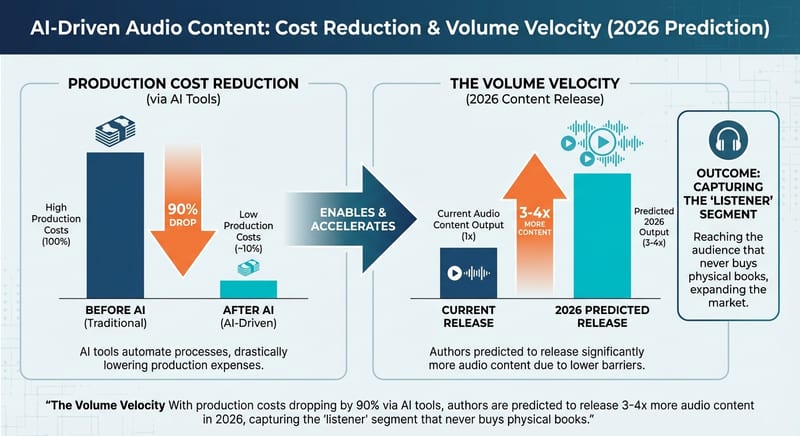
The financial barrier to entry for audiobooks has collapsed. Historically, producing an audiobook cost $3,000 to $5,000 per title—a prohibitive expense for most indie authors, especially for backlist titles that may not recoup that investment quickly. In 2026, AI-assisted narration has matured from a robotic gimmick into a viable, high-quality production standard.
This does not mean the death of human narrators; rather, it signifies a tiered market. 'Performance' audiobooks (celebrity voices, full casts) will remain premium products. However, for the vast mid-list and backlist, AI narration allows authors to monetize IP that was previously sitting dormant. Platforms like PublishDrive predict an explosion in audio availability because of this cost reduction.
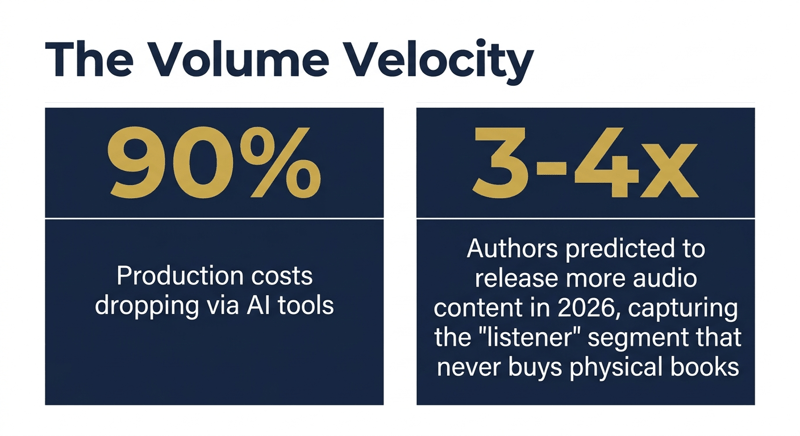
This accessibility opens new marketing channels. Authors can now produce audio magnets—free novellas or prequels in audio format—to onboard listeners into their paid ecosystem. It turns audio from a luxury format into a standard acquisition tool.
"The revival of backlist titles through AI optimization... allows authors to generate revenue from older works with minimal new investment. - PublishDrive 2026 Predictions"
The Ethics of Artificial Voice
While the technology is accessible, the reception varies by genre. Non-fiction audiences generally accept high-quality AI narration readily. Fiction audiences, particularly in Romance and Fantasy, remain more skeptical, valuing the emotional nuance of a human performer. Marketing these editions requires transparency.
Misleading a listener about the nature of the narrator leads to review bombing. The successful strategy involves clear labeling and price differentiation. An AI-narrated book should be priced aggressively to encourage impulse buys, functioning as a gateway to the author's human-narrated premium works.
Short-Form Video & The Demand for Authenticity
In an internet flooded with AI-generated text and images, human connection has become a premium commodity. This drives the continued dominance of short-form video on platforms like TikTok (BookTok) and Instagram Reels. Readers are not just buying a story; they are buying the creator behind the story.
The 'faceless' brand is dying. Successful 2026 marketing strategies heavily feature the author's face, voice, and behind-the-scenes life. Manuscript Report's guide highlights that raw, unpolished videos often outperform highly produced trailers because they signal authenticity.
The strategy here is 'parasocial relationship building at scale.' By consistently showing up on video, authors create a sense of intimacy with their audience. When a reader feels they 'know' the author, price sensitivity decreases, and loyalty increases. This is the antidote to the commoditization of AI-written books.
- Day in the Life: Show the struggle of writing, not just the success. Vulnerability sells.
- Reader Reacts: Duet videos of readers crying or laughing at your plot twists (with permission).
- Direct Response: Answering reader questions via video reply to boost engagement algorithms.