The 2026 Author Strategy: Deep Work, Direct Sales, and the End of the Algo-Chase

A definitive guide to the 2026 publishing landscape. We analyze the shift from social media hustle to direct sales, long-form thinking, and the resurgence of hi
The Exodus from Algorithmic Social Media
For the past decade, authors have been told that 'visibility' is the currency of success. This led to a treadmill of daily TikToks, hourly Tweets, and an exhausting reliance on rented land. However, as we move through 2026, a significant correction is underway. Leading voices like Joanna Penn and Claire Taylor are advocating for a radical departure from social media dependency. The logic is ruthlessly economic: social platforms monetize their user retention, not your book sales.
The shift is toward 'owned' channels—specifically, the email list and the direct sales store. When an author relies on Amazon or Instagram, they are subject to policy changes, shadow-banning, and diminishing organic reach. By moving the transaction to a proprietary site (using tools like Shopify or WooCommerce) and the communication to a newsletter, the author regains control over the customer lifetime value (LTV). This isn't just about higher margins; it's about business continuity.
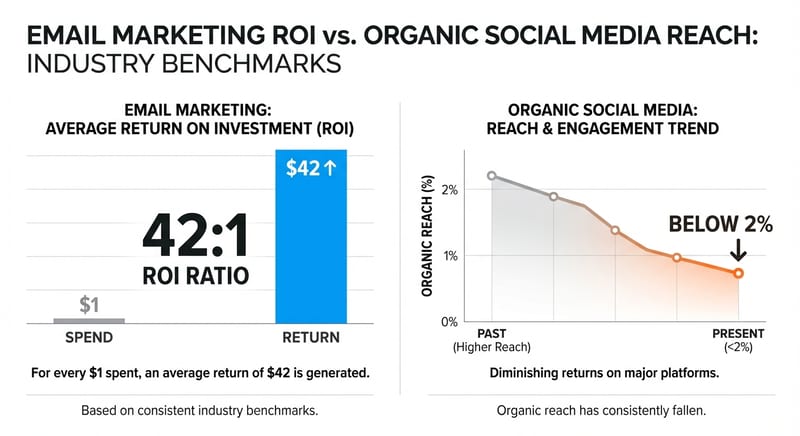
This disparity in ROI explains the migration. Authors are realizing that 1,000 engaged email subscribers are worth more than 100,000 passive followers. The strategy for 2026 is not 'going viral'; it is 'going deep.' This requires a psychological pivot from seeking validation (likes) to seeking connection (replies and sales).
Nuance: The 'Iconic' Character as a Marketing Asset
Leaving social media doesn't mean leaving marketing; it means the product must do the heavy lifting. This is where Claire Taylor's concept of 'Iconic Characters' becomes a business strategy. In a distracted world, readers don't buy plots; they buy people. Characters driven by clear, resonant motivations (often mapped via the Enneagram) create a 'stickiness' that transcends the book itself.
If the character is strong enough, they become the brand. This allows the author to market the identity of the protagonist rather than the premise of the book. It is a subtle but powerful distinction that allows for long-term career sustainability without the need for constant personal branding by the author.
The Renaissance of Long-Form Thinking
In an age of 15-second clips, the counter-intuitive winner is long-form text. Dan Koe argues persuasively that long-form writing (newsletters, essays, manifestos) is the only reliable way to build trust. Short-form content captures attention, but long-form retains it. More importantly, AI LLMs excel at generating generic summaries but struggle with the unique, structured articulation of a human worldview developed over 2,000 words.
Writing long-form is not just a publishing strategy; it is a thinking strategy. It forces the author to organize their thoughts, question their assumptions, and develop a 'proprietary voice.' This voice becomes the moat. When readers subscribe to a Substack or a weekly column, they are subscribing to the author's specific lens on the world, something ChatGPT cannot replicate.
Writing as a Discovery Process
Many authors suffer from 'blank page syndrome' because they attempt to write only when they have a finished idea. The 2026 approach flips this: writing is the process of having the idea. By committing to a regular long-form practice, authors create a content engine that feeds their books.
This 'build in public' approach—sharing the evolution of ideas—creates a feedback loop. Readers feel invested in the journey, making them more likely to purchase the final product (the book) because they helped shape the intellectual territory it covers.
"Writing is more about the journey than the destination. It is the mechanism by which we understand what we actually believe. - K.M. Weiland"
- The Newsletter: The primary vehicle for long-form. It is not for 'news'; it is for essays.
- The Blog: A searchable archive of your best thinking, essential for SEO.
- The Book: The crystallized, premium version of the ideas explored in the newsletter and blog.
The Business Case: Why Proposals Matter (Even for Fiction)
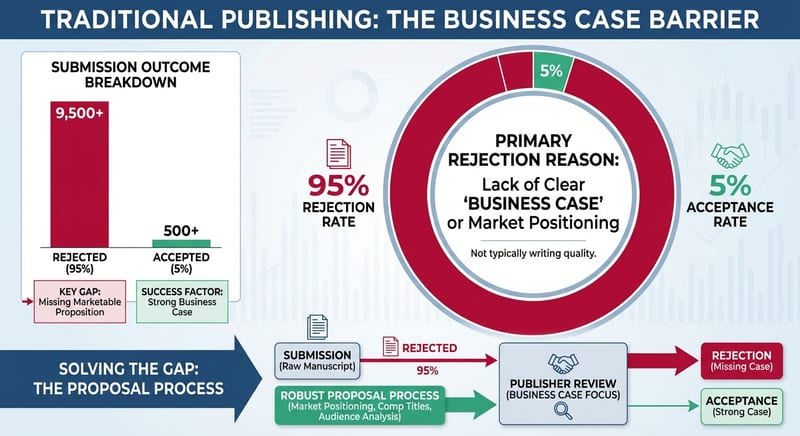
For nonfiction authors, the book proposal has always been standard. But in 2026, the *mindset* of the proposal is critical for everyone. Jane Friedman's guide highlights that a proposal is essentially a business plan. It forces the author to answer the uncomfortable questions: 'Why this book? Why now? Who cares?'
Too many authors write in a vacuum, focusing entirely on 'craft' while ignoring 'market.' The proposal process acts as a filter. It demands a competitive title analysis—proving that a paying readership exists—and a concrete marketing plan. It shifts the author from 'artist' to 'product manager.' This is not about selling out; it is about ensuring the art reaches an audience.
Platform vs. Prose
A harsh reality remains: for prescriptive nonfiction (how-to, self-help), your platform often outweighs your prose. Publishers need to know you can sell the book. However, for memoir and narrative nonfiction, the equation flips. Without a massive platform, the writing must be transcendent.
This dichotomy requires honesty. If you lack a platform, you must double down on craft. If your craft is average, you must build a massive platform. The 'middle'—average writing with a small platform—is the death zone in the modern market.
Crowdfunding: The New Advance Model
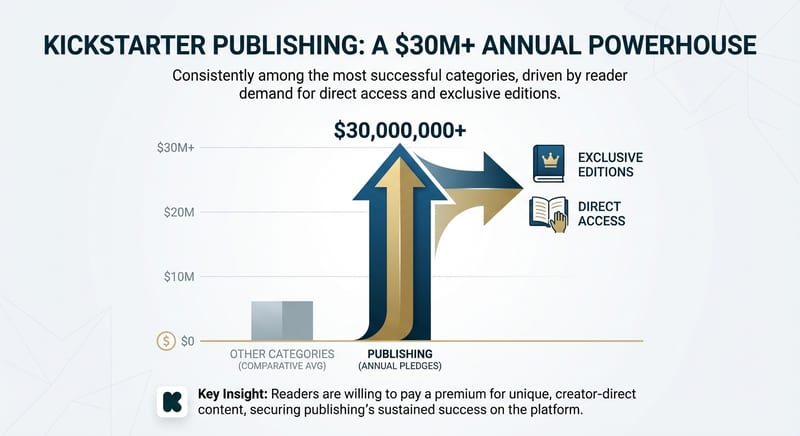
The traditional advance is disappearing for mid-list authors. In its place, crowdfunding has emerged as the superior validation and funding model. As noted by Kris Writes, platforms like Kickstarter are not just for asking for money; they are for building 'super-fans.' A successful campaign proves demand before a single unit is shipped.
This 'Direct-to-Consumer' (DTC) launch model allows authors to offer premium, limited editions—hardcovers, special art, bundles—that retailers like Amazon cannot handle. It turns a $20 book buyer into a $100 tier backer. This influx of cash allows for higher production values (editing, cover design), creating a virtuous cycle of quality.
The Mentorship Gap
With the rise of self-publishing, the 'apprenticeship' phase of writing was largely lost. Previously, editors at publishing houses groomed talent. Now, authors must seek this out proactively. High-level mentorships, like those offered by Dean Wesley Smith and Kristine Kathryn Rusch, are becoming essential for authors who want to move beyond 'hobbyist' status.
These programs focus on the unglamorous basics: setting, pacing, and discipline. The barrier to entry in publishing is low, but the barrier to success is higher than ever. Investing in craft education is the only way to ensure your book doesn't just launch, but lasts.
Conclusion: The Integrated Author
The successful author of 2026 is an integrated professional. They combine the deep focus of the craftsman with the strategic acumen of the entrepreneur. They do not chase algorithms; they build ecosystems. By focusing on direct sales, long-form connection, and undeniable product quality, they inoculate themselves against the volatility of the tech giants.