Big 5 Publishers vs Amazon KDP: Honest Pros & Cons Every Self-Published Author Needs to Know (2026)

A detailed comparison of the Big 5 traditional publishers versus Amazon KDP self-publishing, with honest pros, cons, and real 2026 data to help authors make the
Ten years ago, landing a Big 5 deal felt like the only real measure of success as an author. Today, that has changed dramatically.
The self-publishing market is growing at 16.7% annually and is projected to hit $6.16 billion by 2033. More than 2.6 million self-published titles hit the market in 2023 alone, compared to roughly 300,000 traditionally published books. And fewer than 50% of authors under 45 say they want their next book to be traditionally published.
None of that means traditional publishing is dead. It means authors finally have real options and real data to compare them.
The Big 5: Who They Are and How to Get In
The Big 5 dominate roughly 80% of the traditional publishing market. Their names carry weight: bookstore placement, award eligibility, media coverage, and international distribution are all real advantages. But there is a catch most guides gloss over. You almost certainly cannot submit directly to any of them.
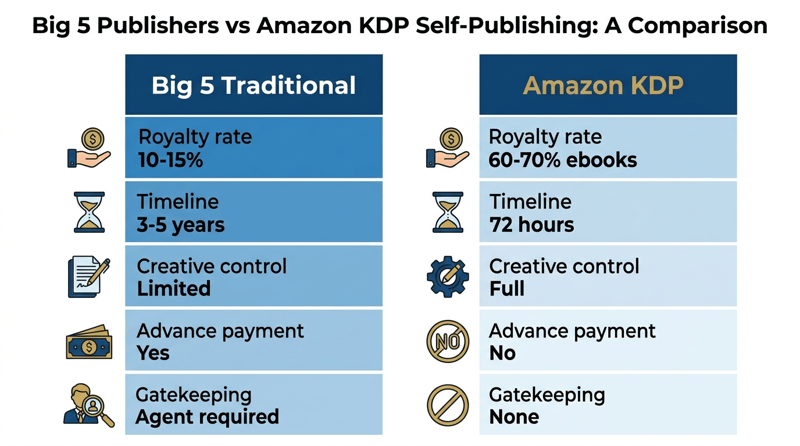
Every Big 5 publisher requires submissions to go through a literary agent. Before your book even reaches an editor, you need to query agents (typically 6 to 12 months), secure representation, and then wait while your agent submits to publishers (another 6 to 18 months). If you get an offer, add another 12 to 24 months to actual publication.
Total timeline from finished manuscript to bookshelf: easily 3 to 5 years.
1. 1. Penguin Random House
The largest trade publisher in the world, with 275+ imprints including Knopf, Crown, Doubleday, Viking, Bantam, and Riverhead. PRH publishes over 15,000 new titles annually across every genre.
Pros: Unmatched global distribution, physical and digital. Significant marketing budgets for select titles. Prestige that opens doors: awards, media, retail placement. Median debut advance of around $25,000, with potential for six figures at auction. Strong backlist management keeps books in print longer.
Cons: Agent required with no exceptions. 90% of submitted books never earn out their advance. Standard print royalties of 10-15% are calculated on net, not cover price. Average time from deal to publication is 18 to 24 months. Limited creative control: cover, title, and positioning are publisher decisions.
2. 2. HarperCollins
America's second-largest publisher, home to imprints like Avon, William Morrow, Harlequin, and HarperOne. Publishes around 10,000 titles per year.
Pros: Strong genre expertise across fiction, nonfiction, romance, and children's books. Avon Impulse has historically accepted unagented digital submissions. Royalties of 15-20% hardcover and 7-7.5% paperback, higher for ebook. Solid international reach through offices in 18 countries.
Cons: Almost entirely agent-gated. Avon Impulse openings are rare and periodic. Underwent significant layoffs in 2022-2023. Response times are slow and rejections usually arrive without feedback. Contract terms heavily favor the publisher on subsidiary rights.
3. 3. Simon & Schuster
Acquired by private equity firm KKR in 2023 for $1.62 billion, making it the only Big 5 house not owned by a diversified media company. Home to Scribner, Atria, Gallery Books, Pocket Books, and Simon & Schuster Kids.
Pros: Has a public Submission Selector tool for certain categories, making it the most accessible of the Big 5. Strong track record in commercial fiction, self-help, and memoir. Royalties of approximately 15-20% for print and 20-25% for ebook.
Cons: The Submission Selector is limited and most categories still require an agent. KKR acquisition introduces uncertainty about long-term editorial priorities. Creative control is largely surrendered upon signing. Response times can stretch 6 to 12 months with no guarantee of a reply.
4. 4. Hachette Book Group
The US arm of French media giant Hachette Livre, with imprints including Little, Brown, Grand Central, Orbit, and Yen Press. Known for strong literary and genre fiction rosters.
Pros: Orbit imprint is one of the best-regarded sci-fi/fantasy publishers in the world. Strong digital and audio distribution. Royalties of 15-20% for print and 25% for ebook, competitive among the Big 5.
Cons: Zero unsolicited submissions accepted. Their website explicitly states they will not return or answer them. A literary agent is not optional: it is a hard requirement. Publishing timelines run long even by Big 5 standards.
5. 5. Macmillan Publishers
Owned by German media company Holtzbrinck, with imprints including Farrar Straus & Giroux, St. Martin's Press, Tor Books, and Flatiron Books.
Pros: Farrar Straus & Giroux is arguably the most prestigious literary imprint in America. Tor Books is the leading publisher for science fiction and fantasy. Royalties of approximately 15% for print and 20-25% for ebook. Strong children's and YA catalog through Henry Holt and Roaring Brook.
Cons: Agent required across virtually all imprints. Tor Books no longer accepts unsolicited submissions. FSG and St. Martin's acceptance rates are well under 1%. Smaller marketing budgets per title than PRH or HarperCollins on average.
Amazon KDP: The Other Path
Amazon Kindle Direct Publishing launched in 2007 and fundamentally changed what it means to be a published author. Today it controls 68% of the ebook market and has made self-publishing a legitimate, full-time career path for tens of thousands of authors.
Pros: Publish in 24 to 72 hours with no gatekeepers. 70% ebook royalties on titles priced $2.99 to $9.99 (35% outside that range). 60% print royalties minus per-copy printing costs. Full creative control over your cover, price, description, and launch date. Real-time sales data and author dashboard. No agent, no advance, no waiting years.
Cons: No upfront advance. You only earn when books sell. Amazon controls your distribution and can change terms at any time. Physical bookstore placement is limited for KDP-only titles. You are responsible for editing, cover design, and marketing. Discoverability requires significant marketing investment.
KDP Select: The Exclusivity Trade-Off
KDP Select is Amazon's optional program that gives you access to Kindle Unlimited's 4+ million subscribers in exchange for 90-day ebook exclusivity. You cannot sell your ebook on Apple Books, Kobo, Google Play, or your own website during that window.
Pros: Access to 4 million Kindle Unlimited readers. Up to 5 free promotion days per 90-day period. Countdown Deal access for discounted promotions. Can significantly accelerate discoverability in high-volume genres like romance, fantasy, and thriller.
Cons: Ebook exclusivity cuts you off from 40% of the non-Amazon market. KU payouts fluctuate monthly (approximately $0.004 to $0.005 per page read), making income unpredictable. Less effective for nonfiction, literary fiction, or niche markets. Long-term career risk from full dependence on one platform.
Best for genre fiction authors building series readership fast. Not recommended for nonfiction authors, literary fiction, or authors targeting international markets beyond the US and UK.
Which Path Is Right for You?
There is no universal right answer, but there are clear patterns.
Traditional publishing (Big 5 or otherwise) makes sense if you are writing literary fiction, narrative nonfiction, or memoir where prestige and placement matter; if you have a platform or credentials that make you attractive to agents; and if you are willing to invest years in the process without a guaranteed outcome.
Amazon KDP makes sense if you are writing in a popular genre like romance, fantasy, thriller, or sci-fi; if you want to build a career systematically over multiple titles; if you value speed, creative control, and higher royalty percentages; or if you want to test your market before pursuing traditional publishing.
Many successful authors today do both. They self-publish in one genre while querying traditionally in another. And a growing number of self-published authors with strong sales records have been approached by traditional publishers for deals, often on better terms than a debut query would ever produce.
The Read & Rate Advantage
Whether you are submitting to agents, launching on KDP, or running a Kindle Unlimited series, one thing remains constant: readers and algorithms both respond to reviews.
Big 5 publishers have PR teams to seed reviews. Self-published authors have to build that credibility themselves, and that is exactly what Read & Rate is designed to help with.
Read & Rate connects self-published authors with real readers who review across Amazon, Goodreads, BookBub, and more, all through a watermarked PDF system that protects your work. It is the review infrastructure that levels the playing field between indie authors and the publishing establishment.