Book Marketing Strategies 2026: The Death of "Hype" and the Return of Systems

Stop chasing viral trends. The 2026 playbook for authors demands metadata mastery, direct-to-consumer pipelines, and a counter-intuitive return to analog networ
The Infrastructure Layer: Metadata as the New Publicist
In the high-stakes environment of 2026 publishing, the romantic notion of 'word-of-mouth' has been replaced by the algorithmic reality of metadata. It is no longer sufficient to write a compelling book; you must engineer the digital signals that allow discovery engines to function. Metadata—comprising keywords, BISAC categories, and semantic search strings—is the silent infrastructure that determines whether your book exists to the buying public. It is the difference between a masterpiece gathering dust and a backlist title that generates passive revenue for decades.
Most authors view metadata as a 'set it and forget it' administrative task. This is a fatal strategic error. In a marketplace saturated with AI-generated content, metadata is the primary filter for relevance. Retailer algorithms have evolved; they now prioritize granular intent matching over broad categorization. If your keywords do not align with the specific, often long-tail queries of your ideal reader, you are effectively invisible. The battle is won in the dashboard, not on the social feed.
We are witnessing a shift where the 'blurb' is written less for human emotion and more for machine readability. This doesn't mean the copy should be robotic, but it must be structurally sound, loaded with the precise terminology that signals genre competence to the algorithm. This is the new baseline for entry.
Nuance: The Semantic Search Shift
The nuance here lies in the transition from 'keyword stuffing' to 'semantic relevance.' Amazon's A9 algorithm and Google's search bots have moved beyond simple string matching. They now look for context. A book about 'Time Travel' isn't just indexed under sci-fi; it's evaluated against related concepts like 'temporal paradox,' 'historical intervention,' and 'alternative history mechanics.'
This requires a sophisticated approach to writing descriptions. You are not just summarizing a plot; you are planting semantic flags. Every sentence in your book description should serve a dual purpose: hooking the human reader with emotional stakes while simultaneously feeding the engine with high-value relevance signals. It is a technical writing exercise disguised as creative copy.
- Frequency Audit: Update keywords quarterly to match shifting search volume trends.
- Category Sniping: Utilize tools like Publisher Rocket to find low-competition, high-relevance subcategories.
- Subtitle Utility: Use non-fiction subtitles for explicit keyword integration, even if the main title is abstract.
The Direct-to-Consumer Pivot: Owning the Graph
If metadata is the infrastructure, the email list is the currency. The vulnerability of relying on 'rented land'—social media followers, Amazon rankings, BookTok trends—has never been more apparent. Platforms decay. Algorithms change. Accounts get banned. The only asset on your balance sheet that retains value independent of platform volatility is a permission-based email list. This is the cornerstone of the systematized marketing approach championed by industry veterans.
Direct sales are the logical conclusion of this strategy. By selling directly from your own website, you not only capture the 30-70% margin typically lost to retailers but, more importantly, you capture the data. When a reader buys from Amazon, they are Amazon's customer. When they buy from you, they are yours. You know their purchase history, their location, and their reading speed.
However, building this pipeline requires a shift in mindset. You are no longer just an author; you are an e-commerce operator. This demands technical competence in funnel architecture—landing pages, lead magnets, and automated sequences that nurture a stranger into a superfan.
Nuance: The 'Superfan' Economics
The economic reality is that 1,000 true fans are worth more than 100,000 casual followers. A 'Superfan' does not just buy the book; they buy the premium edition, the audiobook, and the merchandise. They pre-order without waiting for reviews. This segment of your audience provides the predictable cash flow necessary to fund broader acquisition campaigns.
The strategy, therefore, is not 'growth at all costs,' but 'retention at all costs.' The email sequences you build should be designed to identify and elevate these high-value readers. Segment them out. Treat them like VIPs. Give them early access. The return on investment for retention marketing dwarfs that of cold acquisition.
"Marketing success comes from systems, not luck. Authors should detach from immediate outcomes, focusing on long-term visibility." - A Marketing Expert"
The 'Analog' Renaissance: Offline is the New Luxury
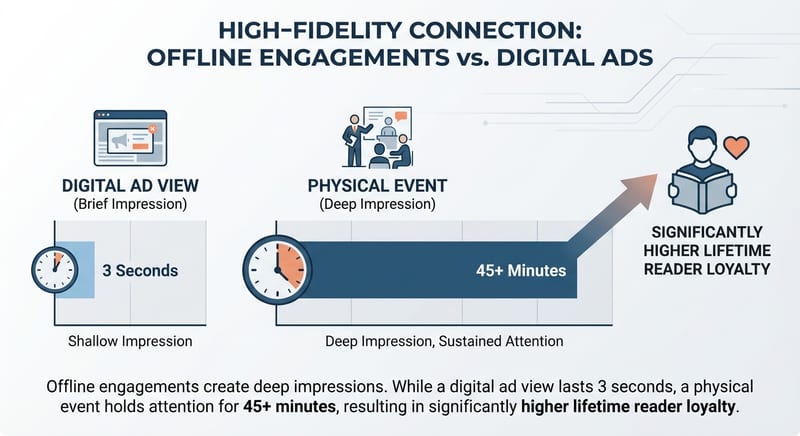
In a digital world drowning in AI slop, physical presence has become a luxury good. We are seeing a powerful counter-trend: the resurgence of 'analog' marketing. This isn't about traditional book tours, which are notoriously inefficient. It is about thematic, high-context speaking engagements. Thematic speaking allows authors to bypass the crowded literary circuit and embed themselves in specific interest groups.
Consider a thriller involving cyber-warfare. Pitching to a bookstore brings 20 random readers. Pitching to a cybersecurity conference brings 500 potential buyers who are professionally invested in the topic. The conversion rate at these events is astronomically higher because the context is pre-validated.
This strategy leverages the 'credibility halo' of the event. By being on stage, you are implicitly endorsed by the organizers. You are not selling a book; you are providing expertise or entertainment to a captive audience. The book is simply the souvenir of that experience.
Nuance: Niche over Broad Appeal
The key to analog success is hyper-specificity. Do not speak to 'readers.' Speak to 'veterans,' 'gardeners,' 'history buffs,' or 'entrepreneurs.' The narrower the niche, the higher the trust. You are looking for rooms where you are the only author, not rooms filled with other authors competing for attention.
This requires a fundamental rethinking of your book's value proposition. You must identify the 'non-fiction hook' within your fiction, or the 'serviceable advice' within your memoir. What problem does your book solve for a specific group of people? That is your entry ticket to the stage.
- Identify the Hook: What themes in your book align with existing organizations (Rotary clubs, trade associations, hobby groups)?
- Bulk Sales: Negotiate purchase of books as part of your speaking fee, guaranteeing volume sales.
- Lead Capture: Always have a physical mechanism (QR code, sign-up sheet) to move offline attendees to your digital list.
Visuals & Paid Acquisition: The ROI of Design
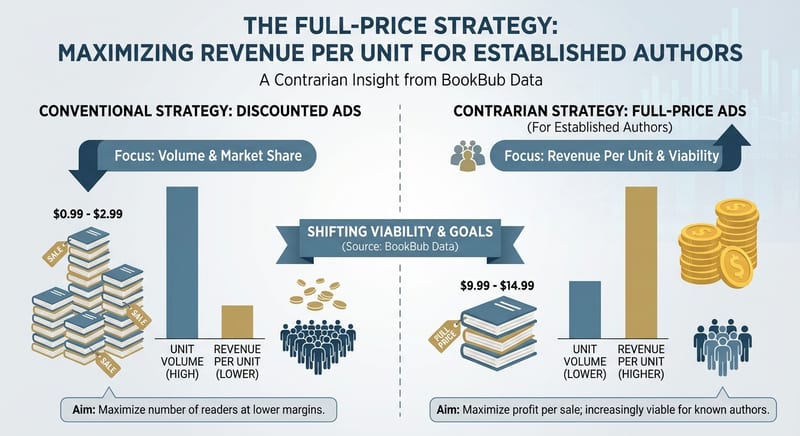
Paid advertising remains a potent accelerant, but the days of slapdash creative are over. Platforms like BookBub report that visual fidelity is a primary driver of Click-Through Rate (CTR). In 2026, your ad creative must be as polished as a film poster. The market has been trained by high-end aesthetics; amateurish design signals an amateurish product.
The strategic shift here is promoting the backlist. Smart money does not just advertise the new release (which is often full price and lower converting). It advertises the first book in a series—often discounted or free—to act as a loss leader. This 'series starter' strategy relies on read-through rates to generate profit on the back end.
Nuance: Unboxing as Content
A specific tactical edge is the 'unboxing' video. This is not just vanity; it is tactile proof of quality. In an era of digital intangibility, showing the physical weight, the texture of the cover, and the interior formatting creates a sensory desire. It validates the book as an object worth owning.
These assets should be deployed across all ad channels. A video ad of a book being unboxed often outperforms a static image of the cover because it arrests the scroll. It triggers a psychological ownership reflex. You are selling the experience of reading, not just the text.