Beyond the Retailer: The Definitive Architecture of Book Marketing in 2026

A white paper analysis of the shift toward direct sales ecosystems, AI-augmented productivity, and the specific metadata protocols required for discovery in 202
The Direct Sales Imperative: Owning the Transaction
For over a decade, the prevailing wisdom in independent publishing was to maximize visibility on major retailers. This strategy, effectively renting an audience from Amazon or Kobo, is now yielding diminishing returns due to rising ad costs and algorithmic opacity. The 'Direct Sales' model is not merely a trend; it is a structural necessity for margin protection. By bypassing the 30-65% retailer tax, authors are converting low-margin royalty checks into high-margin e-commerce businesses.
The context for this shift is economic sovereignty. As platforms tighten their 'pay-to-play' mechanics, the authors surviving the 2026 transition are those who treat their website not as a brochure, but as a primary storefront. Platforms like Shopify and WooCommerce allow for the capture of pixel data, retargeting capabilities, and the granular analysis of customer lifetime value (LTV) that closed gardens like Amazon never provide.
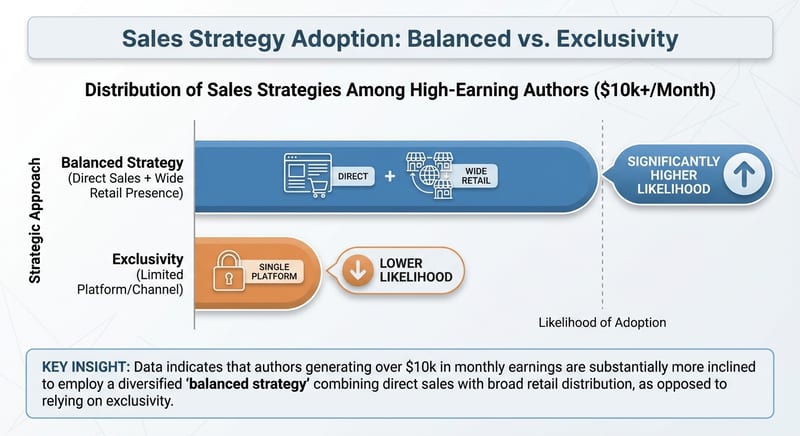
However, this is not an 'all-or-nothing' proposition. The most sophisticated author-businesses operate a hybrid model, using retailers for wide discovery while funneling 'superfans' into a direct ecosystem for higher-ticket purchases.
The Technical Barrier: Payment Gateways and Taxes
The nuance often overlooked in the enthusiasm for direct sales is the administrative overhead. Unlike the 'set and forget' nature of KDP, running a direct store requires a mastery of merchant of record (MoR) protocols. Handling VAT in the EU, GST in Australia, and sales tax nexus in the US is a non-trivial friction point that defeats many early adopters.
Successful implementation relies on middleware solutions. Services like Bookvault or Lemon Squeezy act as the buffer, handling the global tax compliance while the author retains the customer data. This technical stack is what separates the hobbyist selling a PDF from a scalable publishing enterprise.
- Merchant of Record (MoR): Utilize platforms like Payhip or Lemon Squeezy to automatically handle global VAT remittance.
- Fulfillment Integration: Link Shopify directly to Bookvault for automated print-on-demand fulfillment, removing manual shipping.
- Data Ownership: Configure Google Analytics 4 (GA4) server-side tracking to monitor conversion paths that Amazon blocks.
"Direct sales offer full control over customer data and higher profit margins, but it requires treating your writing as a true e-commerce brand. - Dave Chesson, Kindlepreneur"
The Metadata Engine: Algorithmic Discovery in 2026
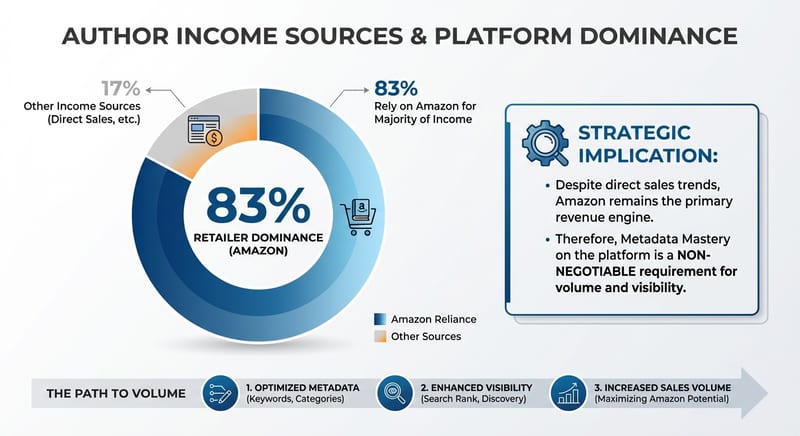
While direct sales protect margins, metadata drives discovery. In 2026, metadata is no longer just 'keywords and categories.' It has evolved into a semantic web of interconnected data points that feed the large language models (LLMs) powering search. If your book's metadata is not structured for machine readability, it effectively does not exist.
The context here is the death of simple keyword stuffing. Modern search algorithms on Amazon and Google utilize semantic vector search. They understand the 'intent' behind a query like 'cosy mystery with a witch protagonist' rather than just matching string text. Authors must optimize their book descriptions not just for humans, but for the training data of these discovery AI agents.
This requires a shift in how we conceive of a book's digital footprint. It is less about 'rank' and more about 'relevance signals.' The more consistent and deep your metadata is across all platforms (ISBN records, website schema, retailer fields), the higher your probability of surfacing in AI-generated recommendations.
Nuance: Semantic Search Optimization
A critical edge case in metadata strategy is the use of 'invisible' tags within the ePub file itself. Sophisticated publishers are now embedding rich schema data directly into the digital file headers. This ensures that even if a retailer strips external metadata, the file itself carries its classification DNA.
Furthermore, the utilization of A+ Content and enhanced descriptive fields is now weighed heavily by discovery algorithms. It's not just visual decoration; the text within these modules is indexed. Ignoring this is leaving discoverability points on the table.
The Hybrid Income Architecture: Wide vs. Exclusive
The dichotomy of 'Wide vs. Exclusive' (Amazon KDP Select) has dissolved into a spectrum of utility. The modern strategy is not a moral stance but a portfolio management decision. High-growth authors are increasingly treating Amazon as a lead generation tool while keeping their most profitable assets (audiobooks, special editions, courses) on wide or direct platforms.
This contextual shift is driven by the realization that exclusivity caps potential reach. While the Kindle Unlimited page-read fund provides stability, it builds no equity in an owned audience. Trends for 2026 show that diversity in income streams is the primary indicator of long-term author survival.
A common implementation is 'windowing.' An author might launch a title exclusively on Amazon to harvest the initial algorithmic boost and page reads, then pull the title wide after 90 days to capture the Apple Books, Kobo, and library markets. This maximizes the specific benefits of both ecosystems without permanent lock-in.
Nuance: The Library Revenue Stream
Often ignored, the library market (via OverDrive/Libby and Hoopla) operates on a different economic model. It is less sensitive to price and more sensitive to professional reviews and catalog availability. For 'wide' authors, library sales can constitute 15-20% of revenue, providing a stable floor that fluctuates less than retail algorithms.
The technical nuance here involves 'Cost Per Circ' (CPC) vs. 'One Copy One User' (OCOU) licensing models. Smart authors actively manage these rights on platforms like Draft2Digital to optimize for library budget cycles, often seeing spikes in Q4 when libraries spend their remaining budgets.
- Windowing Strategy: 90 Days KDP Select -> Wide Distribution + Direct Store.
- Format Exclusivity: Keep eBook exclusive to Amazon, but sell Audiobook and Print Direct/Wide.
- Library Pricing: Set library pricing 2-3x higher than retail price to account for multiple lending licenses.
Premium Productization: The Collector's Economy
In a digital-first world, physical scarcity creates value. The 'Special Edition' is no longer just for major publisher blockbusters. Independent authors are leveraging advanced printing services to create high-margin collector's items—foiled hardbacks, sprayed edges, and annotated manuscripts—that sell for 5x-10x the price of a standard paperback.
This move is a direct counter to the commoditization of the eBook. While an eBook price is anchored low by market forces ($4.99 - $9.99), a limited edition physical product has price elasticity determined only by brand loyalty. This is the 'superfan' monetization layer that fuels the direct sales boom.
Crowdfunding platforms like Kickstarter and BackerKit have become the validation engines for these products. Authors reduce financial risk by pre-selling these premium editions, effectively getting paid to print. This turns printing costs into a variable expense covered by revenue, rather than a sunk capital investment.
Nuance: Fulfillment Logistics
The glory of a $50,000 Kickstarter campaign often dies in the shipping warehouse. The nuance of premium productization is logistics. Shipping a 2lb hardcover book internationally with tracking and insurance is a complex logistical hurdle. Miscalculating shipping zones can wipe out the profit margin of the entire campaign.
To mitigate this, savvy authors are moving away from 'garage fulfillment' to utilizing 3PL (Third Party Logistics) partners or hybrid printers like Acutrack that handle both the offset printing and the individual customer fulfillment. This scales the operation without scaling the author's manual labor.
"Direct sales are becoming an 'advanced' but necessary strategy for higher profitability. We must differentiate by being human in an AI-saturated market. - Joanna Penn, The Creative Penn"