The 2026 Book Marketing Protocol: Agentic Commerce and the Death of Social Media

A definitive white paper on the shift from 'rented' social audiences to owned direct sales, the rise of Agentic AI in discovery, and the strategic exit from the
The Sovereign Infrastructure: Direct Sales First
For the past decade, Amazon was the sun around which the publishing industry orbited. In 2026, that gravity has weakened. The commoditization of content and the squeeze on royalties have forced a strategic migration toward 'Sovereign Infrastructure'—specifically, direct-to-consumer storefronts. As predicted by Joanna Penn, the savvy author is now a merchant first, utilizing platforms like Shopify to bypass the 30-65% tax levied by traditional retailers.
This is not merely about margin; it is about survival. On a retailer's platform, you are a tenant subject to eviction or algorithmic suppression at any moment. When you sell direct, you own the customer record (email, purchase history, location). This data is the only hedge against the volatility of ad costs. The 'Direct First' strategy means launching products on your own site *before* they hit Amazon, training your most loyal readers to transact outside the walled gardens.
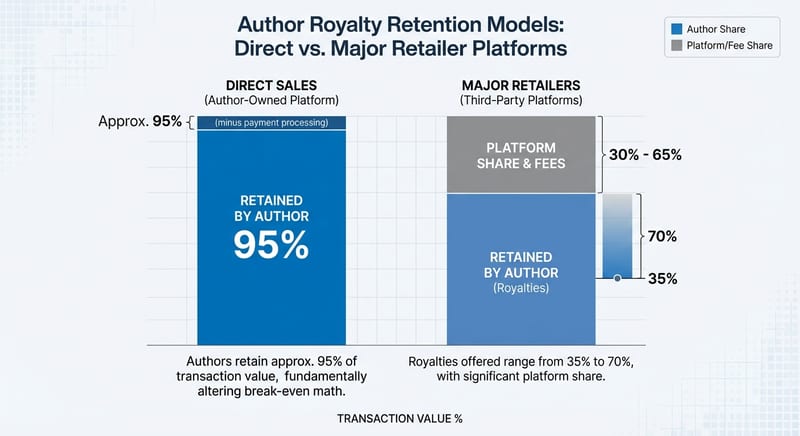
The mathematical implication of the data above is profound. If you retain $9.50 on a $10 book instead of $7.00, your allowable Cost Per Acquisition (CPA) increases significantly. This 'margin advantage' allows direct-selling authors to outbid competitors on ad platforms, effectively buying market share that retailer-dependent authors cannot afford.
Nuance: The Merchant of Record
However, 'going direct' introduces technical complexity that most authors underestimate. You are no longer just a writer; you are a Global Tax Compliance Officer. Selling a digital file to a reader in the EU triggers VAT obligations that are non-negotiable. This is the 'Direct Sales Trap.'
To mitigate this, the 2026 stack relies on 'Merchant of Record' (MoR) solutions like Lemon Squeezy or specialized Shopify plugins. These intermediaries technically 'buy' the book from you and 'resell' it to the customer, handling the remittance of global sales taxes. It costs an extra 1-3%, but it insures the author against international tax fraud liability.
- Shopify: Best for high-volume authors with merchandise and physical books.
- Payhip/WooCommerce: Lower barrier to entry for digital-only sellers.
- Kickstarter: The 'Launch Event' engine used to fund print runs before they enter the ecosystem.
Agentic Commerce: Optimizing for the Non-Human Reader
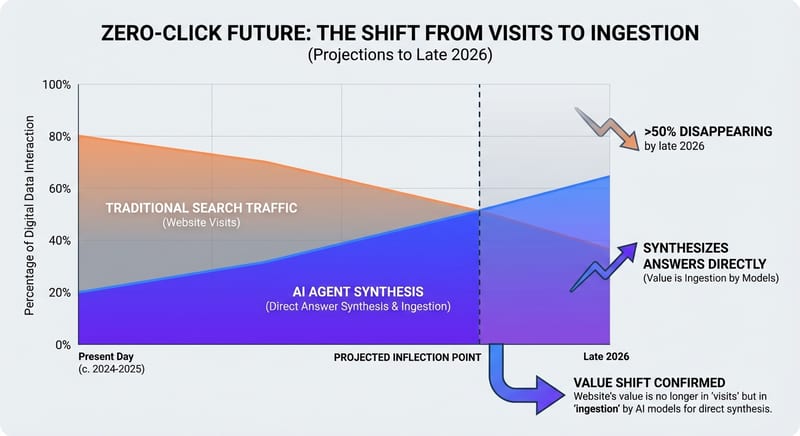
We are witnessing the death of SEO (Search Engine Optimization) and the birth of AIO (Artificial Intelligence Optimization). As Paul Bell notes, the future belongs to 'Agentic AI'—autonomous bots that query the web on behalf of a user. In 2026, a reader doesn't search Google for 'best sci-fi books'; they ask their personal LLM to 'buy me a book that feels like Dune but shorter.'
This shift is catastrophic for authors relying on traditional keywords. AI agents do not look for 'keywords'; they look for 'contextual relevance' and 'semantic authority.' If your book's metadata is not structured in a way that an LLM can easily ingest and verify, you are invisible to the highest-intent buyers in the market.
Nuance: Structured Data for LLMs
The technical response to Agentic Commerce is the implementation of Schema.org markup on author websites. You must explicitly tell the AI what your content is. It is no longer enough to have a 'Book Page'; that page must contain JSON-LD code that identifies the 'Product,' 'Author,' 'Genre,' and 'ISBN' in a machine-readable format.
Furthermore, the 'blurb' must evolve. Marketing copy designed to tease a human with mystery often confuses an AI. Authors now need two versions of their description: the 'Hook' for the human on the landing page, and the 'Synopsis' for the AI in the metadata, which explicitly details themes, tropes, and plot points.
"AI agents will autonomously query websites to synthesize information. Publishers must structure their content to be 'license-ready' for these LLMs to maintain relevance. - Paul Bell, Demand Gen Report"
The Post-Social Pivot: Deep Trust Networks
The 'Gold Rush' of social media organic reach is officially over. As platforms like TikTok and Instagram become saturated with AI-generated sludge, engagement rates for human creators have plummeted. Authors like Claire Taylor are leading the exodus, abandoning the algorithmic hamster wheel in favor of 'Deep Trust' networks.
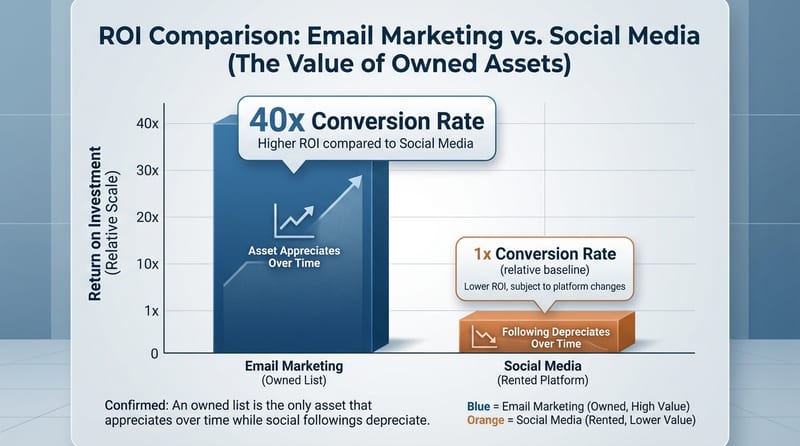
The 2026 strategy is 'Post-Social.' It recognizes that while social media may still offer top-of-funnel awareness, it is functionally useless for conversion and retention. The energy previously spent on daily Reels is now reallocated to high-fidelity channels: email newsletters, private Discord communities, and in-person networking. The goal is no longer 'virality'; it is 'loyalty.'
Nuance: The '1,000 True Fans' Revival
With the fragmentation of mass culture, the '1,000 True Fans' theory has moved from a nice idea to the *only* viable business model for mid-list authors. You cannot compete with AI on volume. You can only compete on humanity. This means cultivating a smaller audience that is willing to pay a premium for connection.
This pivots the business model towards high-ticket offers. Instead of trying to sell 10,000 copies of a $2.99 ebook, the Post-Social author sells special editions, workshops, or annual subscriptions to 1,000 people. The economics of the 'superfan' effectively subsidize the free content given to the casual reader.
- Newsletter Serialization: Delivering the book chapter-by-chapter via email to maintain open rates.
- Private Communities: Moving discussion from public Facebook Groups to private Discords to escape ad targeting.
- Direct Mail: The return of physical postcards and catalogs to cut through digital noise.
The Audio-First Ecosystem
As outlined in 2026 predictions, audio is no longer a subsidiary right; it is often the primary format. The dominance of audiobooks has forced a bifurcation in the market: 'Commodity Audio' (AI-narrated) and 'Luxury Audio' (Human-narrated). Authors must decide which lane they are in.
For backlist titles or rapid-release series, AI narration allows for simultaneous audio/ebook launches at a fraction of the cost. However, for flagship titles, the 'Human Performance' is the marketing hook. The narrator's name on the cover is a trust signal that justifies a higher price point.
"We are seeing the testing of in-app promo videos within audio platforms. The listening experience is becoming the discovery experience. - Writer's Ink Podcast"