The Anti-Slop Protocol: Why Radical Craft is the Only Marketing Strategy Left in 2026

In an era of AI-generated 'slop,' traditional marketing funnels are failing. We explore why 'Voice' is the new SEO and how physical artifacts defeat digital noi
The 'Slop' Crisis and the Visibility Collapse
The fundamental premise of book marketing has shifted from 'discovery' to 'verification.' As industry analysts like Nathan Bransford note, 2025 was the tipping point where AI-generated content—colloquially termed 'slop'—flooded retailer algorithms. This saturation has broken the traditional discoverability engines. Amazon's recommendation algorithms, once the author's best friend, now struggle to differentiate between a human masterpiece and a synthetic hallucination.
For the serious author, this means that volume is no longer a viable strategy. The 'rapid release' model (publishing a book every month) is now viewed with suspicion by readers, who equate speed with automation. Marketing in 2026 requires a pivot toward 'Slow Publishing'—emphasizing the labor, the quirkiness, and the imperfections that prove a human was at the helm.
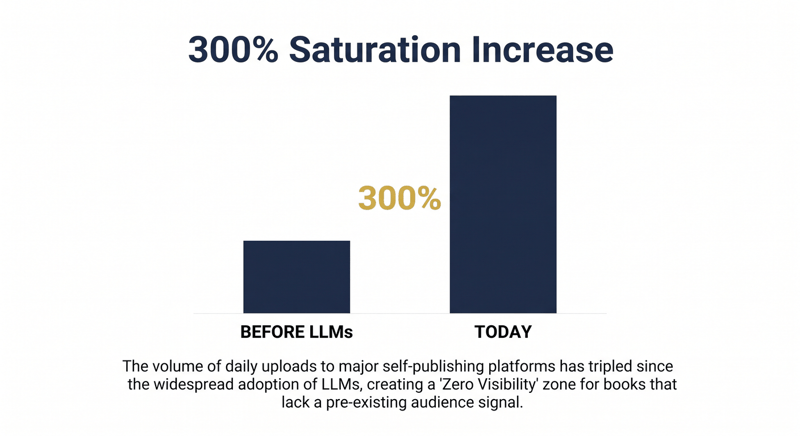
This statistic, extrapolated from the exponential rise in ISBN registrations and digital uploads, illustrates the futility of competing on quantity. If you attempt to out-publish a bot, you will lose. The only winning move is to compete on a vector that AI cannot access: high-context, idiosyncratic creativity.
Nuance: The 'Quirky' Differentiator
The definition of 'marketable' has inverted. Previously, authors were advised to 'write to market'—to smooth off the edges and fit neatly into a trope. Today, Anti-Slop strategy demands the opposite. It is the weird, the specific, and the jagged edges of a story that signal humanity.
AI models are designed to predict the most likely next word, essentially converging on the average. Therefore, marketing copy and book content that feels 'average' is assumed to be AI. Authors must lean into niche obsessions and stylistic risks that an algorithm would statistically prune.
Prose Rhythm as a Marketing Asset
Marketing is usually discussed in terms of ads and emails, but in 2026, the product *is* the marketing. With the rise of 'Look Inside' features and audio samples, the prose rhythm has become a primary conversion tool. The Narrative Craft emphasizes that voice and style are no longer just artistic choices; they are commercial necessities.
Readers are developing a 'Turing Test' intuition for fiction. Flat, functional prose signals 'content,' while rhythmic, voice-driven prose signals 'art.' A marketing campaign that drives traffic to a book with flat prose will result in high bounce rates and wasted ad spend. The efficiency of your marketing funnel is directly correlated to the distinctiveness of your voice.
"Story trumps structure. A compelling voice can carry a wandering plot, but a perfect structure cannot save a robotic voice. - Jerry Jenkins, Industry Veteran"
This insight from Jerry Jenkins is critical. Many authors obsess over plot beats (which AI can generate easily) while neglecting the sentence-level craft (which AI struggles to imbue with subtext). Investing in craft is not distinct from investing in marketing; it is the foundation of customer retention.
Nuance: Ferocious Self-Editing
The bridge between a rough draft and a marketable product is the edit. Jenkins advises becoming a 'ferocious self-editor.' In a market where AI can churn out clean but soulless drafts, the human author's ability to cut, condense, and sharpen is the value add.
Marketing copy should highlight this labor. Use 'Behind the Scenes' content to show the messy revision process. Paradoxically, showing the struggle of writing sells more books than showing the ease of it, because the struggle validates the human origin of the work.
The Physicality Counter-Trend
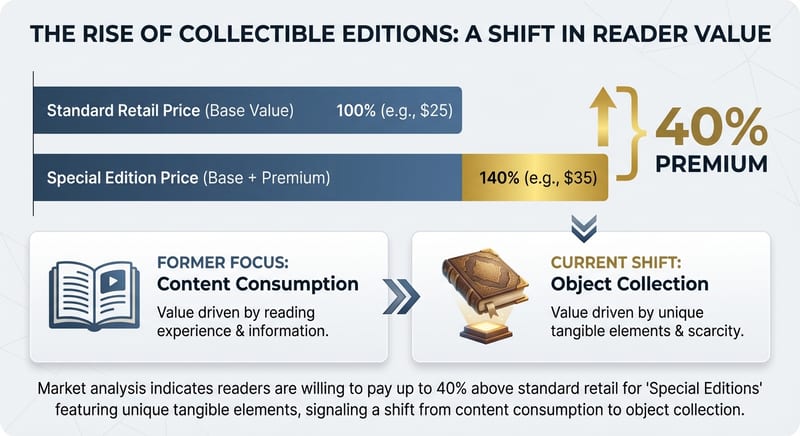
As digital content becomes infinite and essentially free, physical scarcity becomes the premium asset class. We are witnessing a flight to quality in print. Readers who are happy to consume 'slop' on a screen for free are increasingly willing to pay premium prices for 'shelf-worthy' artifacts. This is the Anti-Slop physical pivot.
Marketing strategies must shift from 'buy my ebook' to 'collect my edition.' This involves investing in high-end production values—sprayed edges, foil stamps, ribbon markers—that an AI cannot download. The physical book becomes a totem of resistance against the digital deluge.
Nuance: The Supply Chain of Art
This strategy requires authors to become supply chain managers. It is no longer enough to upload a PDF to KDP. You must source printers, manage fulfillment, and handle quality control. This friction is a feature, not a bug. It creates a moat around your business that low-effort AI prompters cannot cross.
The marketing narrative then becomes about the process of creation. Videos detailing the choice of paper stock or the smell of the ink engage the senses in a way that a screenshot of an ebook never can.
Mentorship and the Return to Basics
A surprising trend in the 2026 market is the collapse of mid-list competency. As noted by KrisWrites, many 'advanced' writers have strong voices but lack foundational skills like setting the scene or grounding the reader. This is a side effect of learning to write in the age of digital skimming.
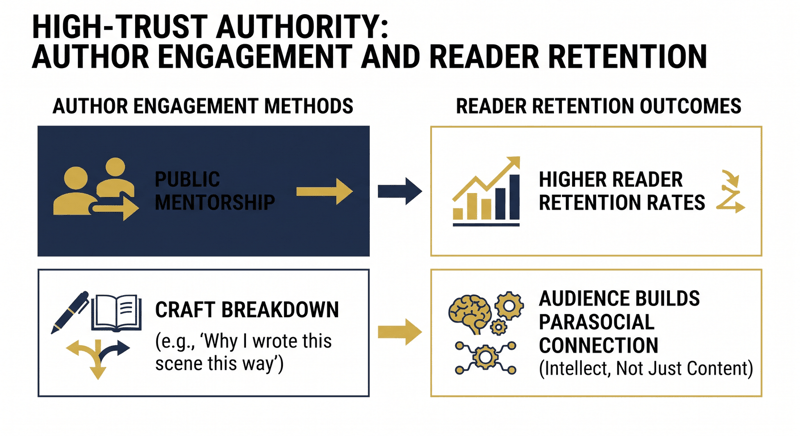
Marketing yourself as a 'craftsman' requires you to actually be one. The 'fake it till you make it' era is over because the AI can fake it better than you. Readers are gravitating toward authors who can demonstrate deep technical mastery. This has led to a boom in author-led education and mentorship as a primary marketing channel. Teaching the craft establishes authority that sells the fiction.
Nuance: The Setting as Character
One specific area of craft that serves as a marketing hook is 'Setting.' In a digital void, readers crave grounding. Kristine Kathryn Rusch points out that advanced writers often forget to 'ground' the reader. Marketing materials that emphasize the immersive world-building—maps, lore, atmospheric descriptions—tap into this desire for place.
Atmosphere is difficult to summarize in a blurb but easy to convey in visual marketing. Use your setting's unique aesthetic to drive your Instagram and TikTok strategy. If your book feels like a place the reader can visit, they will buy the ticket.
The Theological Defense of Creativity
Finally, we must address the philosophical core of the 2026 market. As Steve Laube reflects, there is a growing sentiment that human creativity reflects a divine or at least uniquely biological spark—the 'Image of God' vs the 'Image of Man.' While this may seem abstract, it is a powerful marketing narrative.
Positioning your work as a 'Human endeavor'—emphasizing the blank page, the struggle, and the lack of algorithmic assistance—is a selling point. There is a market segment that actively boycotts AI-assisted creative work. Your 'Human Made' badge is not just a moral stance; it is a competitive advantage in a sea of synthetic noise.