The Algorithmic Author: Data-Driven Book Marketing Strategies for 2026

Stop guessing. This white paper analyzes the ROI of paid ads, AI workflows, and 'promo stacking' using 2026 data. Learn how to transition from organic hope to a
Paid Acquisition: The Engine of Discoverability
For years, authors were told that a 'good book sells itself.' Data from 2026 refutes this entirely. A good book is merely a retention mechanism; it does not solve the problem of acquisition. According to the Manuscript Report's 2026 Guide to Ads, the primary differentiator between hobbyists and career authors is the willingness to pay for traffic. The organic reach of platforms like Facebook and Amazon has been throttled to near-zero to force ad spend.
This shift requires authors to view advertising not as a 'loss' but as a 'Cost of Goods Sold' (COGS). Just as a coffee shop pays for beans, an author must pay for eyeballs. The most successful authors have ceased treating marketing as a slot machine and now treat it as a vending machine: put $1 in, get $1.50 out. This predictability is the foundation of a scalable career.
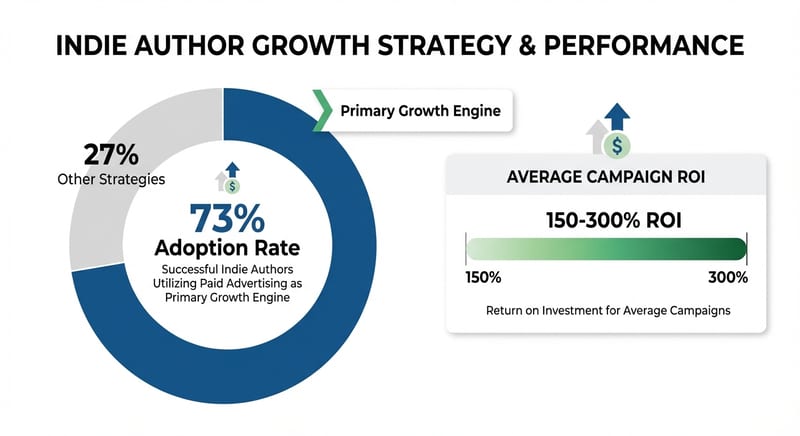
The statistic above is critical because it normalizes the expense. If you are relying solely on word-of-mouth, you are competing with only 27% of the market's capacity. However, throwing money at Amazon Ads without a strategy is burning cash. The data shows that high ROI is reserved for those who master targeting and bid optimization, specifically shifting from 'Auto' targeting to specific 'Product' targeting (placing your book directly on a competitor's page).
Nuance: The 90-Day Learning Phase
The most common failure mode in paid acquisition is premature cancellation. Case studies reveal that profitability rarely occurs in week one. The algorithms governing Amazon and Meta ads require a 'Learning Phase'—typically 60 to 90 days—to identify the correct audience profile for your specific book.
During this period, the Author-CEO must have the stomach to run at a break-even or slight loss. This is data acquisition time. You are buying information about which keywords convert and which covers click. As highlighted in the case study of debut thriller author Sarah Mitchell, enduring a 6-month learning curve resulted in a stabilized 290% ROI, transforming her career.
- Amazon Ads: High intent, lower volume. Best for bottom-of-funnel sales.
- Facebook/Instagram Ads: Lower intent, infinite scale. Best for building a newsletter list.
- TikTok Ads: Volatile but viral. Best for 'trope-based' visual marketing.
"A 60-90 day 'learning phase' is a necessity before profitability. You are not losing money; you are buying data. - Manuscript Report Strategy Guide"
Platform Specialization: Depth Over Breadth
The 'be everywhere' strategy is a recipe for burnout. In 2026, the algorithm rewards depth. Kindlepreneur’s analysis of social media emphasizes that top-tier authors like Neil Gaiman or Colleen Hoover dominate *one* platform rather than diluting their efforts across five. The choice of platform dictates the content strategy: text-heavy for X (Twitter), aesthetic-heavy for Instagram, and personality-heavy for TikTok.
For example, 'BookTok' has evolved from a dance app to a backlist resurrection machine. Authors like Alex Aster have utilized TikTok not just to sell new books, but to make 5-year-old titles viral again. This requires a specific content cadence—often 3-5 videos a day—that is impossible to maintain if you are also trying to be a YouTuber and a LinkedIn influencer simultaneously.
Nuance: Aesthetic vs. Authentic
A critical distinction in 2026 marketing is the 'Vibe Split.' Platforms like Instagram reward the 'Aesthetic'—polished flat-lays of books, coffee cups, and idealized writing setups. This appeals to the 'Upmarket' and 'Literary' demographic, as seen with authors like Coco Mellors.
Conversely, TikTok rewards the 'Authentic'—the unwashed hair, the crying over a plot hole, the raw emotional reaction. Reedsy’s social media breakdown notes that trying to be 'polished' on TikTok often results in lower engagement. You must choose your platform based on your personality type, not just demographics. If you cannot be raw, stay off TikTok. If you cannot be polished, avoid Instagram.
- Instagram: 25-34 age group. Focus on 'The Writing Life' aesthetics. High conversion for literary fiction.
- TikTok: 18-24 age group. Focus on emotional hooks and specific tropes. dominant for Fantasy and Romance.
- Facebook: 45+ age group. Focus on community groups. Essential for Mystery/Thriller.
Efficiency Scale: The AI Marketing Workflow
Marketing is a volume game. You need more emails, more ad copy, and more social posts than a single human can reasonably produce while also writing books. The Manuscript Report AI Guide details how authors are using Large Language Models (LLMs) not to write their books, but to run their marketing departments. This is the difference between an artisan and a business.
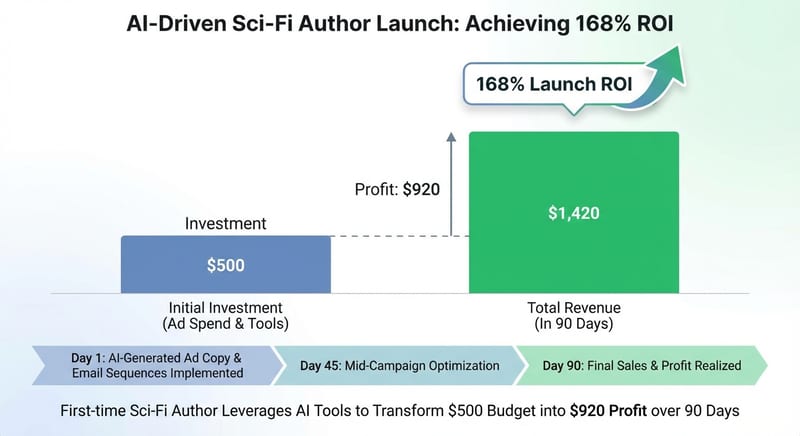
The case study referenced above highlights a crucial efficiency. The author didn't have a better book; they had a faster workflow. By using AI to test 50 variations of ad headlines in the time it takes a human to write five, they found the winning hook weeks faster than the competition. This 'Iterative Velocity' is the primary advantage of AI in marketing.
Nuance: The Human Edit
The danger of AI marketing is 'The Beige Wash'—content that sounds competent but boring. The winning protocol is 'AI-Drafted, Human-Polished.' Authors like Ross & Deborah used AI to reduce copywriting time from 20 hours to minutes, but they spent those saved minutes injecting their unique voice into the final output.
AI is a force multiplier, not a replacement. It can generate the structure of a newsletter or the variations of a tweet, but it cannot replicate the specific inside jokes or emotional vulnerability that bonds a reader to an author. Use AI for structure; use humanity for connection.
The Promo Stack: Hierarchy of Sites
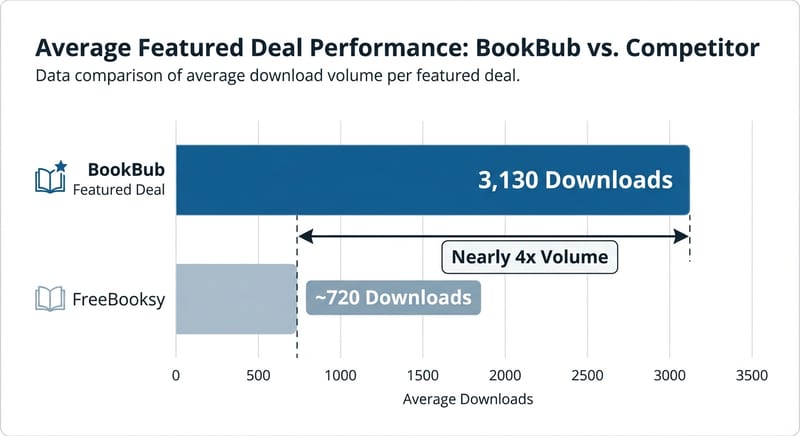
When launching a book or reviving a backlist title, 'Promo Stacking' is the standard methodology. This involves lining up paid placements on newsletter services to fire on consecutive days. However, not all sites are created equal. Indies Today’s 2026 data provides a ruthless ranking of these services based on actual download numbers.
The goal of a promo stack is not just sales; it is 'Rank Stickiness.' A single spike in sales will drop off quickly. By scheduling a smaller promo (like Book Barbarian) on Monday, a medium one (like FreeBooksy) on Tuesday, and the giant (BookBub) on Wednesday, you convince the Amazon algorithm that your book has sustained momentum. This triggers Amazon's own internal marketing emails.
Nuance: The BookBub Moat
Despite the rise of competitors, one titan remains unassailable. The data from 2025/2026 case studies shows a massive disparity between the market leader and the rest of the pack. Securing a 'Featured Deal' here is difficult, often requiring multiple submissions, but it remains the single most effective lever in publishing.
Conclusion: The Integrated Strategy
The successful author of 2026 is a hybrid operator. They respect the 'Deep Work' of writing but execute the 'Deep Analytics' of marketing. By combining the predictability of paid ads, the efficiency of AI workflows, and the viral potential of platform specialization, you build a moat around your career. Marketing is no longer an activity you do 'when you have time.' It is the infrastructure that allows you to write the next book.