The Sovereign Author: Navigating Agentic Commerce and Direct Sales in 2026

A definitive white paper on the shift from retailer dependency to direct sales ecosystems, agentic commerce, and the high-ticket 'True Fan' economy of 2026.
The Imperative of Financial Sovereignty
For over a decade, the "Indie" revolution was defined by access to distribution. Authors celebrated the ability to upload a PDF to a retailer and reach a global audience. However, as we settle into 2026, access is no longer the bottleneck; attention and data ownership are. Relying exclusively on third-party retailers (Amazon, Apple, Kobo) effectively creates a tenant-landlord relationship where the author owns the IP but rents the customer relationship.
The shift toward direct sales is not merely a margin play, though the economics are undeniable. It is a defensive maneuver against platform volatility. When an author utilizes platforms like Shopify or WooCommerce, they secure the customer's email address and purchase history, assets that are contractually walled off by major retailers. This data allows for the calculation of Lifetime Value (LTV) and the creation of high-ticket offers that algorithms suppress.
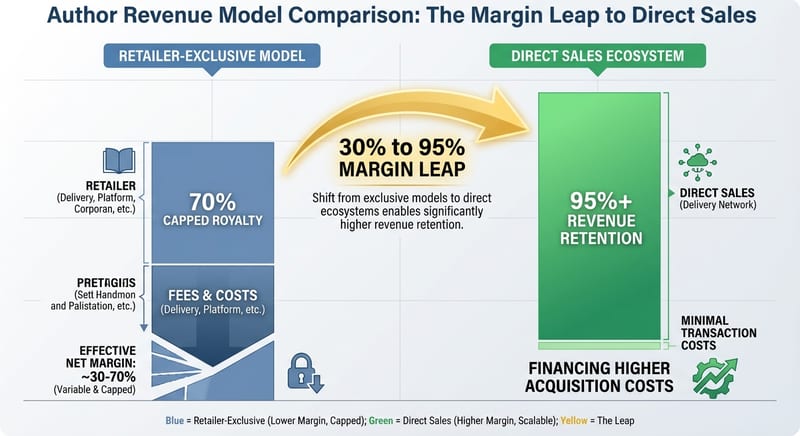
According to Reedsy’s 2026 guide to self-publishing, the disparity in royalty potential is the primary driver for this migration. While retailers cap royalties at 70% (and often push them lower via delivery fees and advertising costs), direct sales channels open the door to near-total revenue retention.
Nuance: The Inventory Threshold
However, the "Direct Sales" panacea comes with a caveat: it requires a backlist. Driving cold traffic to a standalone website for a $4.99 ebook is economically illiterate; the Customer Acquisition Cost (CAC) will almost certainly exceed the product price. The model only functions when the Average Order Value (AOV) can be inflated through bundles, merchandise, or special editions.
This necessitates a change in production strategy. Authors must stop thinking in terms of single units and start thinking in terms of "ecosystem entry points." A direct sale is not the end of a transaction; it is the beginning of a high-LTV relationship managed through email automation, not algorithm serendipity.
Agentic Commerce: The End of 'Browsing'
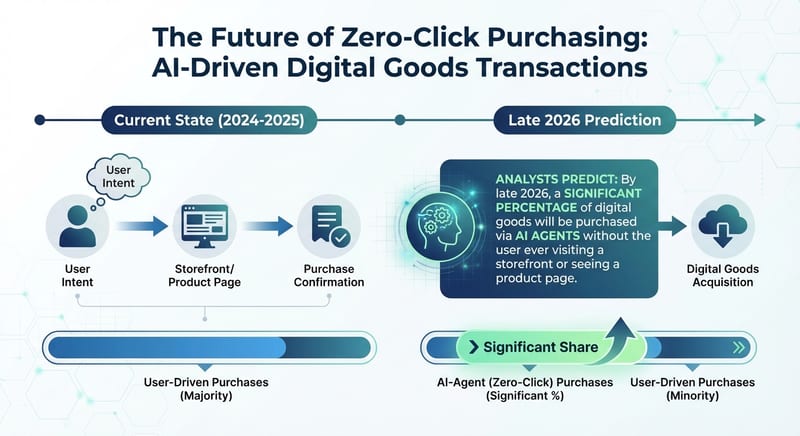
Perhaps the most disruptive trend identified by industry futurists is the rise of "Agentic Commerce." As noted in Joanna Penn’s 2026 predictions, we are moving away from human-driven search—typing keywords into a box and scrolling through results—toward AI-driven procurement.
In this near-future state, a reader might say to their personal AI, "Buy me that new sci-fi thriller everyone is talking about, but only if it's available in audiobook format." The AI then executes the search, comparison, and transaction autonomously. The "browser"—the human looking at book covers—is removed from the loop.
This fundamentally changes the nature of book marketing. Visual optimize (covers) remains important for the final consumption experience, but metadata optimization becomes the primary sales driver. If your book’s metadata does not explicitly communicate genre, format, and availability in a machine-readable syntax, the AI agent cannot "see" it to buy it.
Nuance: Generative Engine Optimization (GEO)
This shift births a new discipline: Generative Engine Optimization (GEO). Unlike SEO, which focuses on ranking a link on a page, GEO focuses on ensuring your content is ingested and prioritized by the Large Language Models (LLMs) powering these agents. This means authors must ensure their names and titles are cited in authoritative, high-traffic domains that are frequently scraped by AI training bots.
The goal is to become part of the AI's "knowledge graph." When an AI is asked for recommendations, it doesn't query Amazon; it queries its own training data. If you aren't in the training data, you don't exist.
- Structured Data: Your website must use Schema.org markup to clearly define Book, Author, and Offer objects.
- Authority Backlinks: Mentions in Wikipedia, major news outlets, and reputable databases are weighted heavily by LLMs.
- Clear Context: Ambiguous book titles or genre-blending descriptions may confuse AI categorization, leading to exclusion from purchase queries.
The Book Proposal as Business Logic
For those pursuing traditional publishing—or even serious self-publishing—the definition of "quality" has shifted. It is no longer enough to write a good book. As Jane Friedman points out, the book proposal is essentially a business plan. For nonfiction especially, the marketability of the concept and the author's existing platform often outweigh the prose itself.
This reality check is crucial in 2026. The market is saturated with AI-generated content that mimics "good enough" writing. To stand out, a project must have a pre-validated audience or a hook so sharp it cuts through the noise. The proposal process forces an author to answer the question: "Who is actually going to buy this?" before a single word of the manuscript is finalized.
"If you want to get a traditional book deal, you need to prove you have a market. The writing is secondary to the business case. - Jane Friedman"
Nuance: Platform vs. Viral Moments
A common misconception is that a "platform" equals a viral TikTok video. Publishers in 2026 are wary of flash-in-the-pan virality. They are looking for *sustained* engagement—an email list, a podcast with consistent downloads, or a professional reputation that guarantees B2B bulk sales. A viral video sells books for a week; a platform sells books for a career.
This distinction is vital for authors deciding between traditional and self-publishing. If you lack the platform to impress a publisher, self-publishing is the logical route—but only if you are willing to build that platform from the ground up while managing the production quality yourself.
The Quality Control Crisis
The democratization of publishing has a dark side: the complete erosion of quality control barriers. A candid assessment from Psychology Today highlights that while self-publishing has grown, the vast majority of these titles fail commercially because they lack professional editing, design, and vetting.
In 2026, the signal-to-noise ratio is worse than ever. Readers have been burned by AI-generated hallucinations and poorly edited indie drafts. As a result, "signaling" becomes a key marketing asset. A book that looks, feels, and reads like a traditionally published artifact—or better—commands a premium. Anything less is dismissed as digital clutter.
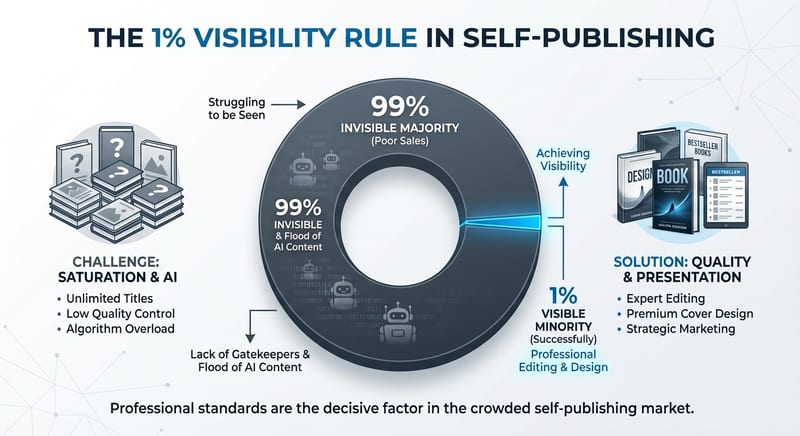
This data point is not meant to discourage, but to clarify the investment required. The "Gold Rush" era of throwing a draft on KDP and making money is over. Success in the 2026 landscape requires treating the book as a startup product, with commensurate investment in QA (editing) and UX (cover design/formatting).
The 1,000 True Fans Model
Finally, the antidote to algorithm dependency and agentic abstraction is humanity. The "1,000 True Fans" model has evolved into a survival strategy. If you cannot compete on volume with AI, you must compete on connection. This means crowdfunding campaigns (Kickstarter/BackerKit) that offer deluxe, physical artifacts that digital agents cannot replicate.
Readers are willing to pay significant premiums—$50, $100, or more—for special editions, signed copies, and direct access to the author. This moves the author out of the commodity business (selling $10 paperbacks) and into the luxury goods business, where margins are healthy and the customer relationship is direct and enduring.