The Sovereign Strategy: 2026 Book Marketing in the Age of AI & Audio

2026 marks the end of retailer dependence. This white paper explores the rise of direct audio sales, copyright sovereignty, and the defense against AI content f
The Direct Audio Revolution
For the past decade, Amazon's ACX held a virtual monopoly on audiobook distribution, locking authors into exclusive contracts with stagnating royalty rates. 2026 has broken this stranglehold. The emergence of platforms like ElevenReader represents a seismic shift in the economic architecture of publishing. Authors can now sell AI-narrated and human-narrated audiobooks directly to consumers, bypassing the "retailer tax."
This is not just a platform change; it is a margin revolution. In the traditional model, an author might see 25% to 40% of the sale price. The new direct-sales standard pushes the majority of the revenue back to the creator, allowing for aggressive reinvestment in customer acquisition. If you are not building a direct audio pipeline in 2026, you are voluntarily surrendering profit.
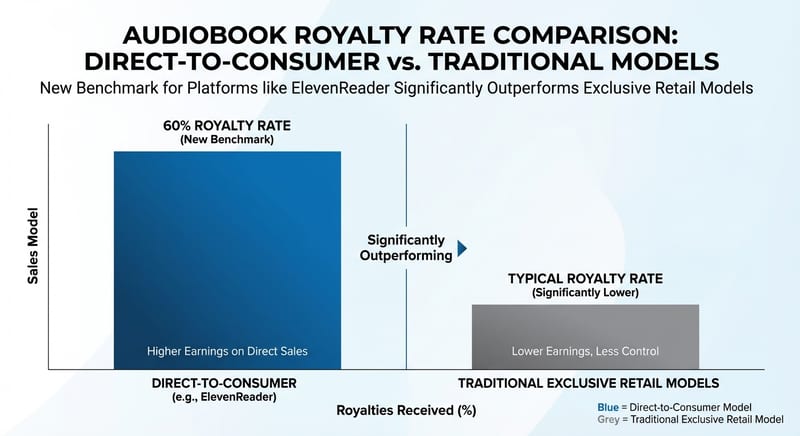
The implication of this data is clear: volume is no longer the sole metric of success. A smaller, dedicated audience purchasing directly generates more free cash flow than a larger audience purchasing through third-party intermediaries. This capital efficiency is the lifeblood of the modern author business.
Nuance: The AI Narration Hybrid
The stigma surrounding AI narration has evaporated under the pressure of market economics. However, the winning strategy is not "all AI." It is a hybrid model. Strategic authors use professional human narration for their flagship "Loss Leader" titles to build brand prestige, while utilizing high-quality AI narration for backlist titles, foreign translations, and lead magnets that would otherwise be unprofitable to produce.
This "Tiered Production" strategy allows an author to have their entire catalog in audio format—a critical requirement as audio consumption surpasses reading for many demographics. The barrier to entry for audio is now zero; the barrier to success is quality control.
- Flagship Titles: Human Narrated (High Investment, Brand Anchor).
- Backlist/Shorts: AI Narrated (Low Cost, High Margin).
- Direct Windowing: Release the direct version 30 days before retail to train audience behavior.
The AI Copyright Defense Strategy
Your book is no longer just a story; it is a data set. Large Language Models (LLMs) are hungry for high-quality, long-form text to improve their reasoning capabilities. This has turned the publishing industry into a battleground over data rights. We are seeing major infrastructure players like Ingram Content Group implementing "Opt-Out" mechanisms, allowing publishers to forbid the sale of their content to AI firms.
This is a critical development. In 2026, "Copyright" encompasses more than plagiarism; it encompasses "Training Rights." Authors must actively manage these rights settings on every platform. Failing to do so grants tacit permission for your unique voice and intellectual property to be assimilated into a model that may one day compete with you.
"If you are not paying for the product, you are the product. In 2026, if you are not protecting your book's data, you are the training set. - Digital Rights Forecast"
Nuance: The "Ask This Book" Dilemma
The threat is also internal. Amazon's introduction of "Ask This Book" features creates a new layer of friction. This AI tool allows readers to query the text of a book to get summaries or specific answers without necessarily reading the content linearly. While pitched as a discovery tool, it fundamentally changes the consumption pattern.
For non-fiction authors, this is perilous. If a reader can extract the "How-To" value via an AI query without reading the surrounding context or emotional journey, the perceived value of the book drops. Authors must monitor these features and, where possible, restrict granular AI indexing of their work to preserve the integrity of the narrative arc.
The Decline of Social & The Rise of Trust
The "Influencer Author" model is collapsing. Organic reach on social platforms is effectively zero, and paid reach is prohibitively expensive. Thomas Umstattd Jr. correctly predicts that 2026 will see the decline of social media as a primary sales driver. The vacuum is being filled by "Trust Marketing."
As the market is flooded with "AI Junk Books"—low-quality, generated content produced at scale—readers are retreating to safe harbors. They are ignoring algorithmic recommendations in favor of human curation: email newsletters, podcasts, and direct author communities. The most valuable asset in 2026 is not a viral video; it is a clean, responsive email list.
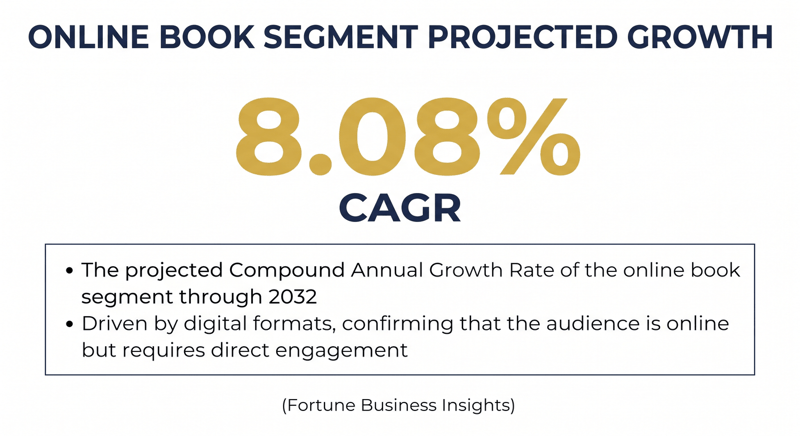
The market itself is growing, but the distribution of that growth is uneven. It favors those who have established digital sovereignty over those relying on platform discovery.
Nuance: Verification as a USP
In a sea of synthetic content, "Human Verification" becomes a Unique Selling Proposition (USP). Authors should explicitly market their work as "Human Created" or "Human Edited." This label serves as a proxy for quality. We are approaching a point where "Organic Writing" will command a premium similar to organic food.
Marketing materials should lean into the personal, the messy, and the specific—elements that AI struggles to replicate authentically. The sterile perfection of AI prose is the new "corporate speak"; it repels engagement.
Market Outlook: The $200 Billion Prize
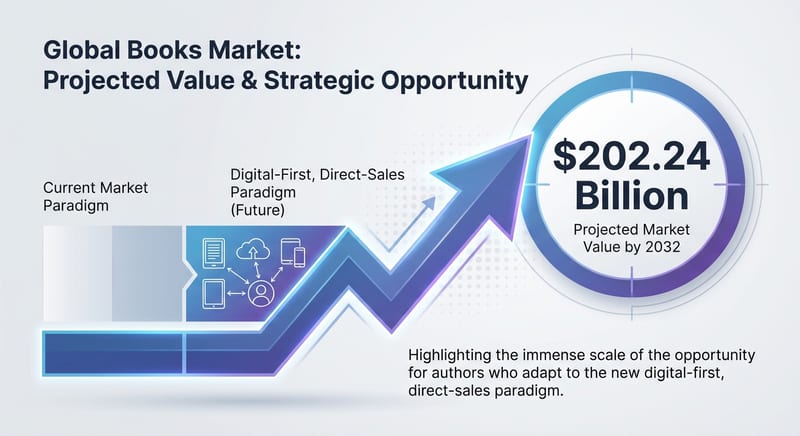
Despite the disruption, the macro outlook for publishing is bullish. The global appetite for stories and information is not shrinking; it is evolving. Market projections indicate substantial growth over the next decade. The authors who will capture this value are those who treat their books as business assets rather than lottery tickets.
This growth is largely driven by fiction and the ease of digital access. However, "access" does not mean "sales" unless the marketing infrastructure is built on direct relationships. The authors scaling to six and seven figures in 2026 are those who have built their own "Media Companies"—combining audio, print, and digital into a cohesive, sovereign brand.
The path forward is clear: Build the direct pipe. Protect the data. Verify the humanity. The tools exist; the variable is execution.