The Post-Consolidation Playbook: Book Marketing in the Era of Agentic Discovery

A strategic analysis of the 2026 publishing landscape, focusing on M&A volatility, AI-driven discovery mechanisms, and the imperative of direct-to-consumer infr
The Consolidation Trap: Why Distribution is No Longer a Safety Net
For decades, the value proposition of a traditional publisher was stability and distribution. In 2026, that promise has been eroded by aggressive Mergers and Acquisitions (M&A). The landscape is characterized by high-velocity deals and, equally importantly, failed acquisitions that leave supply chains in limbo. Recent industry reports highlight the chaos, notably the cancellation of the ReaderLink and Baker & Taylor deal, which sent shockwaves through the distribution network.
Simultaneously, we see Macmillan acquiring Sounds True and Penguin Random House absorbing Wonderbly. This is not merely 'business news'; it is a marketing signal. As publishers consolidate, their marketing resources are concentrated on a shrinking number of 'lead titles.' The mid-list author, once the backbone of the industry, is increasingly left to fend for themselves within a behemoth organization that treats books as commodities rather than intellectual property.
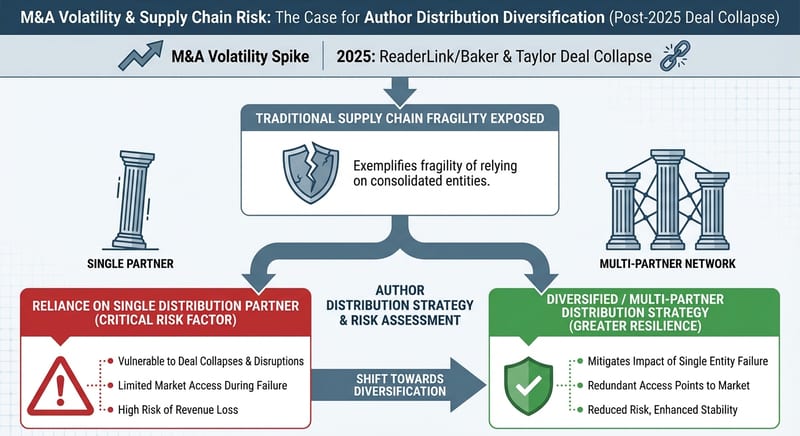
The implication for marketing is clear: you cannot rely on your publisher's infrastructure, because that infrastructure may be sold, merged, or restructured mid-launch. The 'Sovereign Author' treats their publisher as a print-partner, not a business partner, and maintains their own direct-to-consumer channels as a hedge against corporate turbulence.
Nuance: The Hollowing Out of the Mid-Market
The danger is not just in the chaos of the deal, but in the homogenization that follows. When HarperCollins acquires manga operations in Europe, or PRH buys personalized book companies, they optimize for scale. 'Quirky' or niche books that require specialized marketing often fall through the cracks of these merged entities.
Marketing in this environment requires an 'asymmetric' approach. While the conglomerate focuses on mass-market efficiency, the agile author focuses on hyper-niche community building—spaces where the giants are too slow and too broad to compete effectively.
Algorithmic Discovery: Optimizing for the Machine Reader
The most profound shift in 2026 is the move from 'Search' to 'Discovery.' Users are no longer typing keywords into Amazon; they are conversing with AI agents like Google Gemini and ChatGPT. The Silverchair 2026 Tech Trends Report identifies 'Dynamic Discovery' as the new standard. This means your book is not being found by a human browsing a category; it is being surfaced by an AI synthesizing millions of data points.
This demands a complete overhaul of metadata strategy. It is no longer enough to tag a book with 'Mystery.' You must provide the AI with the *context* it needs to recommend your work: emotional arcs, character archetypes, and semantic relationships to other works. The marketing battleground has moved from the bookstore shelf to the vector database.
The Rise of 'Agentic' SEO
Traditional SEO was about ranking for a query. Agentic SEO is about being the answer to a problem. If a reader asks an AI, 'Recommend a book that feels like Succession but set in space,' the AI does not look at sales rank. It looks at the semantic proximity of your book's content to the concepts of 'family dynasty,' 'betrayal,' and 'sci-fi.'
Authors must now create content (blog posts, interviews, detailed synopses) that explicitly connects their work to these deeper themes, effectively 'training' the discovery bots on how to categorize their art.
- Semantic Tagging: Move beyond genre; tag by 'vibe,' emotional payoff, and trope.
- Content Density: Long-form descriptions (>500 words) provide more hooks for AI indexing than short blurbs.
- Review Mining: Use AI to analyze your reviews and identify the keywords *readers* use, then feed those back into your metadata.
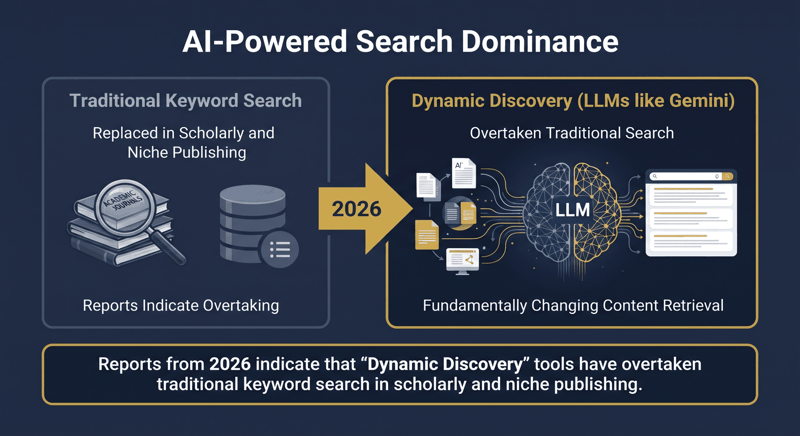
"The integration of AI into workflows is not just about efficiency; it is about discoverability. If the AI cannot 'understand' your content, it cannot recommend it. - Silverchair Tech Trends Report"
The Licensing Frontier: Monetizing the Training Data
A new revenue stream has emerged for the savvy author: licensing data for AI training. Wiley's appointment of a Chief AI Officer signals a massive industry pivot. Publishers are actively negotiating deals to license their backlists to tech companies for model training. While controversial, this is a market reality that cannot be ignored.
For independent authors, this presents a choice: opt-out on principle, or opt-in for profit. The 'marketing' angle here is subtle but powerful. Books that are part of the training data for major LLMs are more likely to be hallucinated (or accurately cited) by those models in the future. Being 'in the brain' of the AI is the ultimate brand awareness play.
Nuance: The Ethics of the Opt-In
The divide between 'Artisan' authors (who reject AI) and 'Tech-Forward' authors (who embrace it) is widening. Your stance on this issue is, itself, a marketing signal to your audience. Transparency is key. Readers in 2026 are savvy; they respect an author who says 'No AI was used in this book,' just as they respect an author who says 'I licensed this data to fund my next novel.'
The mistake is ambiguity. Attempting to hide your AI involvement (or lack thereof) breeds distrust. Define your policy and make it a pillar of your brand identity.
Accessibility as a Market Expander
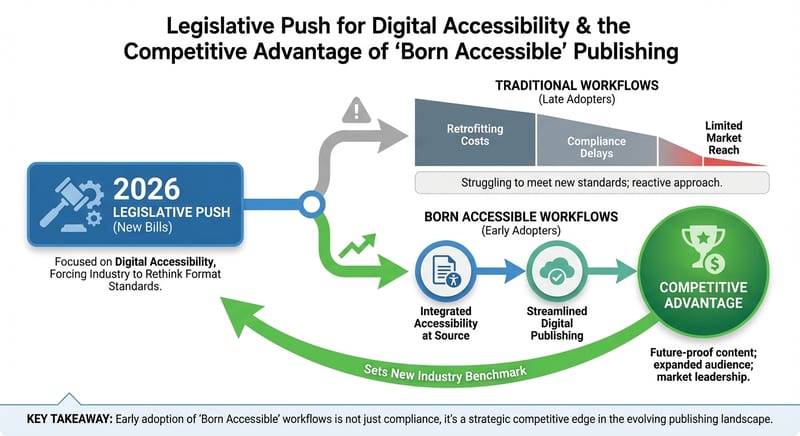
While the industry obsesses over AI, a quiet revolution is happening in accessibility. New legislation in 2026 is mandating stricter digital accessibility standards for content sold to libraries and schools. This is not just a compliance headache; it is a marketing opportunity. The 'print-disabled' market is vast and historically underserved.
Authors who proactively format their ebooks for screen readers, offer high-contrast print options, and ensure their websites are WCAG compliant are tapping into a loyal audience that competitors ignore. In an era of saturation, 'accessibility' is a differentiator. It signals care, professionalism, and inclusivity—values that resonate highly with modern readers.
Leadership Instability and the Portable Team
The executive carousel continues to spin. With leadership shifts at Hachette and Macmillan, authors often find their champions leaving mid-campaign. The marketing strategy for 2026 involves building a 'Portable Team' of freelancers—publicists, editors, and ad managers—who work for the author, not the publisher.
This decentralization ensures continuity. If your editor at Hachette leaves for Scholastic, your independent marketing strategy should not miss a beat. You are the CEO of your book; everyone else is a vendor.