Book Marketing in 2026: Agentic Commerce, GEO, and the End of Search

A definitive guide to the 2026 book marketing landscape. Learn how Agentic Commerce, Generative Engine Optimization (GEO), and hyper-personalization are replaci
The Rise of Agentic Commerce
For the last two decades, book marketing has operated on a simple premise: a human realizes they have a need (entertainment or education), opens a browser, types a query into Google or Amazon, and makes a selection. This linear funnel is collapsing. We are entering the age of Agentic Commerce, where AI agents act as the primary purchaser on behalf of the user. As noted by Joanna Penn, consumers will increasingly delegate the 'shopping' task to personal AIs, asking them to 'buy me the best thriller released this week similar to Blake Crouch.' The AI executes the transaction without the human ever seeing a search results page.
This shift fundamentally breaks the 'cover appeal' dynamic of browsing. If an AI is scraping metadata to make a purchase decision, your book cover's typography matters less than your metadata's semantic clarity. The market is moving from a visual shelf to a data-driven queue. Authors who fail to structure their book data for machine readability will become invisible to the high-intent 'buyers' of 2026—the bots themselves.
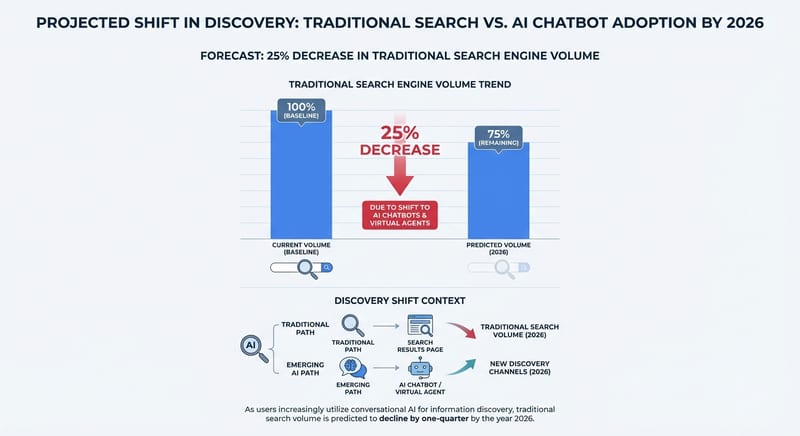
This statistic, highlighted in recent forecasting by Gartner, underscores the urgency. If one in four searches vanishes from Google, the 'long tail' keyword strategy that non-fiction authors rely on becomes obsolete. The battleground is no longer the search engine results page (SERP); it is the Large Language Model (LLM) context window. Your marketing must convince an algorithm, not just a human, that your book is the definitive answer to a prompt.
Nuance: Optimizing for the 'Black Box' Buyer
The technical challenge here is that LLMs do not 'rank' content in the traditional sense; they synthesize it. To be the book that an agent buys, you must achieve 'brand mention dominance' within the training data. This requires a shift from SEO to Brand Authority signals—appearing in high-trust newsletters, podcasts, and white papers that the AI weighs heavily.
It also requires ensuring your book's metadata is accessible via APIs that these agents query. If your book is locked behind a walled garden without clear schema markup, the agent cannot 'see' it to buy it. Universal links and clear, machine-readable descriptions are now technical requirements, not optional administrative tasks.
- Semantic Metadata: Ensure your book descriptions use natural language patterns that match specific user intents, not just keyword stuffing.
- API Availability: List your books on platforms that allow API access for data scraping (e.g., Shopify, direct sites) rather than exclusively on closed ecosystems.
- Review Density: AI agents use review sentiment analysis as a proxy for quality; aggregate ratings matter more than individual review text.
Generative Engine Optimization (GEO)
As SEO fades, Generative Engine Optimization (GEO) takes its place. This is the discipline of optimizing content specifically to appear in AI-generated answers (like ChatGPT or Perplexity summaries). Unlike SEO, which focuses on clicks, GEO focuses on citation and inclusion. The goal is to be cited as the source of truth when a user asks an AI a complex question.
For non-fiction authors, this means your content strategy must pivot. Short, click-bait articles are ignored by LLMs looking for substance. Deep, authoritative content—like this white paper—is prioritized. As Joanna Penn notes, authors need to ensure their personal brand entity is clearly defined in the 'knowledge graph' of major AI models.
This requires a 'defensive' publishing strategy. You must publish enough high-quality, open-web content to train the models on who you are and what you write. If you hide everything behind a paywall, the AI has no data to recommend you. It is a delicate balance between giving away content for training and reserving value for the sale.
Nuance: The Attribution Gap
The dark side of GEO is the lack of direct attribution. A user might get the answer from your book via ChatGPT without ever clicking a link to buy it. This is why GEO must be paired with strong 'brand recall' mechanisms. Your concepts must be named uniquely (e.g., 'The Snowball Effect' vs. 'Compound Interest') so that users are forced to search for your specific terminology.
"In a world of infinite AI content, the only scarcity is authentic human connection. We are seeing a paradox where high-tech discovery fuels high-touch, in-person consumption. - Quad Insights"
By branding your unique methodologies, you inoculate yourself against generic AI summarization. If the AI summarizes your concept but the user wants the 'official' version, they are driven back to your direct sales ecosystem.
Direct Sales & The Margin Renaissance
With Amazon potentially partnering closer with AI giants, the 'middleman tax' is likely to increase. In response, 2026 is the year of Direct Sales Maturity. Authors are moving from 'testing' Shopify to running full-fledged e-commerce operations. This is driven by the collapse of third-party cookies, which makes owning first-party customer data (emails, purchase history) a survival necessity.
Platforms like Improvado highlight the critical nature of first-party data. When you sell direct, you own the customer relationship. You can retarget them without paying Meta or Amazon a premium. Furthermore, the economics of AI-generated products make direct sales vastly more profitable.
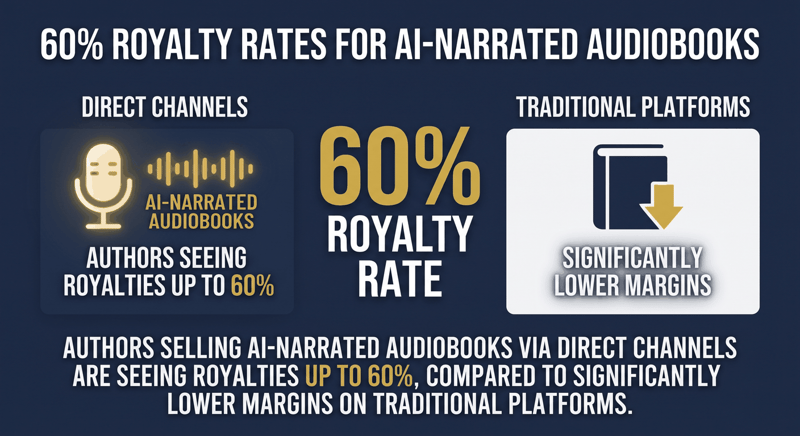
The data above, referenced in discussions on Publishers Weekly regarding AI audio, illustrates the financial incentive. While Amazon squeezes margins to subsidize its AI infrastructure, direct sales channels allow authors to capture the majority of the value created by low-cost AI production tools.
Nuance: The Friction Problem
The historic barrier to direct sales was friction: it was easier to click 'Buy Now' on Amazon. However, digital wallets (Apple Pay, Shop Pay) have largely eliminated this gap. The remaining friction is trust. Readers trust Amazon to deliver; they don't know you. This is where 'Social Proof' and 'Creator Partnerships' become the new infrastructure of trust.
Hyper-Personalization at Scale
The broadcast email blast is dead. 2026 marketing is defined by Hyper-Personalization. Using Autonomous AI Agents, authors can now tailor every touchpoint to the individual reader. An AI agent can analyze a subscriber's past reading behavior and dynamically generate a newsletter intro that references their favorite character from your last book.
This is not science fiction; it is the current capability of tools integrating with CRMs. Improvado predicts that marketing campaigns will increasingly self-optimize, with AI adjusting copy, imagery, and send times in real-time based on individual engagement data. For authors, this means the end of 'launch week' stress and the beginning of 'always-on' automated launches that trigger whenever a new reader enters the ecosystem.
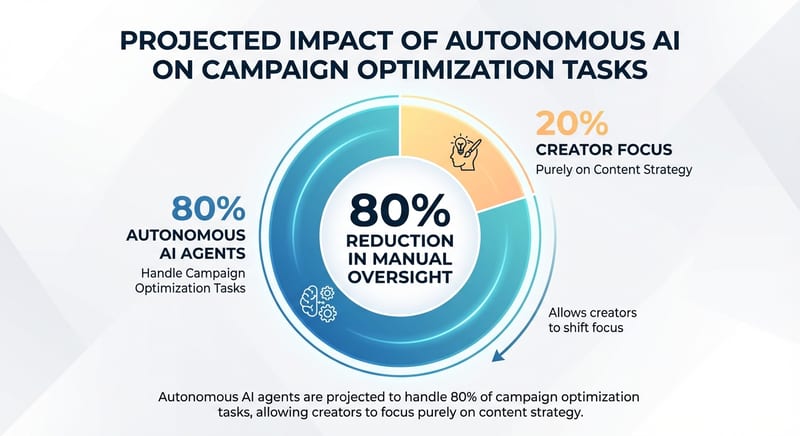
This efficiency dividend is the only way independent authors can compete with major publishers. By automating the 'grunt work' of segmentation and analysis, indie authors can achieve the same level of personalization as a multinational corporation. The key is to trust the data over your intuition.
Social Search & Chaos Culture
Finally, we must address discovery. Younger demographics have abandoned Google for TikTok and Instagram. This is Social Search. But the content that wins here in 2026 is not polished; it is defined by 'Chaos Culture' and 'Nostalgic Remixes,' as identified by Hootsuite. The polished, curated Instagram aesthetic is seen as inauthentic and AI-generated.
To win in Social Search, authors must embrace raw, unvarnished content. 'Micro-dramas'—short, serialized video narratives acting as trailers for books—are exploding. These are not traditional ads; they are entertainment first, utilizing the 'remix' culture to spread virally. If your book marketing looks like marketing, it will fail. It must look like content.