The 2026 Book Marketing Protocol: Agentic Commerce, Direct Ecosystems, and the End of Algorithms

A definitive white paper on the shift from algorithm-chasing to Agentic Commerce. We analyze the unit economics of direct sales and the $5k production floor.
The Unit Economics of Direct Sovereignty
For the last decade, the 'wide vs. exclusive' debate dominated indie publishing. In 2026, that debate is obsolete. The new paradigm is 'rented land vs. owned infrastructure.' Relying solely on third-party retailers (Amazon, Kobo, Apple) subjects authors to volatile changes in royalty structures and delivery fees. The strategic imperative is now the migration to Direct Sales ecosystems using platforms like Shopify or WooCommerce, where the author controls the customer data, the transaction experience, and crucially, the profit margin.
This is not merely a preference for control; it is a mathematical necessity driven by the erosion of organic reach. When you sell direct, you eliminate the 30% to 65% 'gatekeeper tax' levied by retailers. This additional liquidity allows for higher Customer Acquisition Costs (CAC) on paid advertising, making ad campaigns viable that would otherwise be ROI-negative on a retailer platform.
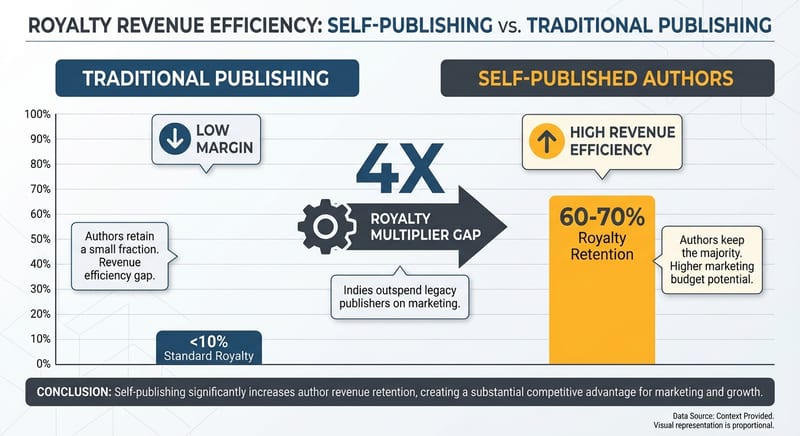
The data above, corroborated by Self-Publishing School, highlights the compounding effect of royalty retention. A traditional author needs to sell four copies to match the net profit of a single direct-sold copy by an indie author. In an environment where attention is the scarcest commodity, this margin efficiency is the defining competitive advantage of the modern author-entrepreneur.
Nuance: The Friction of Fulfillment
However, the shift to direct sales introduces 'merchant friction.' You are no longer just a writer; you are a Chief Logistics Officer. The technical reality of handling VAT (Value Added Tax) compliance, digital file delivery, and customer support for download issues can overwhelm unprepared authors. The ecosystem has responded with 'merchant of record' services, but these come with their own fees that must be factored into the P&L (Profit and Loss) statement.
Furthermore, user behavior in 2026 still favors the path of least resistance. While superfans will navigate a Shopify store, the cold traffic 'impulse buy' still happens largely on integrated retailers. Therefore, the sophisticated strategy is not binary but hybrid: use retailers for discovery (loss leaders) and direct stores for monetization (bundles, special editions, and upsells).
Agentic Commerce: Optimization for the Non-Human Customer
We are witnessing the sunset of traditional SEO (Search Engine Optimization) and the rise of GEO (Generative Engine Optimization). As predicted by industry futurist Joanna Penn, the primary purchaser of content in 2026 is often not a human, but an AI agent acting on a human's behalf. This phenomenon, termed 'Agentic Commerce,' fundamentally alters how books must be marketed.
In this model, a reader asks their personal AI, 'Find me a space opera with political intrigue similar to The Expanse but with a faster pace.' The AI then scans metadata, reviews, and sample text to make a purchase decision. If your book's metadata is optimized for human psychology (clickbait) rather than machine readability (semantic clarity), you effectively do not exist.
Nuance: Semantic Metadata Structuring
To survive Agentic Commerce, authors must adopt 'conversational metadata.' This involves structuring book descriptions and website schemas to answer specific questions an LLM (Large Language Model) might generate. It requires a move away from vague, mysterious blurbs toward detailed, trope-heavy synopses that clearly delineate the book's content, tone, and comparable titles.
Additionally, the rise of AI-assisted translation and audiobook narration means your IP (Intellectual Property) must be ready for rapid format proliferation. The market is stratifying: premium human-narrated audio for high-ticket sales, and AI-narrated audio for mass-market accessibility. Ignoring the AI audio sector leaves money on the table in emerging markets where price sensitivity is high.
"We are moving to a world where AI bots purchase on behalf of users. Optimization is no longer just about keywords; it's about being the most 'understandable' answer to an agent's query. - Joanna Penn, The Creative Penn"
The Financial Barrier: The $5,000 Quality Floor
The 'Gold Rush' era of zero-cost publishing is over. While it remains technically free to upload a file to KDP, the market has matured to a point where amateur production values are instantly rejected by readers. The cover art, typography, and editing standards of self-published works must now equal or exceed those of the 'Big Five' traditional publishers to be competitive.
This professionalization has created a distinct financial barrier to entry. Successful authors operate like small media production houses, allocating significant capital to pre-production before a single word is read. The notion of 'bootstrapping' with zero budget is increasingly a survivor bias myth rather than a replicable strategy.
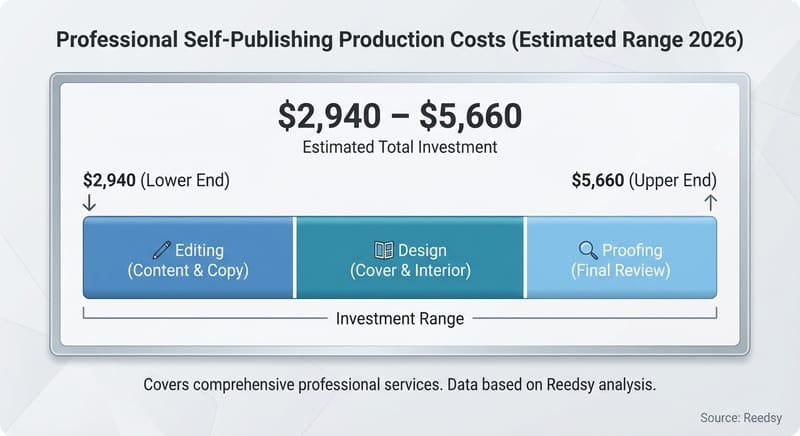
- Developmental Editing: The most expensive but critical phase, ensuring narrative structure holds up ($0.03/word).
- Cover Design: The primary click-driver; custom illustration is now standard for fantasy/sci-fi ($700+).
- Formatting: specialized Vellum or InDesign work to ensure cross-device compatibility.
As detailed in recent cost analyses, the investment required to launch a book that has a legitimate chance of marketplace traction has standardized around a specific range. This capital requirement filters out hobbyists, leaving the field open for serious author-entrepreneurs.
Nuance: AI as a Cost-Deflationary Tool
While the headline costs are high, savvy authors are utilizing AI to deflate specific line items. AI tools for proofreading (not developmental editing) and initial market research can reduce hours billed by freelancers. However, relying on AI for creative execution—specifically cover art—remains a high-risk strategy due to copyright ambiguity and reader backlash in certain communities.
The smart capital allocation in 2026 involves spending heavily on human-centric elements (voice, unique art style) while automating the administrative and structural checks. This hybrid production pipeline maximizes quality while controlling the burn rate.
The Hybrid Acquisition: Traditional Publishing as VC
The relationship between indie and traditional publishing has inverted. Traditional publishers are no longer the gatekeepers of validation; they are venture capitalists seeking de-risked assets. We are seeing a surge in 'acquisitions' where major houses bid on self-published titles that have already proven their market fit via TikTok or Kindle Unlimited.
Kelly Beck's 2026 predictions highlight how imprints like Simon & Schuster's 'Scarlett Press' are specifically designed to capture this market, particularly in high-volume genres like 'Romantasy' and Dark Romance. For the author, this presents a choice: cash out for distribution scale, or hold the asset for long-term cash flow.
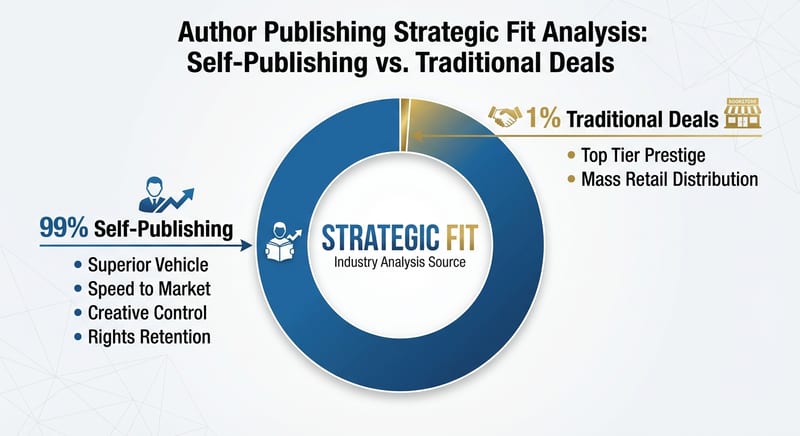
The statistic above reinforces the 'Indie First' mentality. Unless an author receives a mid-six-figure advance that offsets the loss of 60% royalties, the math rarely favors a traditional deal. The modern career path is often to self-publish to build leverage, then negotiate a 'print-only' deal with a traditional publisher while retaining digital rights—a 'hybrid' model that maximizes both reach and revenue.
Nuance: The Non-Fiction Proposal
For non-fiction, the calculus is slightly different. Here, the book is often a loss leader for a consulting practice or speaking career. However, as Jane Friedman notes, the rejection rate for non-fiction proposals is driven primarily by a lack of 'author platform.' In 2026, a publisher does not buy a manuscript; they buy access to your existing audience. Without a pre-built community, the proposal is dead on arrival.
This necessitates that non-fiction authors spend 12-18 months building a newsletter and social presence before pitching. The proposal itself has morphed into a business plan, where the 'Marketing' section is scrutinized more heavily than the 'Sample Chapters.'