The Death of Discovery: Agentic Commerce, GEO, and the 2026 Book Marketing Landscape

A strategic white paper on the transition from SEO to Agentic Commerce, the necessity of direct sales ecosystems, and the technical realities of marketing to AI
The Era of Agentic Commerce
For two decades, book marketing relied on a simple premise: a human types a query into a search bar, sees a list of results, and clicks 'buy.' In 2026, this model is obsolete. We have entered the era of Agentic Commerce. In this new reality, consumers utilize AI agents to execute complex tasks—including product research and purchasing—on their behalf. The reader is no longer the browser; the AI is.
This shift fundamentally alters the "customer" profile. Authors are no longer designing covers and writing blurbs solely to catch the human eye; they must now structure data to be parsed, understood, and trusted by a non-biological agent. If an AI agent cannot verify the metadata, genre fit, and availability of a book through standardized protocols, that book effectively ceases to exist in the commercial algorithm.
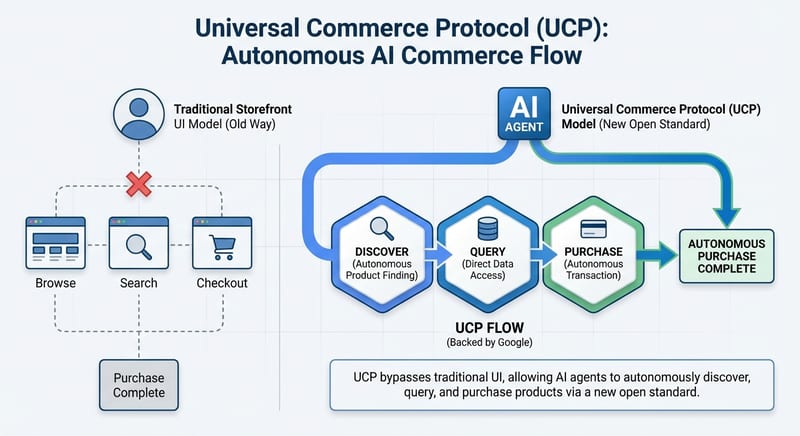
The implication of the statistic above is stark. Retailers and authors who fail to adopt these open standards will be invisible to the high-intent AI traffic that now dominates e-commerce. The battleground has moved from "Search Engine Optimization" to "Agent Optimization."
Nuance: Structured Data is the New Copyright
While many authors obsess over social media algorithms, the technical reality of 2026 demands a focus on 'Schema' and 'Structured Data.' An AI agent does not read a witty Instagram caption. It reads JSON-LD markup. Authors must ensure their websites explicitly define the entity relationships: Author -> Wrote -> Book -> Part of Series -> Genre.
Google’s introduction of 'Business Agents' further complicates this. These are AI-driven customer service interfaces that sit between the author's catalog and the world. If these agents are not fed accurate, real-time data regarding inventory and book themes, they will hallucinate incorrect information or, worse, recommend a competitor's title that offers better data clarity.
The Collapse of Organic Search (GEO)
The 'Answer Engine' has replaced the Search Engine. Users no longer want ten blue links; they want a synthesized answer. According to predictions from the Reuters Institute, this shift is precipitating a sharp decline in referral traffic from major tech platforms to individual websites. The days of relying on SEO to drive organic traffic to an author blog are effectively over.
This necessitates a pivot to Generative Engine Optimization (GEO). Marketing copy must be rewritten not for keyword density, but for 'informational density.' Large Language Models (LLMs) prioritize content that provides unique value, definitive facts, and clear semantic connections. Fluff pieces are filtered out; authoritative, deep-dive content is cited as the source of truth.
- Entity Authority: Establish yourself as the definitive source for your niche topics on Wikipedia and Wikidata.
- Citation Networks: AI models trace consensus. Ensure your book is cited by other high-authority domains.
- Conversational Syntax: Rewrite FAQs and book descriptions to directly answer natural language questions (e.g., "What is the best hard sci-fi book about terraforming?").
Nuance: The 'AI Slop' Crisis
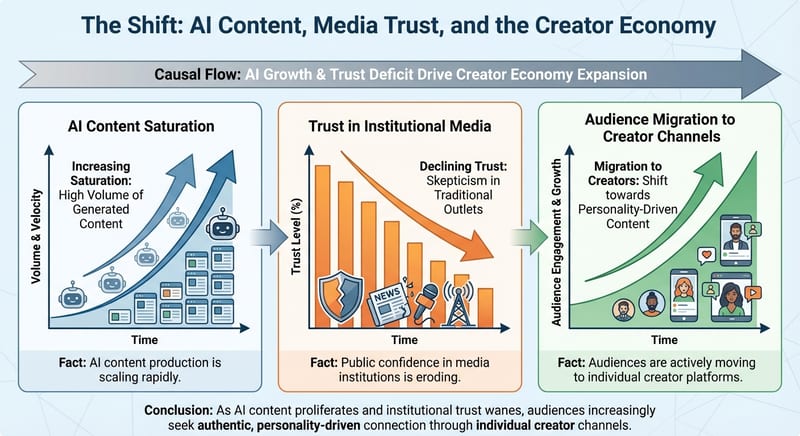
A significant threat to visibility is the proliferation of 'AI Slop'—low-quality, mass-produced content flooding the web. As noted in tech communication forecasts for 2026, the internet is drowning in synthetic noise. This has created a trust deficit.
For the discerning author, this is an opportunity. By verifying your identity and producing 'High-Provenance Content'—content that is cryptographically signed or visibly human-verified—you distinguish your signal from the noise. Platforms are increasingly prioritizing content that can prove human authorship.
"The focus will shift to producing unique, high-value content... Publishers are bracing for a sharp drop in traffic from search engines. - Reuters Institute"
The Direct Sales Ecosystem
As third-party platforms become flooded with AI-generated content and squeeze margins, the only safe harbor is a Direct-to-Consumer (DTC) ecosystem. Industry leaders like Joanna Penn have long predicted this bifurcation: the 'wide' market for discovery, and the 'direct' market for income. In 2026, this is no longer a prediction; it is the standard operating procedure for career authors.
Direct sales on platforms like Shopify or WooCommerce allow for the capture of First-Party Data. In an Agentic world, owning the customer's email address and purchase history is the only way to retrain your own marketing AI to find lookalike audiences. Relying on Amazon's black-box data is a strategic vulnerability.
Nuance: The 'Merchant' Mindset Shift
Moving to direct sales requires an author to transition from a writer to a merchant. This involves managing sales tax nexus, handling digital file delivery logistics, and optimizing checkout flows. It is a high-friction transition that filters out the hobbyist.
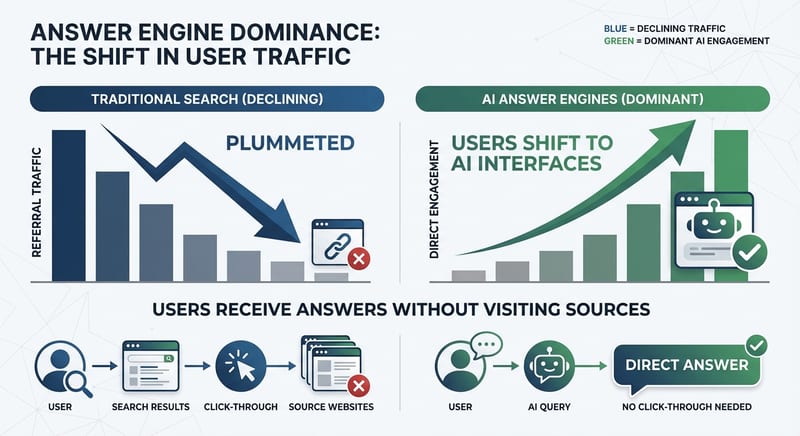
The data above reinforces the necessity of the direct model. If users are not clicking through from Google, you must acquire them elsewhere—likely via social or paid ads—and retain them permanently in your own ecosystem to justify the acquisition cost.
The Personality-Driven Media Pivot
In a world of synthetic media, human connection commands a premium. The Reuters Institute notes a decisive pivot toward personality-driven news and media. For authors, this means the 'brand' is no longer the book cover; it is the author's voice, face, and worldview.
Readers are seeking refuge from AI bots in communities led by verified humans. This resurgence of the '1,000 True Fans' model prioritizes deep engagement over broad reach. It is better to have 1,000 subscribers on a paid Substack than 100,000 followers on a platform like TikTok, where algorithm changes can wipe out visibility overnight.
Nuance: Verification as a Feature
The technical challenge for 2026 is proving you are human. We are seeing the rise of 'Human-in-the-Loop' badges and verification protocols. Authors who use AI tools must be transparent about their usage. The audience will tolerate AI assistance (e.g., for translation or outlining) but will ruthlessly abandon creators who pass off AI generation as human creativity.
This transparency builds the 'Trust Capital' required to sell high-ticket items—courses, masterminds, or premium print editions—directly to your superfans. In an age of infinite digital abundance, scarcity and authenticity are the only assets that retain value.
Conclusion: The Sovereign Author
The successful author of 2026 is not merely a writer but a sovereign media entity. They leverage the Universal Commerce Protocol to sell to agents, optimize their metadata for Answer Engines, and cultivate a direct relationship with readers that bypasses the volatility of tech giants. It is a more demanding landscape, but for those who adapt, it offers unprecedented control.