Beyond the Algorithm: The 2026 Blueprint for Sovereign Book Marketing

A strategic analysis of the shift toward direct sales, agentic commerce, and Generative Engine Optimization (GEO) defining the next era of publishing.
The Direct Sales Sovereign Ecosystem
For the last decade, "Direct Sales" was considered a fringe tactic for tech-savvy indie authors. As we approach 2026, it has calcified into the primary indicator of long-term author viability. The shift is not merely about avoiding retailer fees (though the 30-65% margin reclamation is significant); it is about data sovereignty. When an author sells exclusively through a retailer, they are structurally prevented from knowing who their customer is, rendering retargeting and Lifetime Value (LTV) optimization impossible.
Recent comprehensive studies indicate that successful direct sales architectures require more than just a Shopify store; they require deep inventory. A single book is insufficient to sustain the Customer Acquisition Cost (CAC) associated with direct traffic driving. According to data analyzed by Kindlepreneur’s survey of 500+ authors, there is a distinct inventory threshold that separates hobbyists from enterprise-level author businesses.
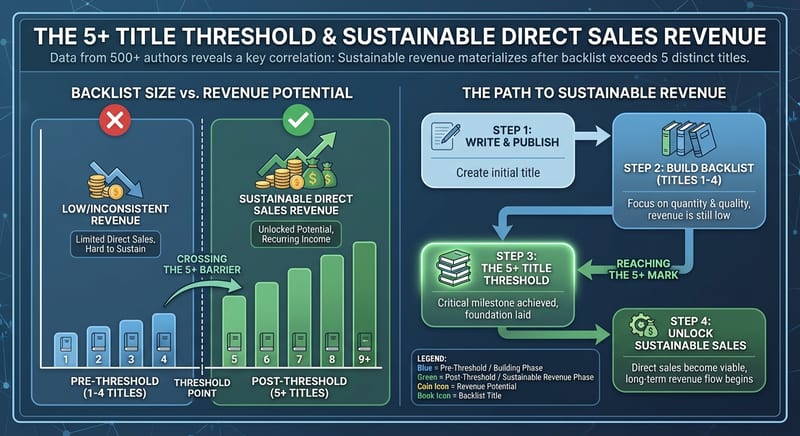
This "Volume Velocity" metric suggests that marketing a single frontlist title directly to consumers is economically inefficient. The friction of moving a customer from a social platform to a private transactional environment is high; once that friction is overcome, the Average Order Value (AOV) must be maximized via bundles, upsells, and backlist cross-pollination. Without a backlist of at least five books, the mathematics of direct acquisition simply do not hold.
Furthermore, the psychological contract between reader and writer changes in a direct environment. The transaction shifts from a commodity purchase (cheapest price, fastest shipping) to a patronage model. This allows for higher price points and the introduction of premium formats—special editions, merchandise, and digital bundles—that retailers like Amazon are ill-equipped to manage dynamically.
Nuance: Platform Agnosticism vs. Integration
A technical divergence is occurring regarding platform selection. While hosted solutions like Shopify offer robust scalability, the WordPress ecosystem (specifically WooCommerce) remains a dominant player for authors seeking total ownership. The choice is often dictated by technical proficiency versus convenience.
However, the critical nuance is not the store builder, but the payment processor. As we look toward future trends, the ability to integrate with emerging payment rails (including crypto and seamless mobile wallets) will define conversion rates. Authors locked into restrictive ecosystems may find themselves unable to pivot when purchasing behaviors change.
- The Bundle Economy: Direct sales allow for 'digital box sets' that increase AOV without increasing production costs.
- Data Ownership: The ability to upload customer lists to ad platforms (Facebook/Google) for 'Lookalike Audiences' is a strategic advantage unavailable to Amazon-exclusive authors.
- Instant Cash Flow: Direct platforms pay out daily or weekly, unlike the 60-day lag time standard in traditional publishing contracts.
The Rise of Agentic Commerce
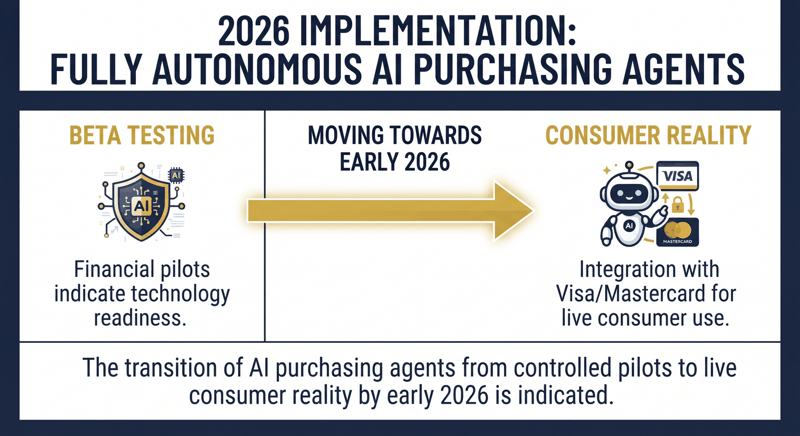
If direct sales is the present, "Agentic Commerce" is the inevitable future. By 2026, we anticipate a fundamental shift in how books are discovered and purchased. We are moving from a "search and browse" model to a "prompt and fulfillment" model. In this scenario, AI agents—software operating on behalf of users—will autonomously scan the web, compare prices, read metadata, and execute purchases.
Major financial institutions are already building the rails for this economy. As reported by CNBC, Visa and Mastercard are developing infrastructure to verify and secure transactions initiated by AI bots. This implies that your book's metadata must appeal not just to human psychology, but to machine logic. If an AI agent cannot parse your pricing, format availability, or genre fit via structured data, your book essentially does not exist.
This transition creates a new optimization discipline: Generative Engine Optimization (GEO). Unlike SEO, which fights for placement on a results page, GEO fights for inclusion in the AI's synthesized answer. When a user asks a bot, "Buy me the best sci-fi trilogy about political intrigue released in 2025," the AI will likely select *one* result to purchase, making the "Winner Take All" dynamic even more extreme.
Nuance: The Liability of Autonomous Purchasing
The technical friction in Agentic Commerce lies in liability and authentication. If an AI agent purchases the wrong format (e.g., an audiobook instead of a hardcover), who bears the cost of the return? The infrastructure currently being piloted focuses on strict parameters set by the user (price caps, format restrictions) to mitigate this.
For authors, this means metadata accuracy is no longer just a discoverability issue; it is a transactional requirement. Sloppy tagging or ambiguous genre classifications will cause AI agents to filter out titles to avoid 'error risk' in their purchasing protocols.
The Email List as a Valuation Multiplier
While AI dominates the headlines, the humble email list remains the single most potent economic engine for authors. However, the strategy has matured. It is no longer about "blasting" a newsletter; it is about segmented, automated narrative delivery. The choice of infrastructure is critical here. As noted in Kindlepreneur's 2026 service review, platforms like MailerLite have emerged as the standard for their balance of deliverability and cost, while legacy players like Mailchimp are increasingly viewed as detrimental to author margins.
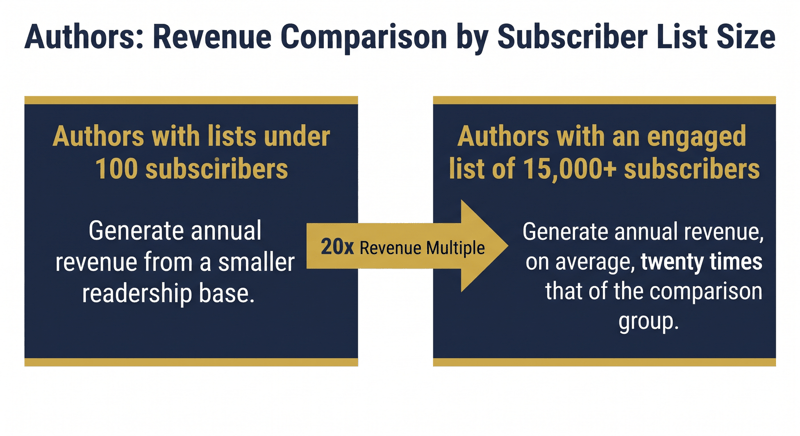
The disparity in earnings between authors with and without robust lists is widening. We are witnessing a "K-shaped" recovery in publishing, where authors with direct access to readers ascend, and those dependent on third-party visibility decline. The email list is the mechanism that converts a casual reader into a "True Fan," capable of supporting high-ticket offers.
This leads to a stark financial reality. An email subscriber is not just a metric; they are a unit of potential energy that can be directed at will—to a launch, a Kickstarter, or a backlist promotion—without paying a "gatekeeper tax" to social media algorithms.
Nuance: List Hygiene vs. List Size
The amateur obsesses over the total subscriber count. The professional obsesses over the open rate and click-through rate (CTR). In an era of aggressive spam filters and the "Promotions Tab," a list of 50,000 unengaged subscribers is a financial liability due to hosting costs and damaged sender reputation.
Modern email strategy involves ruthless "pruning"—deleting subscribers who have not opened emails in 6 months. This improves deliverability percentages, ensuring that your core audience actually sees your message. It is a quality-over-quantity game.
"In a world of infinite AI-generated content, the personal connection of an email is the only thing that cannot be commoditized. We must double down on being human. - Joanna Penn, The Creative Penn"
The "Human-Centric" Premium Strategy
As AI tools lower the barrier to entry for content creation (writing, covers, audiobooks), the market is flooding with mid-tier quality content. In 2026, "competent" is no longer a selling point. The market value is shifting toward provenance and authenticity. As discussed in Joanna Penn’s 2026 predictions, the "1,000 True Fans" model is evolving into a high-ticket economy.
Readers are showing an increased willingness to pay premiums for connection. This manifests in crowdfunding campaigns (Kickstarter/BackerKit) where fans pay $50 or $100 for a deluxe edition of a book they could buy on Amazon for $5. They are not buying the paper; they are buying the relationship and the artifact. The AI cannot sign a book. The AI cannot host a live Q&A. These human-exclusive activities are becoming the primary revenue drivers.
This bifurcation means authors must choose a lane: high-volume commodity publishing (feeding the algorithms with rapid releases) or low-volume, high-touch boutique publishing. The middle ground—writing one average book a year and hoping for organic discovery—is dead.
- Crowdfunding: Using Kickstarter not just for funds, but as a hype-generation engine before retail release.
- Special Editions: Foil stamps, sprayed edges, and illustrations are becoming standard requirements for physical book sales to compete with digital convenience.
- Community Access: Charging for access to Discord communities or Substack tiers.