The Copyright Wars & The Capital Squeeze: A 2026 Book Marketing White Paper

An exhaustive analysis of 2026's defining conflicts: AI copyright litigation, rising production costs, and the pivot from 'hustle' to 'retention' marketing.
The Algorithmic Enclosure: AI vs. IP Sovereignty
For years, the threat of AI in publishing was theoretical. In 2026, it is existential. The launch of Amazon's 'Ask This Book' feature marks a critical inflection point where the retailer effectively scrapes the semantic value of a book to answer reader queries without necessitating a full read-through. This commoditization of content has triggered a massive backlash from the Authors Guild and independent creators alike.
The marketing implication is severe: if an AI can summarize your book's core value proposition (non-fiction) or plot twists (fiction) for free, the incentive to purchase evaporates. Authors must now structure their work to be 'AI-resistant'—focusing on voice, personal anecdote, and complex narrative structures that Large Language Models (LLMs) struggle to replicate authentically. Marketing copy must aggressively highlight the 'human experience' that the machine cannot simulate.
This rejection is a market signal. It establishes that the industry values the training data of a book far higher than a one-time payout. For the astute marketer, this emphasizes the need to protect digital rights. Opting out of AI training datasets (where possible) and using 'poison pill' metadata strategies are becoming standard defensive marketing tactics.
The 'Poison Pill' Strategy
How do you market against a machine? The 'Poison Pill' involves embedding specific, unique terms or 'neologisms' within your text and marketing materials that are exclusively defined by you. If an AI uses these terms without citation, it proves ingestion.
Furthermore, marketing campaigns are shifting to 'gated' communities. By moving the most valuable content (bonus chapters, deep-dive guides) behind a login wall (Substack, Patreon, or a direct site), authors prevent AI crawlers from scraping the value, ensuring that only paying humans can access the premium material.
Capital Intensity: The Rising Cost of Excellence
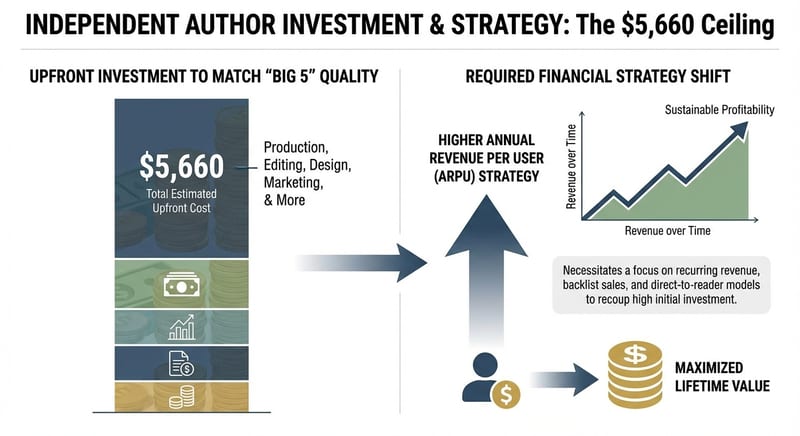
The 'Gold Rush' era of zero-cost publishing is officially over. As the market saturates, the threshold for quality has skyrocketed, dragging production costs with it. In 2026, the average cost to publish a professional-grade book ranges from $2,940 to over $5,600. This is not inflation; it is professionalization.
This capital requirement fundamentally alters the marketing funnel. If your Break-Even Point (BEP) is 2,000 copies (up from 500 copies five years ago), you cannot rely on 'organic reach.' You need a calculated, paid acquisition strategy from Day 1. The 'hobbyist' author is being priced out, leaving the market to 'authorpreneurs' who treat their books as venture-backed startups.
- Editing (Developmental & Copy): $2,000 - $4,720. The single largest line item, but non-negotiable for retention.
- Cover Design: ~$880. This is your primary Click-Through Rate (CTR) driver.
- Marketing Launch: $665 - $1,180. Essential for the first 30 days of algorithmic visibility.
"We are seeing a shift towards consistent daily sales... rejecting aggressive 'bro marketing' tactics. - Publish A Profitable Book, 2026 Trends"
Platform Stability: The TikTok Stabilization
The regulatory uncertainty surrounding TikTok has finally settled. With TikTok securing its US future, 'BookTok' remains the dominant discovery engine for fiction. However, the 'Wild West' era of viral organic reach is ending. The platform is maturing into a 'Pay-to-Play' media channel similar to Facebook in 2016.
For 2026, the strategy is no longer 'hope for a viral video.' It is 'paid amplification of organic winners.' Authors must test content organically, identify the videos with high retention, and then put ad spend behind those specific assets. This hybrid model protects the budget while leveraging the algorithm's targeting capabilities.
The Shift to 'Slow Marketing'
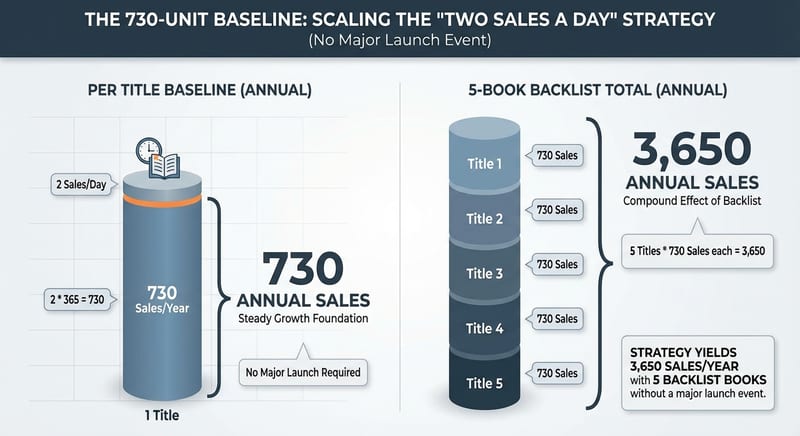
In response to platform volatility, a counter-movement has emerged: 'Slow Marketing.' Instead of chasing the dopamine hit of a viral spike, authors are optimizing for consistent daily sales. The goal is 'Two Sales a Day'—a metric that, over a year, builds a sustainable backlist income without burnout.
This philosophy rejects the 'Launch Week or Die' mentality. It focuses on evergreen email sequences, auto-responder series, and SEO-driven blog content that compounds over time. It is the transition from 'hunting' (seeking new readers daily) to 'farming' (nurturing an existing ecosystem).
This baseline provides the psychological safety required to create better work. When an author is not desperate for immediate cash flow, they can take the time to write the higher-quality, higher-cost books that the 2026 market demands.
- Evergreen Funnels: Automated email sequences that sell your backlist 24/7.
- SEO Blogging: Writing articles that answer reader questions (like this one) to drive organic traffic.
- Direct Sales: Moving loyal readers off-platform to increase margins and data ownership.