Book Piracy in 2026: How Indie Authors Protect Their Books

A practical 2026 playbook for self-published authors who want to fight book piracy without breaking the reader experience. Watermarking, DMCA takedowns, direct
How big is the book piracy problem in 2026
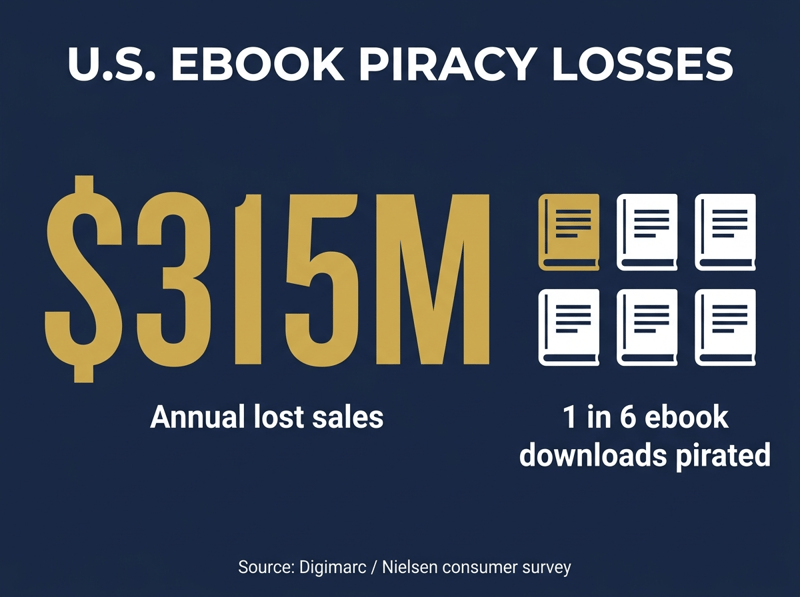
Book piracy is bigger than most indie authors think and smaller than most piracy alarmists claim. The most-cited number is $315 million, the annual lost-sales estimate that Digimarc published from a 2017 Nielsen consumer survey. That figure is dated, but every more recent indicator points in the same direction: more visits, more domains, more shadow libraries.
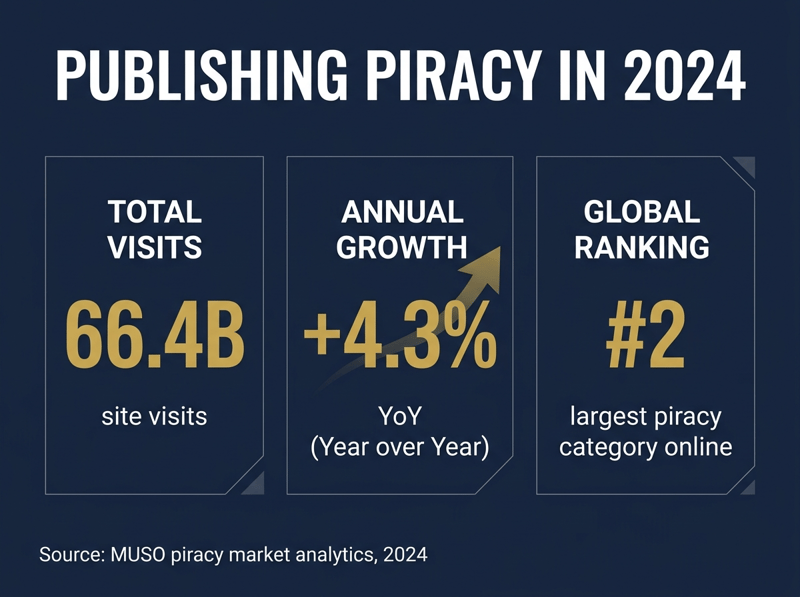
In 2024 alone, the publishing piracy category logged 66.4 billion site visits, a 4.3 percent year over year increase that made it the second-largest piracy vertical online after video streaming. Hachette alone filed DMCA takedown requests against more than 3 million domains in the first week of 2024, almost all of them targeting Z-Library mirrors. Z-Library itself remains accessible through Tor and rotating clearnet domains despite multiple FBI seizures, French court orders, and the 2024 escape of its founders from house arrest in Argentina.
For self-published authors, the operational question is simpler than the legal debate: how much of your readership is downloading your book for free when they would otherwise have bought it? Industry surveys consistently show that roughly 10 percent of ebook readers acquire books exclusively through piracy, and another 13 percent mix legal and illegal sources. Not all of those readers are lost sales (many would not pay either way), but in the long tail of self-publishing, even a few hundred dollars a year per title compounds.
Why piracy hits indie authors harder than the Big 5
A Penguin Random House title can absorb piracy because its publisher has a legal team, automated DMCA tooling, and bulk contracts with shadow library monitors. A self-published author has none of that infrastructure and operates on a much thinner margin to begin with. Every pirated copy that displaces a legitimate sale takes a $1 to $2 bite directly out of monthly royalties, not the publisher's bottom line.
The compounding problem for indie authors is review velocity. A reader who pirates your book usually does not buy, so they cannot leave a verified purchase review on Amazon. They might rate you on Goodreads, but unverified ratings carry less algorithmic weight, and Amazon increasingly filters reviews that do not match purchase history. Piracy is therefore a double tax: lost royalty plus suppressed social proof. The second tax is often the worse one.
Where pirated books actually live
Knowing where piracy happens is the prerequisite to fighting it. Most indie authors imagine a single shadowy site. The reality is a layered ecosystem with four distinct tiers, each with its own takedown economics.
- Shadow libraries. Z-Library, Libgen, Anna's Archive. These are the largest indexed repositories of pirated ebooks. They use distributed hosting and rotate domains weekly to survive DMCA action.
- File-locker scrapers. Sites like Ebook-Hunter, Oceanofpdf, and various lookalikes that scrape shadow libraries and re-host content with affiliate advertising. They are easier to take down but new ones appear every week.
- Telegram channels and Discord servers. Closed-network distribution is now the dominant route for new releases. Telegram banned the public Z-Library channels in 2024, but invite-only channels keep operating.
- Social media and forums. Reddit's r/ebookrequests, Twitter file-share threads, and niche Facebook groups. Smaller volume per copy, but very visible to your paying readers.
The single most useful action you can take in week one is a Google search for your exact title plus the words pdf, epub, or download. Do this in incognito. The first page of results will usually tell you which tier you are dealing with. If you only see scraper sites, your DMCA workload is light. If you see Z-Library and Anna's Archive at the top, you have a long-tail problem and need a recurring takedown process, not a one-off email.
Should you enable Amazon's optional DRM?
When you publish on Amazon KDP, you get a one-time choice during upload: enable Amazon's DRM, or publish DRM-free. This decision is permanent. You cannot toggle DRM later without unpublishing and re-uploading, which can reset your reviews and ranking. The choice deserves more than 30 seconds of thought.
Most working indie authors and many publishing professionals now recommend publishing DRM-free. Amazon's DRM is widely considered ineffective: tools like Calibre with the DeDRM plugin or commercial converters such as Epubor can strip it in seconds. Pirates are not slowed down. Meanwhile, paying readers who want to read on a non-Kindle device, archive their library, or convert files for accessibility software get punished. DRM has become a tax on your real customers.
What watermarking actually does (and does not) prevent
Social watermarking, sometimes called social DRM, is the most effective compromise between protection and reader experience. Instead of locking the file, it brands every copy with the purchaser's identity. The watermark exists in two layers: visible (an embedded line of text on the cover page or footer naming the buyer and order ID) and invisible (metadata, file-name hashes, and obfuscated identifiers spread through the file).
The trade-off is clear. Watermarking does not stop a determined pirate from uploading. It does change the social contract. Most casual sharers (the largest source of piracy uploads from indie books) will think twice when their email address or name will appear in the file they post. And for the small minority who upload anyway, you now have evidence pointing to a specific buyer when you find the file in the wild.
- Visible watermark elements: reader name, email address, transaction ID, purchase date, originating platform.
- Invisible watermark elements: unique file-name hash, embedded metadata fields (DC.creator, DC.identifier), font kerning fingerprints, image steganography in cover or chapter graphics.
- What it cannot do: prevent a determined pirate from running a watermark-stripping script. The deterrent is social, not cryptographic.
- What it can do: identify the source of a leak, deter casual sharing, and satisfy DMCA requirements for proof of ownership.
The largest commercial watermarking services for ebooks include BooXtream, LemonInk, and EditionGuard, all of which integrate with major ecommerce stacks and produce per-buyer files for EPUB and PDF. For Read & Rate users distributing review copies, watermarking happens automatically on every reviewer download, so the operational overhead is zero. Whichever path you choose, the principle is the same: every copy in the wild should be traceable to the original buyer.
Method 1: Watermark every download you send
The single highest-leverage action is making watermarking the default, not the optional add-on. Every PDF or EPUB that leaves your system should carry the reader's identity. This applies to ARC copies, reader-magnet downloads, KU borrows you cannot control, and direct sales you can. The friction for the reader is zero. The deterrent for the casual sharer is significant.
Method 2: Send DMCA takedown notices yourself
The Digital Millennium Copyright Act gives you the right to demand removal of any infringing content hosted on U.S.-connected services. Almost every major hosting provider, search engine, and social platform has a DMCA process. The process is intimidating the first time and routine after the third. Here is the playbook.
- Find the infringing URL. Search your exact title plus pdf, epub, mobi, or download in incognito mode. Save every URL.
- Identify the host. Use a WHOIS lookup or a tool like ViewDNS to find the hosting provider and registrar.
- Locate the DMCA contact. Look for links labeled DMCA, Safe Harbor, Legal, or Abuse. Most providers publish a dedicated email or web form.
- Draft the notice. Include identification of the copyrighted work, identification of the infringing URL, your contact information, a good-faith statement, an under-penalty-of-perjury statement, and your physical or digital signature.
- Send and log. Email the notice, then save a row in a spreadsheet with date, host, URL, and follow-up status.
- Follow up if needed. Most hosts respond within 24 to 72 hours. Search engines like Google take 1 to 5 days. If a host ignores you, escalate to the registrar (Cloudflare, GoDaddy, Namecheap), which can pull the domain.
Google's DMCA dashboard at lumendatabase.org also accepts notices for delisting search results. Delisting does not remove the file from the host, but it makes the pirated copy invisible to anyone searching your title. For practical traffic reduction, delisting is often more valuable than file removal because the file sitting on a server nobody can find is functionally dead.
"The DMCA notice-and-takedown system was designed to be usable without a lawyer. If you can write a polite cease-and-desist letter, you can file a DMCA notice. The Authors Guild has templates and will help members through complex cases."
Method 3: Use Google Alerts and reverse image search
Detection beats reaction. Set up automated alerts so you are not manually searching for pirated copies once a month. The goal is a piracy radar that runs in the background while you write the next book.
- Google Alerts: create alerts for your exact title plus pdf, epub, and download. Use quotation marks around the title. Set frequency to daily for new releases, weekly for backlist.
- Reverse image search: upload your cover image to Google Images and TinEye. Pirated copies frequently use the original cover, and reverse search catches them even when the title is altered.
- Talkwalker Alerts or Mention: free or low-cost services that cover sources Google Alerts misses, including some forums and message boards.
- Goodreads and Amazon reviews: readers occasionally complain about file quality in reviews of pirated copies, leaving you a free lead to a piracy source.
Method 4: Sell direct with watermarked PDFs
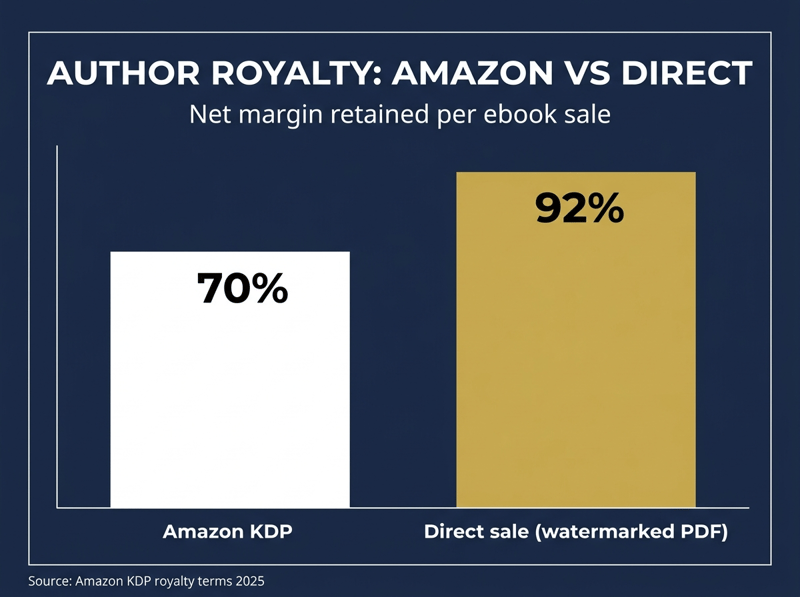
The single best way to reduce your piracy footprint is to control distribution. Every Amazon sale produces a file that is one Calibre-plugin away from being stripped and uploaded. Every direct sale through your own store produces a watermarked PDF tied to a verified customer. You also keep 90 to 95 percent of the price instead of 70 percent (Stripe fees and Cloudflare R2 hosting costs are a fraction of Amazon's cut). Direct sales are not a replacement for Amazon, but they should be at least 20 to 30 percent of revenue for any serious indie author by 2026.
Method 5: Use a paid takedown service for backlist titles
If you have a backlist of more than three or four titles and consistent piracy detection, a paid takedown service is usually cheaper than your own time. These services file DMCA notices at scale, monitor mirror sites, and handle the registrar escalations when hosts ignore notices. Most charge a monthly subscription that lands between $30 and $200 depending on volume.
- Book Defender: indie-author focused, monthly subscription, handles search engine delisting and host takedowns.
- MUSO: enterprise-grade piracy analytics and takedowns. More expensive, more comprehensive reporting.
- OnSist: per-takedown pricing, useful for occasional bulk requests rather than continuous monitoring.
- The Piracy Guard: mid-market option for authors with 5 to 20 titles, offers a free initial scan.
Method 6: Build a community where readers feel ownership
The least technical and most underrated piracy defense is community. Readers who know you, follow your newsletter, see your face on launch livestreams, and feel like insiders are dramatically less likely to pirate your work. They are also far more likely to report piracy when they spot it, often before you do. A reader who feels like a stakeholder will email you with screenshots of a shadow library upload because they want you to win. Build that audience and watermarking becomes a backup, not a frontline defense.
The biggest mistake authors make
How Read & Rate watermarks every download
Read & Rate is built for self-published authors who want the protective infrastructure of a big publisher without the cost. Every PDF that flows through the platform is watermarked at download time, before the reader receives the file. The watermark includes the reviewer's verified email, order ID, and timestamp. Files are hosted on Cloudflare R2 with signed URLs that expire on download, so the file the reader receives is the only copy that ever leaves the platform.
- Automatic visible watermarking on every PDF download (reviewer name, email, order ID, date).
- Invisible metadata fingerprinting embedded in the file structure.
- Signed expiring download URLs hosted on Cloudflare R2.
- Multi-platform review collection: Amazon, Goodreads, Kobo, Apple Books, Barnes & Noble, and direct site reviews.
- Private reviewer comments (visible only to the author) for early signal on content issues before reviews go public.
- Author community hub for sharing piracy alerts and best practices with peers at your stage.
For a serious indie author releasing two or more titles per year, the watermarking and review-velocity infrastructure pays for itself within the first launch. The platform is designed to let you focus on writing while the operational layer (file protection, review collection, community alerts) runs in the background.
Frequently asked questions
Is ebook piracy actually hurting my sales?
In most cases, modestly. Empirical studies of casual book piracy suggest that 30 to 50 percent of pirated downloads displace a sale; the rest would not have purchased at any price. For a typical indie author selling 500 to 5,000 ebooks per year, that means realistically 5 to 15 percent of potential royalty leaking through piracy. Not catastrophic, but not zero, and the review-velocity tax compounds the loss. The fix is watermarking and direct sales, not a war on every Z-Library mirror.
Should I send DMCA notices for every pirated copy I find?
Prioritize. Send notices to high-traffic sites that rank on Google for your title (these displace direct sales), then to scraper sites in the top 20 search results. Skip private Telegram channels and dark-web mirrors unless you have a takedown service. Your time is the constraint, not the legal right. A focused 30-minute weekly batch beats a 4-hour monthly purge.
Can I tell which reader pirated my watermarked book?
Yes, if the watermark is intact. The buyer's email or order ID is typically embedded in the file. When you find a pirated copy, download it (legally, since you are the copyright holder), inspect the metadata and visible watermark, and trace it back to the original purchase. You then have several options: file a DMCA, remove the reviewer from your ARC list, or, in rare cases of repeat offenders, pursue a small-claims action.
Should I enable DRM on Amazon KDP?
No, for most indie authors. Amazon's DRM is broken in practice (Calibre plus the DeDRM plugin strips it in seconds), but it adds real friction for paying readers who want format conversion, accessibility tools, or cross-device reading. The choice is permanent at upload, so once you enable it you are stuck without a full unpublish-and-republish cycle. Publish DRM-free and rely on watermarking instead.
Sources and further reading
Primary sources for the data and claims in this guide: Authors Guild piracy advocacy resources (DMCA templates and policy positions for working authors), Digimarc and Nielsen $315M ebook piracy study (the most-cited industry loss estimate), TorrentFreak coverage of publisher DMCA campaigns against Z-Library (3 million domain takedowns in week one of 2024), U.S. Copyright Office DMCA reference (the legal framework and template language), and Amazon KDP DRM documentation (the official terms on Amazon's optional DRM and what it covers).