Goodreads Reviews for Indie Authors: Complete 2026 Guide

How indie authors get more Goodreads reviews in 2026, with data on Goodreads scale, the Goodreads Giveaway model, ARC routing, Listopia, and review conversion i
Why Goodreads still matters for indie authors in 2026
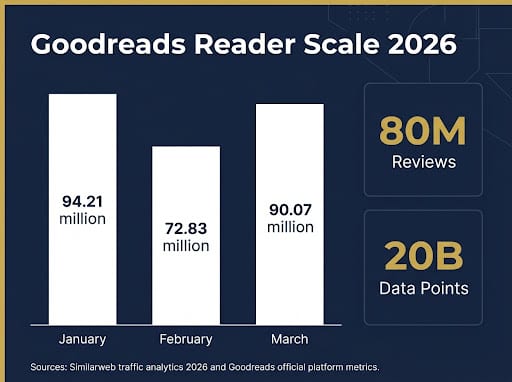
Goodreads is owned by Amazon, which already makes it a strategic platform for any indie author selling through KDP. The bigger story is the audience size. According to Similarweb traffic data for 2026, Goodreads received 94.21 million visits in January, 72.83 million in February, and 90.07 million in March. That is roughly 257 million sessions in a single quarter, almost all of them tied to readers actively building reading lists, rating books, or hunting for the next title in a series.
The platform sits on a database of more than 80 million reviews and a recommendation engine that analyzes around 20 billion data points to surface books to readers, according to platform statistics aggregated by Expanded Ramblings in 2026. The audience skews female, around 61 percent, with the largest age bracket between 25 and 34. That demographic profile lines up almost exactly with the heaviest indie fiction buyers in romance, romantasy, thriller, and contemporary womens fiction.
That scale is why review velocity on Goodreads still influences book sales. Books with at least 5 reviews show an average 270 percent sales lift compared to books with fewer than 5 reviews, per a 2025 WriteStats analysis of Amazon and Goodreads data. Books with a 4.0 plus average rating and 5 plus reviews convert three times better than books with no ratings, according to BookBub Partners insights. And 82 percent of online book buyers check reviews before buying, per Nielsen BookScan 2024.
How Goodreads reviews differ from Amazon reviews
Authors who treat Goodreads and Amazon as interchangeable misread the platforms and lose reviews unnecessarily. The two systems have different rules, different reviewer behaviors, and different downstream effects on sales.
- Goodreads reviews can be added before publication. Amazon reviews can only be added after the book is live and require a verified purchase or qualifying account history.||Goodreads accepts ARC disclosure language openly. Amazon allows ARC reviews but filters identical or coordinated disclosure text aggressively.||Goodreads reviews never disappear automatically. Amazon removes a meaningful share of indie launch reviews within the first 30 days.||Goodreads ratings appear on the Amazon product page widget for many titles, so a strong Goodreads average can lift Amazon conversion even when the Amazon review count is low.||Goodreads recommendations route on shelf adds and rating volume, not just star average. Amazon weights verified purchase, recency, and helpfulness votes.
8 ways to get more Goodreads reviews as a self published author
There is no single tactic that produces hundreds of Goodreads reviews on its own. The authors who stack reviews in 2026 layer 3 or 4 of the following moves across a launch window of 60 to 90 days. The order below is roughly the sequence in which to deploy them.
1. Claim and optimize your Goodreads Author Program profile
This is the unglamorous first move that most indie authors skip. The Goodreads Author Program is free for any published author and unlocks the ability to write blog posts on your profile, run giveaways, and respond to reader questions. Without it, your profile is a passive book listing and you cannot use any of the platforms reach tools. Once approved, fill in your bio, link your website and newsletter signup, upload a high resolution photo, and pin one anchor book to your profile so first time visitors see your strongest title first.
2. Run a Goodreads Giveaway at launch
The Goodreads Standard Giveaway costs 119 US dollars per campaign and runs for 7 to 30 days. Each giveaway typically collects between 500 and 5,000 entries, depending on the genre and external promotion. The key mechanic is not the prize itself. Every entrant is required to add your book to their Want to Read shelf, which generates the most valuable discovery signal on the platform. A 5,000 entry giveaway produces up to 5,000 shelf adds, and a meaningful share of those readers will go on to rate and review the book once it releases.
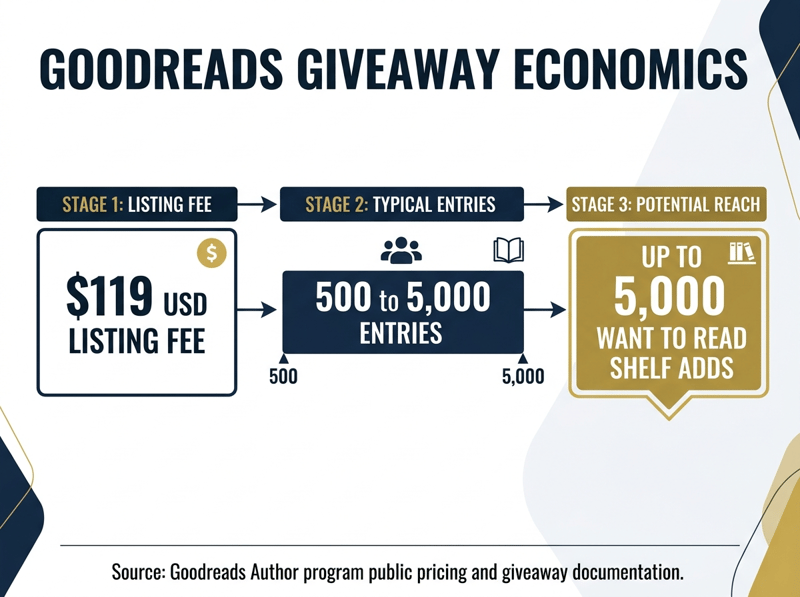
A Goodreads Giveaway is worth running when the launch budget can absorb 119 dollars in marketing spend and when the author plans to promote the giveaway on social and email. Without external promotion, entries default to the bottom of the range. With cross channel promotion, 5,000 entries and a strong Want to Read base are realistic for genre fiction launches.
3. Route ARC reviewers to Goodreads alongside Amazon
Most indie authors send ARCs and ask reviewers to post on Amazon. The Goodreads review is left as an afterthought, if it happens at all. That is a missed opportunity. Goodreads accepts pre publication reviews, accepts ARC disclosure openly, and never removes ARC reviews retroactively the way Amazon does. The smart move is to send every ARC reviewer a two link follow up: one to the Amazon product page after release, one to the Goodreads book page from day one. Platforms like Read and Rate are built around this multi platform routing, with reviewers selecting which platforms they want to post on at the moment of download.
4. Get on Listopia lists in your sub genre
Listopia is the most underused discovery tool on Goodreads. Readers vote books up themed lists like Best Slow Burn Romantasy 2026 or Best Indie Thriller of the Year. Books with active fan engagement climb fast. The author work is to find 3 to 5 active lists in your sub genre on the Listopia directory, add your book, and ask your launch team to vote it up. Many authors also create their own themed list and seed it with comparable titles, which signals to Goodreads that the list is genuine and surfaces your book alongside established names in the genre.
5. Plug into the Goodreads Reading Challenge
Every January, millions of Goodreads users commit to a yearly Reading Challenge. They pick a book count target and log everything they read against it. Authors who release in Q1 catch the largest wave of TBR building on the platform. Q1 is described as peak discoverability season for Goodreads by indie author marketing resources like Write Publish Sell, with January through March being the months when readers are most actively hunting for new titles to log against their challenge.
6. Stack Goodreads on top of multi platform review collection
Sending the same ARC reviewer to 5 platforms at once is a survival strategy. If Amazon removes 30 to 60 percent of launch reviews, the same reviewer who posted on Goodreads, BookBub, Apple Books, and Kobo still leaves a permanent footprint. Goodreads is the most durable review home of the bunch. Reviews stay live for years, accumulate ratings, and continue to influence discovery long after the launch window closes.
7. Engage with every Goodreads review, positive or critical
Goodreads is a reader community first and a marketing channel second. Authors who thank reviewers, answer reader questions, and stay visible inside the platform get more reviews over time because regular Goodreads users notice and signal boost engaged authors. The line to hold: never argue with a negative review. Like the comment, move on, and let the next reader form their own view.
8. Time your push around Q1
If launch timing is flexible, January, February, and early March are the strongest months on Goodreads. Readers are most actively building TBR shelves, the Reading Challenge is fresh, and the platform recommendation algorithm has higher session volume to draw from. Authors locked into a Q3 or Q4 launch can still mount a Q1 reading challenge campaign with a backlist title to maintain visibility during the slow months.
The data: why Goodreads reviews convert
The strongest argument for investing in Goodreads is the conversion data. The numbers below come from multiple 2024 and 2025 studies, and they explain why authors who track review metrics keep prioritizing Goodreads even when each individual review takes longer to earn than on smaller ARC platforms.
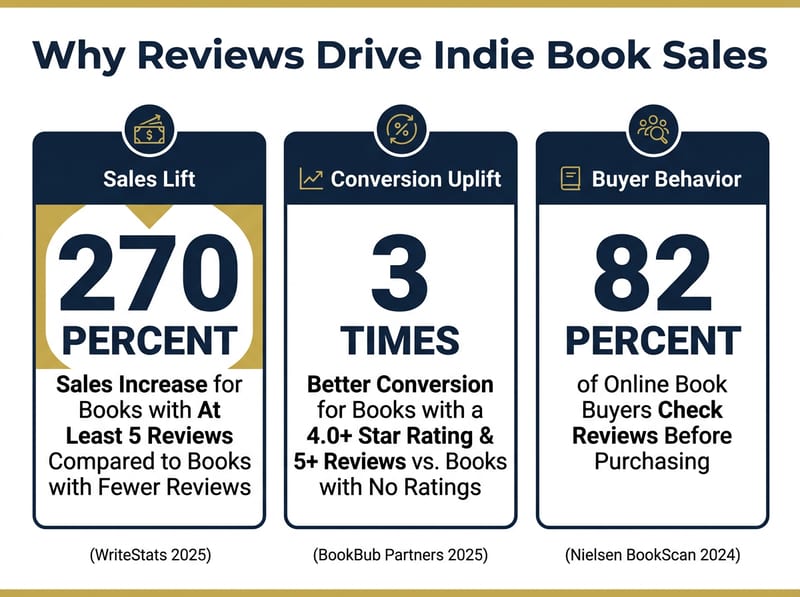
None of those studies pull data exclusively from Goodreads, but the platform social discovery loops amplify the same effect. When a reader adds a book to their Want to Read shelf, that action surfaces to their followers and into genre feeds. When that same reader posts a detailed 5 star review, the social proof flows back into the book page and into Amazon via cross platform widgets.
Common mistakes that suppress Goodreads reviews
- Sending the same disclosure copy to every ARC reviewer. Identical text reads as coordinated promotion and hurts review credibility.||Skipping Goodreads at launch and only chasing Amazon reviews. Most authors who do this lose 6 to 12 months of compounding social proof.||Treating a Goodreads Giveaway as the whole campaign. Without social and email promotion, entries default to the bottom of the range.||Arguing publicly with negative reviewers. Goodreads users are sensitive to author behavior, and the community signal boosts examples of bad author conduct.||Asking friends and family to post reviews. Goodreads detects clustered new accounts and either filters or flags them, and authentic reviewers spot the pattern immediately.||Ignoring Listopia. The most active discovery feature on Goodreads, and the one most indie authors never touch.
Frequently asked questions
Do Goodreads reviews count toward Amazon review minimums? No. Goodreads ratings show up on some Amazon product pages via widget, but they do not count toward the 50 or 100 review thresholds Amazon uses internally. Treat Goodreads as a parallel and complementary review home, not a substitute.
Can I run a Goodreads Giveaway for an ebook? Yes. Goodreads runs both physical and Kindle ebook giveaways. Kindle giveaways are restricted to US readers, which limits the audience compared to physical campaigns. Physical book giveaways draw broader entries but cost more in shipping. Pick based on launch budget and target reader location.
How long does it take to get to 50 Goodreads reviews? For a debut indie title, 50 reviews in 90 days is realistic with a Standard Giveaway, an ARC team of 30 to 50 reviewers, and consistent cross promotion. Without those moves, the same 50 reviews can take 12 to 18 months.
Is a low Goodreads rating worse than no reviews? A rating below 3.5 with under 25 reviews is statistically noisy and tends to filter buyers away. A rating between 3.8 and 4.4 with 50 plus reviews is the strongest social proof zone, often more persuasive than a 4.7 with only 8 reviews.
Where Read and Rate fits in your Goodreads strategy
Read and Rate is built for indie authors who want reviews that survive on Amazon and accumulate on Goodreads at the same time. Reviewers are vetted before they can request ARCs, every PDF download is automatically watermarked with the reviewer ID, and at the moment of download the reviewer selects which platforms they want to post reviews on. That list always includes Goodreads, Amazon, BookBub, Apple Books, and Kobo, with the reviewer free to add more.
Reviewers can also leave a private comment that only the author sees, which catches developmental feedback before it ever becomes a public 3 star review. Pricing starts from 25 US dollars per month and the platform bundles ARC distribution, multi platform review routing, book biometrics analytics, file conversion, and a private indie author community for tip exchange. Most competitors offer 1 or 2 of those features in a single tool.