IngramSpark vs KDP Print: The Honest 2026 Comparison for Indie Authors

A data-backed 2026 comparison of IngramSpark and Amazon KDP Print for self-published authors: royalty math, setup costs, bookstore reach, returns risk, and a de
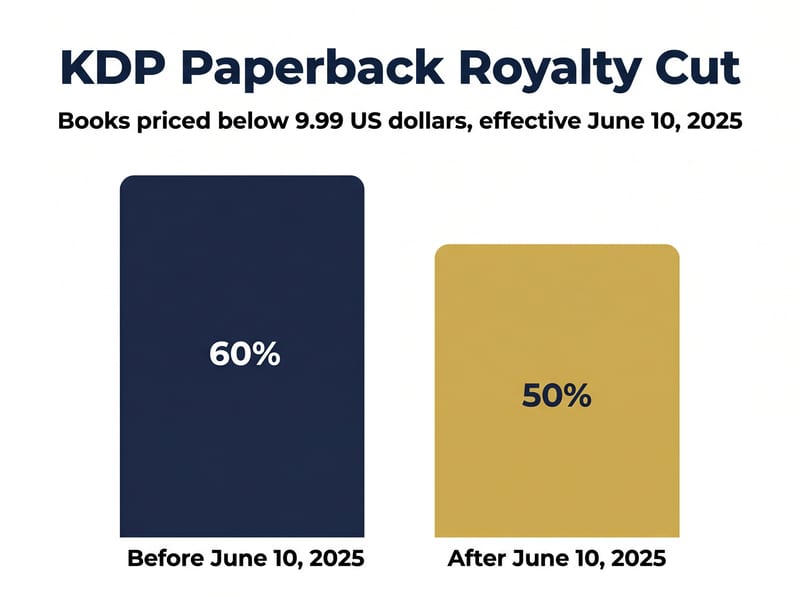
On June 10, 2025, Amazon quietly cut KDP paperback royalties from 60 percent to 50 percent on any book priced below $9.99. That single change forced thousands of self published authors to either raise prices, accept lower per book earnings, or look at IngramSpark seriously for the first time. The print on demand decision matters more in 2026 than it did a year ago because the economics on Amazon are no longer as clean as they used to be, and the alternative platforms have evolved.
Why this comparison matters more in 2026
Two structural shifts have changed the print game for indie authors. First, Amazon dropped its paperback royalty rate from 60 percent to 50 percent on June 10, 2025 for books priced below $9.99 in the US (and equivalent thresholds in other markets). Second, IngramSpark introduced a 1.875 percent market access fee on February 1, 2026, applied to wholesale sales through its distribution network. Neither change is catastrophic on its own, but together they force a fresh look at the math behind every paperback you sell.
At the same time, the self publishing market keeps growing. The number of self published works with print and ebook formats rose to more than 3.5 million in 2024 according to Bowker, and roughly 87 percent of self published authors now use print on demand instead of upfront print runs. With more authors competing for shelf space, the platforms you choose for distribution shape how easy it is for a librarian, indie bookstore, or international retailer to actually order your book.
How each platform pays you
Both platforms use print on demand: they print each book only when someone orders it. The difference is in how they calculate your share of every sale. Once you understand each model on a single book, the strategic question becomes much easier to answer.
KDP Print royalty math
Amazon KDP pays a fixed royalty rate, then subtracts the per copy printing cost. On Amazon.com sales, that rate is 60 percent for paperbacks priced at $9.99 or above, and 50 percent for paperbacks priced below $9.99. If you enable Expanded Distribution, which extends your book to non Amazon retailers through Amazon wholesale partners, the rate drops to 40 percent on those sales. Print cost depends on page count, color, and trim size. A 300 page black and white paperback prints for roughly $4.45 in the US at 2026 rates.
IngramSpark royalty math
IngramSpark uses a wholesale model. You set the list price and the wholesale discount (typically between 30 and 55 percent), and your royalty equals the list price minus that discount minus the printing cost. As of February 1, 2026, distribution enabled titles also pay a 1.875 percent market access fee on wholesale sales. The catch is that bookstores and libraries expect a 55 percent discount; setting it lower makes your book economically unattractive to anyone who wants margin to resell.
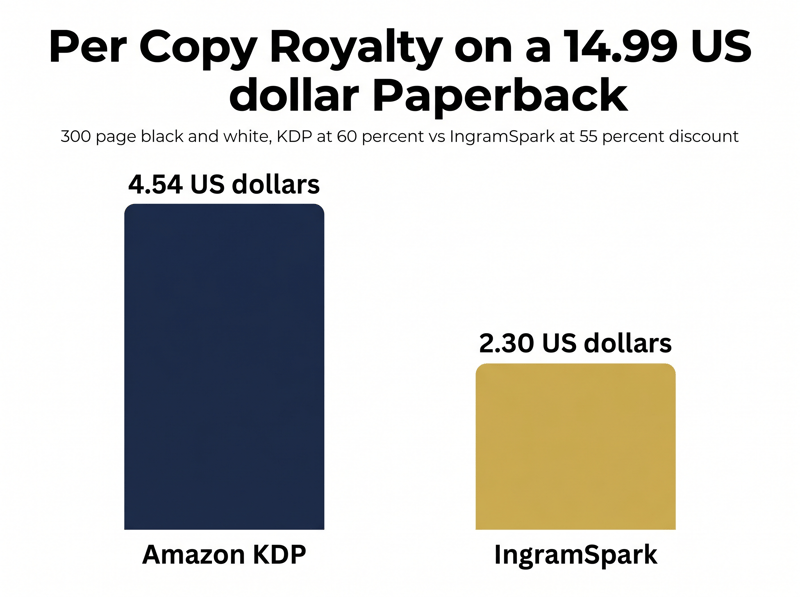
Here is a concrete example. Take a 300 page paperback priced at $14.99. On KDP, you earn roughly $14.99 times 0.60 minus $4.45, or about $4.54 per Amazon copy. On IngramSpark with a 55 percent wholesale discount, you earn $14.99 minus ($14.99 times 0.55) minus $4.45, or about $2.30 per wholesale copy. KDP wins on Amazon. IngramSpark wins everywhere KDP cannot reach efficiently. That is the entire economic case in one paragraph.
Setup costs and ongoing fees
Neither platform charges you to write your book. Both will reject low quality files. The fee structures differ enough to matter for an author publishing a series, and IngramSpark policy has changed twice in the last two years, so always verify current pricing before you upload.
- Setup fee: $0||Revision fee: $0||Account fee: $0||Proof copy: cost of printing plus shipping||ISBN: free if you use Amazon, $125 to $295 for a Bowker ISBN if you want full ownership and want to use the same ISBN on IngramSpark
- Setup fee: $0 for the initial upload as of the May 2023 policy update (verify on IngramSpark current pricing page before publishing)||Revision fee: free within 60 days of publication, then a per revision fee applies under older policies||Annual market access fee on distribution enabled titles: 1.875 percent of list price on each wholesale sale, effective February 1, 2026||Proof copy: cost of printing plus shipping||ISBN required: must be your own; IngramSpark does not issue one for you
Returns: the most misunderstood IngramSpark risk
Bookstores rarely buy non returnable books. To get into chain stores and many independents, you set your IngramSpark title to returnable. If a bookstore returns an unsold copy, you owe back the wholesale price you originally earned, plus return shipping and handling. On a $20 book with a 55 percent discount, a single return can claw back the $9 you were paid plus shipping. KDP Print does not offer returns through its standard channel, which removes this risk entirely but also makes your book less attractive to bookstores.
Distribution reach: Amazon vs the global catalog
KDP Print sells almost exclusively through Amazon. Expanded Distribution does technically extend your book to non Amazon retailers, but those orders are wholesaled through Amazon partners and pay you only 40 percent minus print cost. In practice, almost no indie bookstore or library will order a KDP book through Expanded Distribution because the discount is too small for them to make money on the resale.
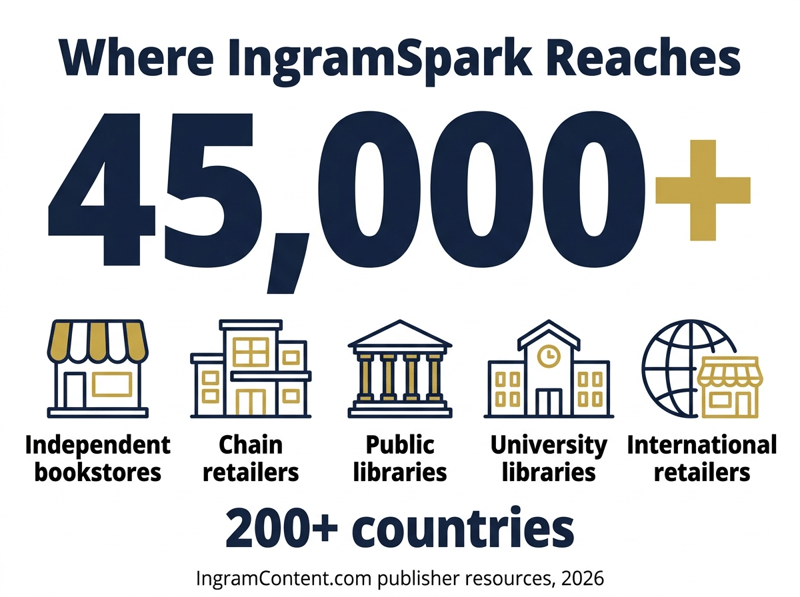
IngramSpark lists your book in the Ingram catalog, which is the same catalog Barnes and Noble, indie bookstores, libraries, universities, and international retailers already use. According to Ingram, that catalog reaches more than 45,000 retail and library accounts across more than 200 countries. Listing alone does not equal sales. A librarian or bookstore buyer still has to choose your title. But you are at least in the catalog they use every day, with terms that let them earn a margin.
Print quality, formats, and trim sizes
On print quality, the gap that used to favor IngramSpark has narrowed considerably. Both platforms use Lightning Source presses, and in many regions an IngramSpark book and a KDP Print book come out of the same facility. IngramSpark still leads on format range, offering more trim sizes, hardcover options including cloth bound and dust jacket combinations, and premium color paper choices. KDP has expanded its hardcover and color paperback options since 2024, but if you want a 6x9 hardcover with a dust jacket and matte laminate, IngramSpark is the practical choice.
The both strategy: how most successful indies actually publish
The most common pattern among career indie authors in 2026 is to use KDP for Amazon and IngramSpark for everywhere else. The setup looks like this. Upload the same interior file and cover to both platforms. Set your Amazon listing through KDP. Disable KDP Expanded Distribution so it does not undercut IngramSpark. Let IngramSpark handle distribution to bookstores, libraries, and the rest of the world. You earn the higher KDP royalty on Amazon and the wider Ingram reach on everything else.
The work is mostly upfront. After both files are set up, the platforms run themselves. Amazon orders go through KDP, non Amazon orders go through IngramSpark, and the print quality is consistent enough that no reader notices the difference. The Alliance of Independent Authors (ALLi) has documented this dual setup as the recommended approach for serious indie authors for several years running.
Decision framework: which to pick first
- Publishing your first book and selling only on Amazon: start with KDP Print. The setup is faster, the royalty on Amazon is higher, and you do not need to learn the IngramSpark dashboard.||Targeting independent bookstores, libraries, or international readers: add IngramSpark. KDP alone will not get you stocked at indie bookstores or appear in librarian ordering systems.||Writing a series with a strong existing Amazon base: use both. KDP captures the Amazon revenue while IngramSpark catches the smaller but valuable bookstore and library demand.||Selling at events or directly to readers: IngramSpark bulk author copy pricing is usually better than KDP for orders over 50 copies. KDP author copies are fine for one off needs.||Publishing hardcover with a dust jacket or premium color interior: IngramSpark, almost always. The format range is significantly wider.
Common mistakes that cost authors money
- Leaving KDP Expanded Distribution on while also using IngramSpark. The two compete and the KDP version at 40 percent will usually undercut your IngramSpark listing on non Amazon channels.||Setting the IngramSpark wholesale discount too low. Anything below 50 percent makes your book economically unattractive to bookstore buyers. 55 percent is the standard for a reason.||Enabling returns without a reserve. Returns can claw back money months later, and many authors get caught by surprise when a single school district or chain return wipes out a month of earnings.||Pricing your paperback below $9.99 on KDP after June 2025. That tier earns 50 percent instead of 60 percent, which often wipes out per copy profit on longer books.||Using the free KDP issued ISBN if you also plan to use IngramSpark. The Amazon ISBN is locked to KDP and cannot be moved. You will need a separate ISBN for IngramSpark, and matching identifiers across retailers keeps your sales data clean.
Frequently asked questions
The Read & Rate take
At Read & Rate, we work with self published authors who care about reach beyond Amazon. The pattern we see in our community is consistent. Authors who only use KDP cap out at Amazon driven revenue, while authors who run both KDP and IngramSpark capture a steady second stream from bookstores and libraries. Neither platform is a magic solution. Both are tools. The right combination depends on whether your readers are buying primarily on Amazon or somewhere else. If you want help thinking through your launch and review strategy across both Amazon and bookstore channels, Read & Rate gives you the community, watermarked review distribution, and multi platform review collection to make either choice work.
Sources cited
Start your free Read & Rate trial