Kindle Unlimited vs Going Wide: 2026 Indie Author Guide
Kindle Unlimited vs going wide for self-published authors in 2026. Compare KENP page reads, wide retailer royalties, exclusivity rules, and genre fit.
What Kindle Unlimited and going wide actually mean in 2026
Kindle Unlimited is the consumer-facing name for Amazon''s ebook subscription service. Readers pay $11.99 per month and get access to over 4 million titles. For authors, the access point is KDP Select. When you enroll a Kindle ebook in KDP Select, that file becomes part of the Kindle Unlimited catalog, and you earn from the KDP Select Global Fund based on how many KENP pages your readers consume. The catch is that you grant Amazon 90 days of digital exclusivity on that specific ebook.
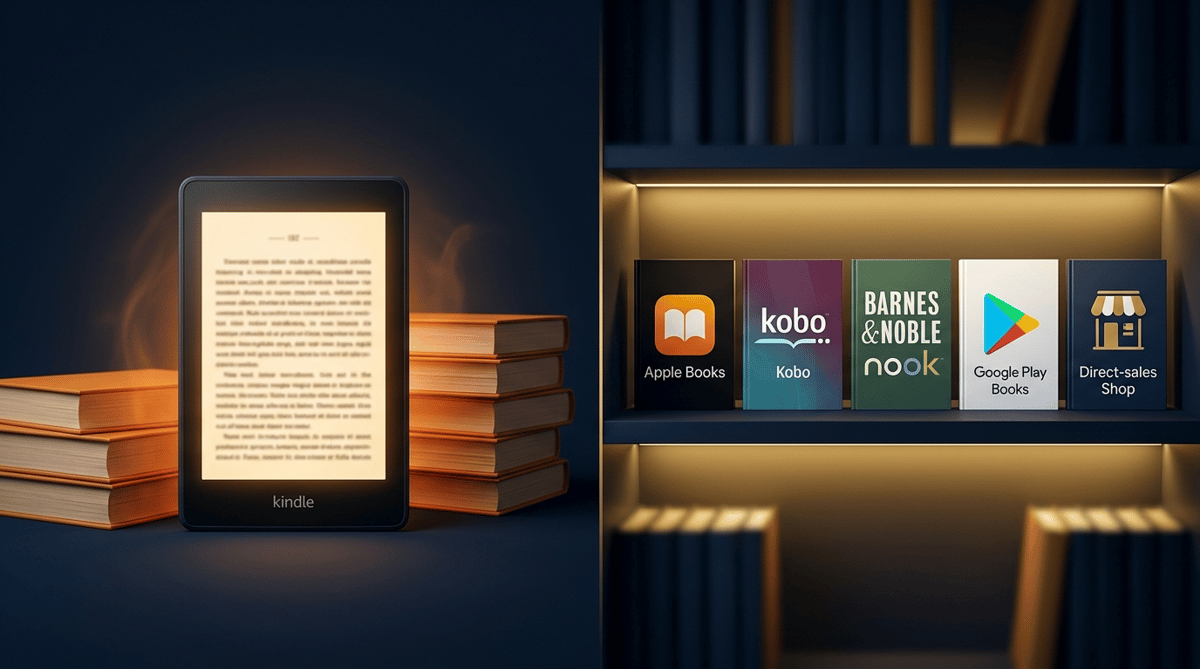
Going wide means publishing your ebook on multiple retailers at the same time, with no exclusivity agreement to any of them. The standard wide stack is Amazon, Apple Books, Kobo, Barnes and Noble Nook, Google Play Books, and often direct sales through your own site using Stripe or Shopify. Wide authors typically distribute either directly to each platform or through an aggregator like Draft2Digital or PublishDrive that handles upload, metadata sync, and royalty consolidation.
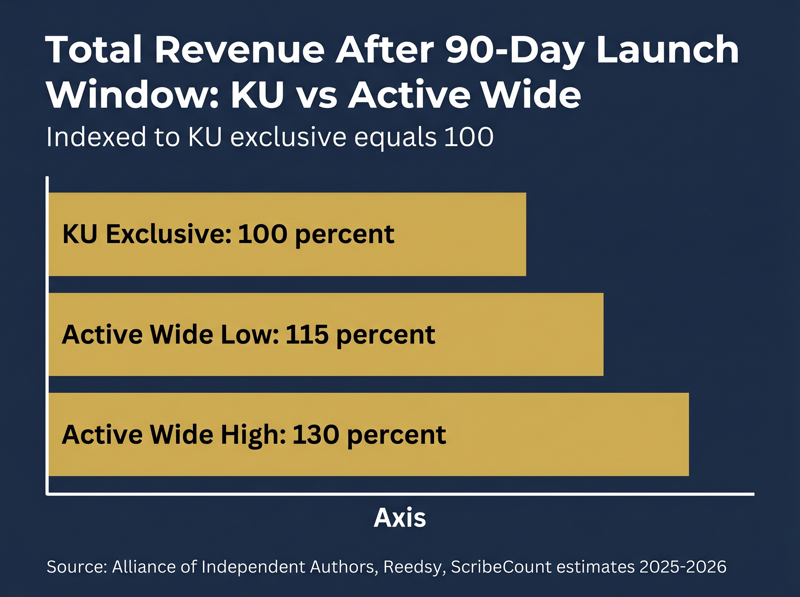
The decision sits at the intersection of three variables: genre, release strategy, and your existing reader base. For some authors KU is a discovery engine that funds the next book. For others, the wide royalty stack adds 15 to 30 percent on top of Amazon revenue. The wrong choice for the wrong book leaves real money on the table in either direction.
The KENP math: what authors actually earn from Kindle Unlimited
Kindle Unlimited pays authors per page read using a unit called KENP, short for Kindle Edition Normalized Page. Amazon normalizes every page so a large print page counts the same as a standard one. The Global Fund payout each month is divided across total KENP pages read across the entire catalog. That gives a per-page rate that fluctuates monthly. In 2026 the rate has hovered between $0.0044 and $0.0050 per page.
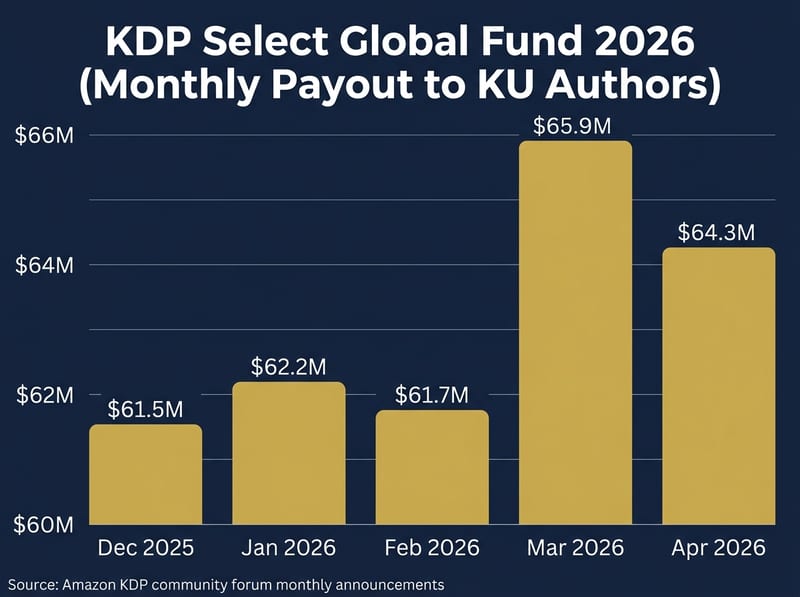
For a 300-page novel read cover to cover, that math works out to roughly $1.32 to $1.50 per full read. Compare that to a $4.99 ebook on Amazon with a 70 percent royalty, which earns about $3.46. On a per-read basis, a direct sale always pays more. The argument for KU is volume. The 7.2 million estimated global Kindle Unlimited subscribers read at a much higher rate than the average ebook buyer, and many of them will never buy your book outright but will absolutely binge a series.
What wide actually pays: the 70 percent royalty plus the long tail
Wide retailers pay a percentage of the list price. The Amazon 70 percent royalty band runs from $2.99 to $9.99 for ebooks delivered to most major markets. Apple Books pays 70 percent at any price point. Kobo pays 70 percent above $1.99 and 45 percent below. Google Play Books defaults to 52 percent. Barnes and Noble Nook pays 65 percent above $2.99 and 40 percent below. The headline numbers are similar, but the discovery mechanics differ wildly.
- Amazon Kindle: 70 percent royalty between $2.99 and $9.99, 35 percent outside that range. Best for raw discovery volume because of total market share.
- Apple Books: 70 percent at any price. Strong editorial curation and audio synergy through Apple devices.
- Kobo: 70 percent above $1.99, 45 percent below. Dominant in Canada, France, Japan, and Australia. The Kobo Plus subscription program is opt-in and pays per page read like KU.
- Barnes and Noble Nook: 65 percent above $2.99. Smaller share but loyal reader base concentrated in the US.
- Google Play Books: 52 percent default. Often used by readers buying on Android tablets and Chromebooks.
- Direct sales (own site): 90 to 97 percent net after Stripe and Shopify fees. You own the reader email and the data.
The compounding benefit of wide is the long tail. Amazon ranks books by recent sales velocity in a 30-day rolling window. After that window, your book drops in the algorithmic discovery feed unless you keep promoting. Apple Books, Kobo, and Google Play Books all weigh editorial curation, reader reviews, and category positioning more heavily than recent velocity. A wide book that does not hit the Amazon top 100 in its category can still earn steady monthly income from the other retailers for years.
Amazon vs the rest: where readers actually buy ebooks
Many authors stay in KDP Select because they assume Amazon is the only retailer that matters. The numbers are more nuanced than that. Amazon holds roughly 67 percent of the US ebook market by unit sales. Barnes and Noble Nook holds close to 25 percent, Apple Books about 5 percent, Kobo under 3 percent in the US but much higher in international markets. Globally, Amazon''s share drops to about 38 percent because Kobo dominates several non-English-speaking markets and regional players like Rakuten and JD ebooks own significant share in Asia.
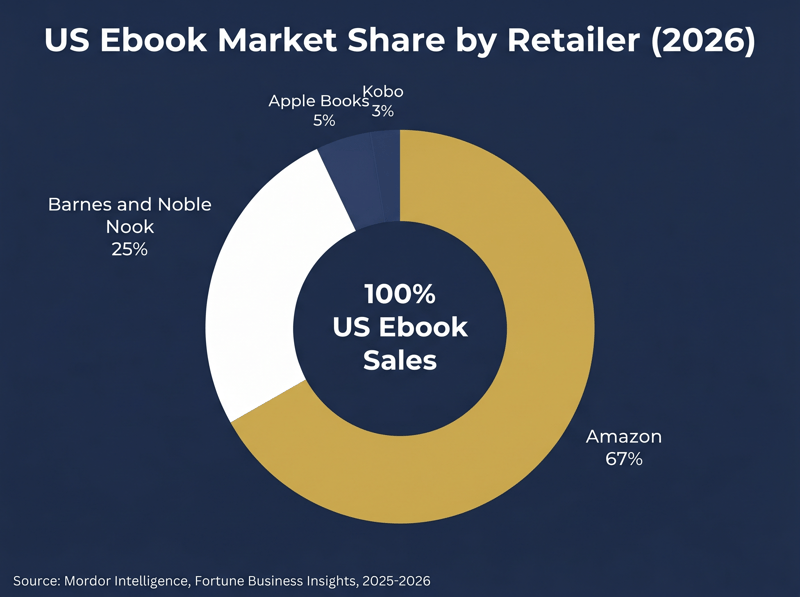
For US-only romance and thriller authors targeting Amazon-native readers, KU exclusivity costs you less than 10 percent of addressable market. For international literary fiction, nonfiction, or any book that ranks in Kobo strongholds, KU exclusivity can cost you 25 to 40 percent of your potential audience. The right answer depends on which 33 percent you are walking away from.
Genre is the deciding factor
Genre is the single biggest predictor of whether KU or wide will earn more. Romance, paranormal, urban fantasy, LitRPG, and military science fiction have ravenous binge readers concentrated inside Kindle Unlimited. Nonfiction, memoir, literary fiction, cookbooks, business books, and children''s books skew toward readers who own the books they buy and discover them through library networks, Apple editorial features, and direct site recommendations.
- Choose KU for: contemporary romance, paranormal romance, urban fantasy, LitRPG, military sci-fi, dark romance, harem fantasy, and any genre where readers consume 5 to 10 books per month.
- Choose wide for: literary fiction, mystery and thriller with strong international appeal, business nonfiction, memoir, cookbooks, children''s picture books, and any book aimed at library purchase orders.
- Test both for: traditional fantasy, science fiction outside LitRPG, young adult contemporary, and historical romance. These genres have meaningful readership in both KU and wide channels, so the right answer depends on your specific subgenre and reader base.
The 90-day exclusivity trap: what you give up
Enrollment in KDP Select runs in 90-day blocks and auto-renews unless you opt out. During an active enrollment, your ebook cannot appear in digital form anywhere else. This includes Apple Books, Kobo, Google Play Books, Nook, your own site, Gumroad, BookFunnel direct sales, library distribution through OverDrive or Hoopla, and even free PDF copies for ARC reviewers if those copies are findable through search.
- No other retailers: Apple Books, Kobo, Google Play Books, Nook, Smashwords, Scribd, Everand are all blocked.
- No direct sales of the ebook: selling EPUBs or DRM-free PDFs from your own site triggers a violation.
- No library distribution: OverDrive, Hoopla, and library aggregators are blocked for the duration of enrollment.
- Print and audio are allowed: KDP Select exclusivity only applies to digital editions of the ebook itself. Paperback, hardcover, and audiobook formats can still go wide.
- ARC distribution gets complicated: any reviewer copy that ends up indexed by search engines or shared on platforms outside Amazon can count as a violation.
Auto-renewal is the most common reason authors stay in KDP Select longer than they intended. The opt-out window closes about 3 days before the 90-day period ends. Miss it and you are locked in for another full quarter. Set a recurring calendar reminder for day 85 of every enrollment cycle. KDP will email you, but the email often lands in the same inbox as 100 other Amazon notifications.
Hybrid strategy: how the smartest indie authors actually publish
Most six-figure indie authors do not pick a side. They use KU and wide simultaneously across different parts of their catalog. The decision happens at the book level or the series level, not the author level. The patterns that work in 2026 fall into four hybrid models.
- Series funnel: book 1 in KDP Select to capture the KU binge audience, books 2 and beyond wide so dedicated fans can buy on their preferred platform. The free promo days on book 1 act as a permanent acquisition channel.
- Backlist anchor: oldest titles wide for the long tail, newest releases in KDP Select for the launch boost. Roll books out of KU after 90 to 180 days once initial velocity fades.
- Subgenre split: pen names or series in romance and LitRPG stay in KU, while literary or memoir work goes wide. Same author, different distribution per audience.
- Direct sales primary: book sold direct on your own site at 90 percent margin plus wide distribution for discovery. KU is skipped entirely because the direct funnel makes exclusivity too expensive.
"Exclusivity is a tool, not an identity. The question is never whether you are a KU author or a wide author. The question is what this specific book, in this specific genre, at this specific point in your catalog, needs from its distribution strategy."
Distribution aggregators: publish wide without managing 10 dashboards
The friction of going wide used to be real. Uploading the same file with different metadata to Apple Books, Kobo, Google Play, and Nook took hours per book. Distribution aggregators solved that problem. You upload once, set pricing once, and the aggregator pushes to every retailer and reconciles royalties. In 2026 the three serious options are Draft2Digital and Smashwords (now one company since the 2022 acquisition), PublishDrive, and Books2Read for the delivery layer.
- Draft2Digital (now owns Smashwords): takes 10 percent of net royalty. No upfront fees. Excellent for authors earning under $1,500 per month wide. Strong universal book link generator through Books2Read. Free EPUB and print formatting tools included.
- PublishDrive: flat subscription starting at $13.99 per month. You keep 100 percent of royalties. Becomes cheaper than D2D once you cross roughly $170 per month in wide revenue. Best for authors with growing catalogs.
- Direct upload: upload to each retailer yourself, no middleman. Best margin and most control, but requires significant time investment per release. Worthwhile once your catalog stabilizes.
How Read & Rate fits into a wide strategy
One of the hidden costs of going wide is review acquisition. KDP Select gives you Kindle Countdown Deals and 5 free promo days that drive Amazon reviews fast. Once you leave KU, you need a deliberate way to collect reviews across every retailer where you sell. Read & Rate solves this directly. Reviewers download a watermarked PDF of your book and choose which platform to post the review on, including Amazon, Apple Books, Kobo, Barnes and Noble, Goodreads, and BookBub. That multi-platform review collection is the missing piece in most wide strategies. Read more about Read & Rate''s multi-platform review system.
Common mistakes when switching between KU and wide
Switching between channels carries real risk. Books pulled out of KU can take 4 to 8 weeks to climb back into Apple Books and Kobo charts. Books re-enrolled in KDP Select can trigger compliance flags if any wide copy remains discoverable online. The most expensive mistakes are usually the easiest to avoid.
- Forgetting to opt out before auto-renewal. Set a calendar reminder for day 85 of every enrollment. Amazon''s reminder email is easy to miss.
- Going wide with a book whose buyer base is 90 percent on Amazon. Read your KDP report. If 90 percent of your sales were Amazon US in the last six months, wide will not magically open new doors without active wide promotion.
- Leaving free PDF copies indexed online during KDP Select. Any reviewer or pirate copy that Google can find counts as a violation. Audit your discoverable surface before enrolling.
- Pricing wide ebooks the same as Amazon. Each platform has different price sensitivity. Apple Books readers tolerate higher prices; Kobo readers respond strongly to discounts. Price per platform.
- Skipping Kobo promotions. Kobo Plus is the closest analog to KU. The Kobo Promotions Tab opens monthly merchandising slots. Authors who ignore them leave Kobo revenue on the table.
- Treating wide as set and forget. Wide revenue comes from active distribution work: pricing strategy, monthly Kobo and Apple submissions, direct sales funnels. Authors who upload to D2D and walk away earn a fraction of what active wide authors earn.
Frequently asked questions
Is KDP Select worth it for first-time authors?
For a debut book in romance, urban fantasy, LitRPG, or military sci-fi, the answer is usually yes for the first 90 days. KU gives you immediate access to 7.2 million subscribers, and the 5 free promo days drive initial Amazon reviews and algorithmic visibility. For literary fiction, memoir, or nonfiction debuts, the answer is usually no. Wide distribution and direct sales build a more sustainable launch even at lower initial volume.
Can I switch from KU to wide mid-enrollment?
No. Once enrolled in KDP Select, the 90-day exclusivity period must complete. You can opt out of auto-renewal at any time, but you cannot exit early without violating the agreement. Plan the opt-out date carefully. If you are launching a wide retailer push, your earliest wide go-live date is the day after your final KDP Select enrollment day ends.
Which retailer pays the highest royalty after Amazon?
Apple Books pays the highest standard royalty at 70 percent on any price point, including books under $2.99 where Amazon and Kobo drop to lower bands. Kobo matches 70 percent above $1.99. For direct sales through Shopify or your own checkout, you keep 90 to 97 percent after Stripe fees, which makes direct the highest-margin channel by a wide margin for authors with an audience that buys direct.
How long should I stay in KDP Select before going wide?
The most common pattern is 90 to 180 days in KDP Select, then opt out and go wide. The first 90 days captures the launch boost from KU visibility and free promo days. The second 90-day period extends the algorithmic momentum if KU is still earning meaningfully. Once monthly KU income drops below 50 percent of estimated wide income, opt out and migrate. Series authors often keep book 1 in KU permanently as a funnel into a wide back catalog.
Sources and further reading
Primary sources for the data and platform claims in this guide: Amazon KDP Royalties in Kindle Unlimited documentation, Written Word Media KDP Global Fund tracker, Amazon KDP Kindle Countdown Deals official documentation, Reedsy guide to KDP Select exclusivity, Kindlepreneur Smashwords vs Draft2Digital review, PublishDrive aggregator comparison, Alliance of Independent Authors wide vs KDP Select analysis, ScribeCount Wide vs Kindle Unlimited decision framework.