NetGalley Alternatives: 7 Better ARC Platforms (2026)
NetGalley charges $575 per listing and many indie authors get poor results. Compare 7 cheaper ARC platforms with higher review rates and proven track records.
Why NetGalley falls short for most indie authors
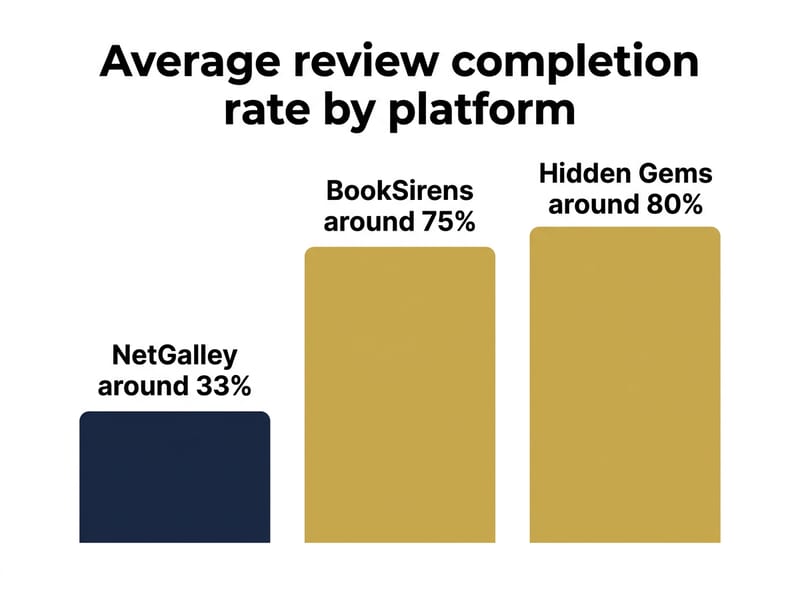
NetGalley was built for traditional publishers running dozens of titles across the same fiscal year. Its pricing structure assumes you can amortize a $575 listing across thousands of expected sales. For an indie author releasing one book at a time, that listing has to recover its cost from a single launch window, and the platform's overall review completion rate sits around 33 percent for self-published titles, according to multiple author case studies and indie author retrospectives published over the last three years.
The platform also runs on a one-by-one reviewer approval model. Every request must be vetted manually. For a debut book getting 100 reviewer requests in week one, that is hours of clicking that you could spend writing the next book. Indie authors who use NetGalley successfully almost always pair it with a co-op program (IBPA, BooksGoSocial, or Victory Editing), which cuts the cost in half but layers in extra administrative steps and approval gates.
There is also a discovery problem. NetGalley hosts thousands of titles at any given time, most of them from established publishers with marketing budgets behind them. A self-published romance debut competing against a Penguin imprint will struggle to surface in the same browse list. As multiple author retrospectives have noted, the reviewers most active on NetGalley are also the harshest, because they have built reputations on filtering out weak books at high volume.
Cost comparison: NetGalley vs the 7 alternatives
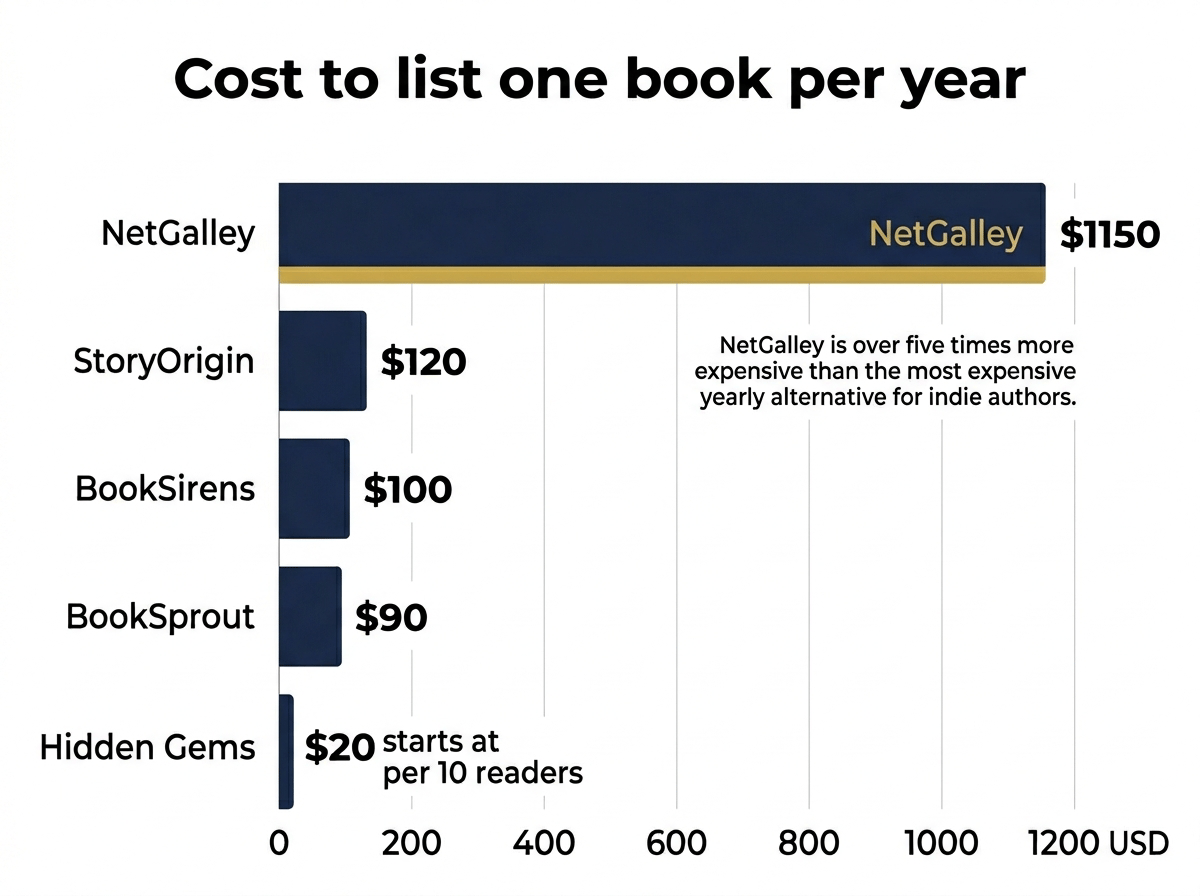
The fastest way to see the cost gap is to normalize every platform to a single book listing for one calendar year. NetGalley's 6-month listing scaled to a full year runs roughly $1,150 (or $400 with IBPA co-op stacking). BookSirens' Author Plan covers unlimited ARCs for a year at $100. BookSprout sits between $90 and $229 per year. Hidden Gems is priced per reader (around $20 per 10 readers), so total spend scales with volume.
- NetGalley: $575 for 6 months ($199 for 3 months via IBPA co-op)
- BookSirens: $10 per book plus $2 per reader, or $100 per year unlimited
- Hidden Gems: from $20 for 10 readers, scaling per genre
- BookSprout: $90 to $229 per year depending on campaign volume
- StoryOrigin: $10 per month ($120 per year), full marketing suite included
- BookFunnel: from $20 per year for basic ARC delivery
- Voracious Readers Only: tiered pricing, often under $50 per campaign
- Read & Rate: tiered monthly pricing, with watermarking, multi-platform reviews, and exchange community included
For a typical self-published author releasing 2 or 3 books per year, the math is uncomplicated. If you can pull 30 to 60 reviews on a single launch from a $100 to $200 platform spend, your effective cost per review sits between $2 and $7. NetGalley, by contrast, frequently lands indie authors at $20 to $50 per review. The cost-per-review metric is the only one that actually maps to ROI for an independent author.
The 7 best NetGalley alternatives ranked
The ranking below is ordered by overall fit for indie authors. Best fit factors in cost, review completion rate, reviewer quality, audience size, and platform infrastructure (file delivery, watermarking, automation). The right platform for your book also depends on genre and launch stage, so use the genre guide below before you commit to a yearly subscription.
1. BookSirens: best for budget-conscious indie authors
BookSirens has become the default first choice for indie authors who want predictable cost and a high review completion rate. As of January 2026, BookSirens reports an average review return of about 75 percent and an average reviewer rating of 4.1 out of 5 across all books. The platform reaches roughly 51,000 verified readers and works with more than 12,000 authors, making it one of the largest indie-focused ARC pools in the world.
Pricing comes in two flavors. The Promote Plan is pay-per-book at $10 to list plus $2 per reader who downloads. The Author Plan is a flat $100 per year for unlimited ARCs with no per-reader fee. For any author releasing more than one book per year, the Author Plan recovers its cost in the first launch. BookSirens publishes its pricing openly, which is uncommon in the ARC industry.
- Best for: indie authors with 1 to 4 books per year, all genres but especially genre fiction
- Strength: 75 percent average review completion rate, transparent pricing, large reviewer base
- Weakness: reviewers skew U.S. and Canada; less coverage in UK and EU than NetGalley
- Skip if: you need press, library, or trade reviewer access
2. Hidden Gems Books: best for the highest review completion rates
Hidden Gems has been distributing ARCs since November 2015 and reports an industry leading review return rate of over 80 percent. The model is unusual: instead of charging per book or per year, Hidden Gems charges per reader. Pricing starts around $20 for 10 readers and scales by genre. Romance and thriller campaigns typically attract 40 to 200 readers per campaign; military, sports, billionaire, and bad-boy subgenres each have their own pricing tiers.
The trade-off is supply. Hidden Gems has a sizable author waitlist because it deliberately limits reviewer-to-book ratios to keep completion rates high. If you have a launch window of 2 or 3 months, plan to book your slot at least 60 days in advance. Some authors also report inconsistent transparency on which readers were assigned to their campaign, so keep your own download-to-review tracking spreadsheet alongside whatever the platform shows.
3. BookSprout: best for backlist promotion and series launches
BookSprout was started in 2015 by self-publishing author Chris Leippi specifically for indie authors. It offers three plan tiers ranging from $90 per year for a single active campaign to $229 per year for unlimited campaigns and unlimited reviewers. For series authors who want to keep multiple titles in rotation (a perma-free book 1, a current launch, a deep backlist), BookSprout's unlimited tier is one of the better deals in the ARC market.
- Best for: series authors and backlist holders running multiple simultaneous campaigns
- Strength: flat yearly pricing with no per-reader fees, integrates with Amazon review requests
- Weakness: smaller reviewer pool than BookSirens or NetGalley
- Skip if: you publish less than one book per year
4. StoryOrigin: best for combining ARCs with newsletter swaps
StoryOrigin is technically a marketing platform that includes ARCs as one feature. For $10 per month, you get newsletter swaps, group promotions, reader magnet hosting, and ARC management with individual reviewer logins and automated follow-up tracking. If you are building an email list alongside your launch, StoryOrigin gives you the connective tissue between the two activities. Kindlepreneur's review of StoryOrigin goes deep on the newsletter side.
5. BookFunnel: best for ARC delivery automation
BookFunnel is the most polished delivery layer in the indie author stack. Plans start at $20 per year for basic file delivery and scale up from there. BookFunnel handles the file format troubleshooting that wastes the most reviewer time (Kindle send-to-device issues, EPUB versus MOBI confusion, side-loading instructions for iPhones), so review completion rates climb when you remove that friction. Many authors use BookFunnel as the delivery layer underneath whatever ARC platform sources the readers.
6. Voracious Readers Only: best for getting your first 10 reviews
Voracious Readers Only specializes in matching debut and early career authors with active readers who have opted into being matched with books in their preferred genres. Pricing varies by campaign size but typically lands under $50 for a starter package. The reviewer base skews UK and Canada with a solid U.S. presence; it is one of the better choices for an author trying to break the first 10 review threshold, which is the point at which Amazon's algorithm starts treating your book as a real product.
7. Read & Rate: best all-in-one ARC and review platform
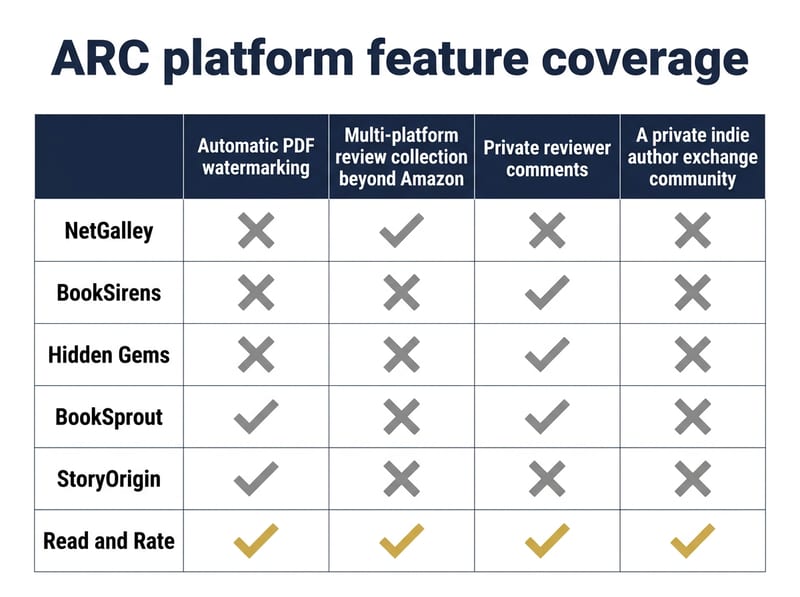
Read & Rate is built specifically for self-published authors who need more than reviewer matching. It combines watermarked PDF delivery, multi-platform review collection (Amazon, Goodreads, BookBub, Apple Books, Kobo, and others), private reviewer comments that only the author can see, and a private community where indie authors exchange tips and run review trades. The platform also includes book biometrics dashboards, file conversion, and UGC video tools, which sit outside what any single competitor offers.
- Automatic PDF watermarking: every reviewer download is watermarked with their email and order ID, deterring leaks before they happen
- Multi-platform reviews: reviewers choose where to post (not just Amazon), so you collect reviews across the entire retail ecosystem
- Private reviewer comments: reviewers can send you feedback that nobody else sees, surfacing editing notes before public reviews land
- Indie exchange community: a private hub where authors trade reviews, share launch strategies, and answer each other's questions
- Book biometrics, file conversion, watermark tools, and UGC video creation bundled in the same subscription

How to pick the right platform for your genre
Genre is the single biggest determinant of which platform fits. NetGalley still has the strongest librarian and trade reviewer base for literary fiction and nonfiction with industry interest. BookSirens and BookSprout dominate genre romance, paranormal, urban fantasy, and most cozy mystery niches. Hidden Gems is strong in romance subgenres and thrillers. StoryOrigin pairs particularly well with romance and clean fiction where newsletter cross-promotion is heavy. Voracious Readers Only skews general fiction, women's fiction, and crime.
- Romance, paranormal, urban fantasy: BookSirens, Hidden Gems, BookSprout, Read & Rate
- Thriller, mystery, suspense: Hidden Gems, BookSirens, Voracious Readers Only, Read & Rate
- Literary fiction: NetGalley co-op, Reedsy Discovery, Read & Rate
- Nonfiction and memoir: NetGalley co-op, StoryOrigin, Read & Rate
- Sci-fi and fantasy: BookSprout, Read & Rate, StoryOrigin
- Children's and middle grade: Hidden Gems, NetGalley co-op, Read & Rate
"The cheapest ARC platform is the one that gets you to 50 verified reviews fastest. After 50 reviews, Amazon's algorithm treats your book differently, and every additional review compounds. Optimize for review velocity, not for list size."
Common mistakes when running an ARC campaign
Most failed ARC campaigns do not fail because the platform was wrong. They fail because the campaign was structured badly. The 5 mistakes below show up in roughly half of the indie campaigns analyzed publicly, and any one of them can cut your review yield by 40 percent or more.
- Sending the book in the wrong format. EPUB and PDF are mandatory. MOBI is dead since Amazon deprecated it in 2022. Reviewers who cannot open the file will not chase you for a replacement.
- No watermarking. Unwatermarked PDFs end up on Z-Library within days of distribution. Watermark every copy so casual sharers know the file traces back to them.
- No follow-up sequence. Most reviewers need 2 reminders before posting. Platforms that automate this (StoryOrigin, BookSprout, Read & Rate) outperform manual platforms by 20 to 40 percent on review yield.
- Wrong launch timing. Distribute ARCs 6 to 8 weeks before launch. Earlier and reviewers forget; later and reviews land after your visibility window closes.
- Putting all reviews on Amazon. Amazon throttles reviews that arrive in clusters from a single source. Spread reviews across Amazon, Goodreads, BookBub, Apple Books, and Kobo to avoid suppression and to build SEO weight across the entire retail web.
Frequently asked questions
Is NetGalley worth it for self-published authors?
For most indie authors releasing 1 to 3 books per year, the math does not work. NetGalley's standalone $575 listing rarely returns 30 reviews at competitive cost per review. The exceptions are literary fiction, nonfiction with industry stakeholders, and authors who can split the cost via the IBPA or BooksGoSocial co-op. If your book has trade, library, or press appeal, the co-op route is still worth testing.
What is the cheapest NetGalley alternative?
BookFunnel for delivery only starts at $20 per year. For full ARC sourcing, Voracious Readers Only often lands a campaign under $50, and BookSirens' Author Plan is $100 per year for unlimited books. Hidden Gems can be cheaper or more expensive depending on how many readers you order. If your priority is cost per review, the BookSirens Author Plan paired with BookFunnel delivery is one of the strongest combinations in the indie market.
Which NetGalley alternative gets the most reviews?
Hidden Gems reports the highest completion rate at over 80 percent, followed by BookSirens at around 75 percent. These rates assume a properly formatted file, accurate genre tagging, and a 6 to 8 week launch window. NetGalley's completion rate hovers near 33 percent for indie titles, which is why review velocity on NetGalley campaigns tends to disappoint indie authors who were expecting publisher-class performance.
Can I run ARC campaigns on multiple platforms at once?
Yes, and you should. Most successful indie launches use a stack: BookSirens or Hidden Gems for reviewer sourcing, BookFunnel or Read & Rate for delivery and watermarking, and StoryOrigin for newsletter swaps in parallel. The only constraint is the total number of files in circulation. If you have 200 ARC copies in the wild, watermarking matters. If you have 30, you can run leaner.
Sources and further reading
Primary sources for the data and platform claims in this guide: BookSirens pricing page (Author Plan and Promote Plan pricing, January 2026 review completion stats); Hidden Gems Books ARC Program (80 percent review rate, per-reader pricing model); IBPA NetGalley Program co-op pricing ($199 3-month listing for member authors); Kindlepreneur StoryOrigin review (feature breakdown and pricing tiers); BookSprout (plan tiers, $90 to $229 per year); BlueRoseOne NetGalley analysis (indie author drawbacks, review completion context).