Product-First Marketing: Why the Best Sales Strategy is a Better Book

Marketing begins before the first draft is finished. Learn how to utilize book proposals, character engineering, and rigorous discipline to build a product that
The Business Case: Why You Need a Proposal Before the Manuscript
A pervasive myth in the author community is that the 'art' must remain uncontaminated by commerce until the final edit is complete. This is a recipe for failure. Successful authors treat a book as a startup treats a product launch: with a business plan. As noted by industry expert Jane Friedman, a book proposal is not merely a sales pitch to publishers; it is a stress test for your idea. It forces you to define the 'Why' and the 'Who' before you invest hundreds of hours in the 'What.'
Writing a proposal requires you to step out of the creator role and into the marketer role immediately. You must identify a specific, reachable target audience rather than a nebulous 'everyone.' If you cannot articulate the business case for your book—why it matters *right now* and who specifically needs it—no amount of post-launch advertising will save it. The proposal is the blueprint of your marketing funnel.
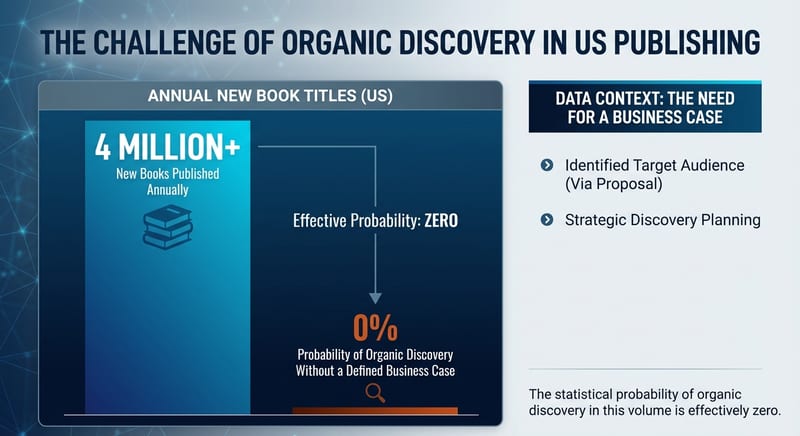
The statistic above, derived from Bowker data, illustrates the sheer noise of the modern marketplace. A 'good book' is not enough; a 'marketable asset' is required. The proposal process filters out passion projects that lack viability, saving the author from the most expensive cost in business: opportunity cost. By validating the market angle first, you ensure that every word written contributes to a sellable product.
The Nuance: Marketability vs. Pandering
Critics often confuse strategic positioning with artistic compromise. They fear that writing to a market means chasing trends. However, the nuance lies in identification versus alteration. You do not change your voice to suit the market; you identify which segment of the market naturally aligns with your voice and verify that segment is large enough to sustain a career.
A strong proposal identifies comparable titles (comps). If you cannot find books like yours that have sold well, you have not found a 'blue ocean'; you have likely found a market void where no demand exists. The technical reality is that readers buy what they recognize. Your job is to be 'the same, but different'—familiar enough to be comfortable, yet unique enough to be necessary.
Engineering Viral Retention: Character Flaws as Marketing Hooks
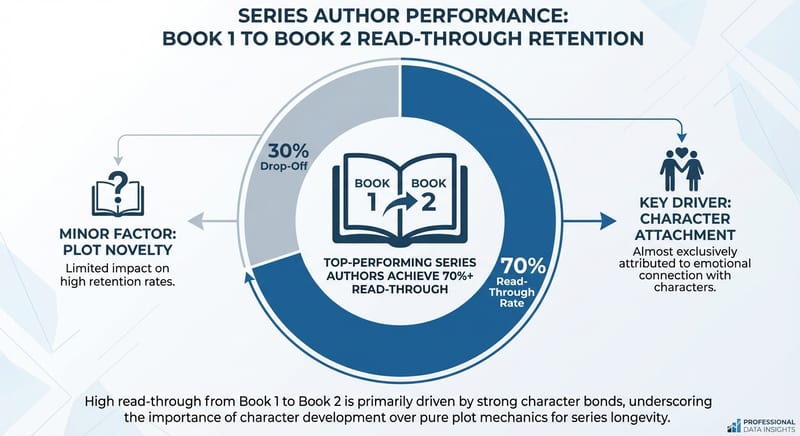
Once the business case is established, the product itself—the story—must be engineered for retention. In marketing terms, 'Customer Lifetime Value' (CLV) is determined by read-through rate. If readers don't finish the book, they don't buy the sequel, and your marketing ROI collapses. The primary driver of this retention is not beautiful prose, but psychological depth. Jerry Jenkins notes that 'story' is what grabs readers, but it is character that keeps them.
Modern readers are sophisticated. They reject 'Mary Sue' characters (perfect, flawless protagonists) because they lack narrative tension. To create a 'sticky' product, you must engineer deep character flaws. As explored in recent analyses of plot mechanics, a character's flaw should be the engine of the plot. A protagonist who acts against their own best interest creates 'active' conflict, which is the most marketable form of storytelling.
The Nuance: The 'Fatal Flaw' as Brand Identity
From a branding perspective, your protagonist's flaw is their USP (Unique Selling Proposition). Sherlock Holmes is defined by his arrogance and lack of social grace, not just his intelligence. Katniss Everdeen is defined by her prickly defensiveness. These flaws make the characters memorable and discussable.
When marketing the book, you pitch the conflict derived from the flaw. You don't pitch 'a detective solves a crime.' You pitch 'an addict who creates chaos must solve a crime to save himself.' The technical execution involves ensuring the flaw is an 'extreme version of a strength'—loyalty becoming obsession, or bravery becoming recklessness. This creates empathy, which drives word-of-mouth marketing.
- Identify the Strength: What is the character best at? (e.g., Analytical thinking).
- Radicalize it: Push that strength until it breaks relationships (e.g., Cold detachment).
- Monetize it: Use this internal conflict as the hook in your blurb and ad copy.
"Give your protagonist a flaw that actually hurts them. If their flaw doesn't cost them something"
The Production Chain: Professional Discipline as a Competitive Advantage
The final pillar of product-first marketing is reliability. In the algorithmic era, consistency is currency. The platforms (Amazon, Instagram, TikTok) reward creators who produce regular, high-quality content. This requires shifting from the mindset of an 'inspired artist' to that of a 'disciplined producer.' Novice writing advice often focuses on overcoming writer's block, but the professional reality is that writer's block is a luxury you cannot afford.
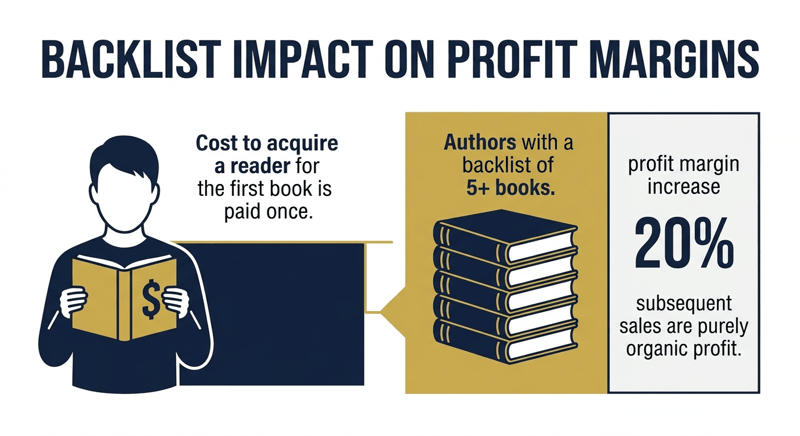
Productivity is a marketing function because inventory is your best asset. The more books you have on the virtual shelf, the more 'hooks' you have in the water. Building a daily writing habit—even just 500 words—compounds over time into a backlist that generates passive income. This allows you to amortize your marketing spend across multiple products, lowering your CPA (Cost Per Acquisition).
The Nuance: Separating Flow from Analysis
To maintain this pace without burning out, one must master the separation of 'Creator' and 'Editor.' Attempting to edit while you write is akin to driving with the parking brake on; it destroys momentum and breeds perfectionism, which is the enemy of shipping product. The best books on writing emphasize this bifurcation: write with your heart (fast), edit with your head (slow).
Technically, this means drafting in a state of 'flow' where critique is suspended. You are generating raw material. The 'Editor' comes in later to refine that material into a marketable product. Mixing these modes results in 'Frankenstein' prose that is neither creative nor polished, and it drastically slows down your time-to-market.
Furthermore, developing a 'thick skin' is essential for the editing phase. Feedback is not a personal attack; it is market data. If five beta readers say the middle drags, the middle drags. Ignoring this data to protect your ego is bad business. You must view your manuscript as a prototype that requires iteration based on user testing.
Ultimately, the most powerful marketing strategy is a product that delivers on its promise. By applying a business framework to your proposals, engineering psychological hooks into your characters, and professionalizing your production schedule, you render the 'hustle' of selling significantly easier. A great book is the only marketing asset that gains value over time.