The Arbitrage of Control: Self-Publishing vs. Traditional Models in the 2026 Economy

A definitive analysis of the publishing landscape in 2026. We dissect the economics of royalty rates, the shift to direct sales, and the 'Plan A' pivot.
The Economic Divergence: Royalty Rates as the Primary KPI
For decades, the allure of the 'advance' obscured the mathematical reality of publishing contracts. In 2026, authors are increasingly viewing their work through the lens of asset management. The stark contrast between a 10-15% royalty on net sales (Traditional) and a 70% royalty on gross sales (Self-Publishing) creates a revenue gap that requires massive volume to bridge. A traditional author must sell roughly 4-6 copies to match the profit a self-published author generates from a single unit.
This is not merely a margin analysis; it is a cash flow necessity. With the cost of paid acquisition (ads) rising, the margin provided by self-publishing allows for aggressive reinvestment. An author earning $0.80 per book cannot afford to spend $1.00 to acquire a customer. An author earning $4.50 per book can spend $2.00 and still scale profitably. This unit economic reality is the foundation of the modern author business.
This multiplier effect is critical when considering the 'Long Tail' of book sales. Most books do not stay on physical store shelves for more than 3-6 months. Once a book is backlisted, the traditional distribution advantage evaporates, but the low royalty rate remains. The independent author, however, retains the high margin in perpetuity, allowing for profitable marketing campaigns years after release.
The Advance Trap: Debt vs. Revenue
A common misconception is that a publishing advance is 'free money.' It is, in technical terms, a non-recourse loan against future royalties. Until this loan is earned out—at the lower royalty rate—the author sees zero additional income. In an era where mid-list advances have stagnated around $5,000-$10,000, the 'security' this provides is illusory.
Furthermore, if a book fails to earn out its advance, the author becomes a liability in the eyes of the publisher, making future deals difficult to secure. The independent model removes this ceiling. There is no 'earning out'; revenue begins with the very first sale, providing immediate liquidity to fund cover design, editing, and launch strategies.
- Traditional Math: $10k advance / $1.50 royalty = 6,666 copies to break even.
- Indie Math: $0 advance / $5.00 royalty = Profit starts at Copy #1.
- Risk Profile: Traditional centralizes risk on the publisher but caps upside; Indie distributes risk but offers unlimited upside.
Agility and the 'Plan A' Pivot
The narrative that self-publishing is a 'backup plan' for rejected manuscripts has collapsed. In 2026, it is the 'Plan A' for authors who prioritize agility. The traditional publishing cycle—spanning 18 to 24 months from contract to shelf—is simply too slow for the current velocity of culture. Trends on platforms like BookTok rise and fall in weeks, not years.
Independent authors can write, produce, and release a book within 3-4 months, capitalizing on 'micro-genres' and viral trends while they are still relevant. As noted by Reedsy's comparative guide, this speed to market is a structural advantage that large institutions cannot replicate due to their logistical overhead.
Income Disparity and the Gender Gap
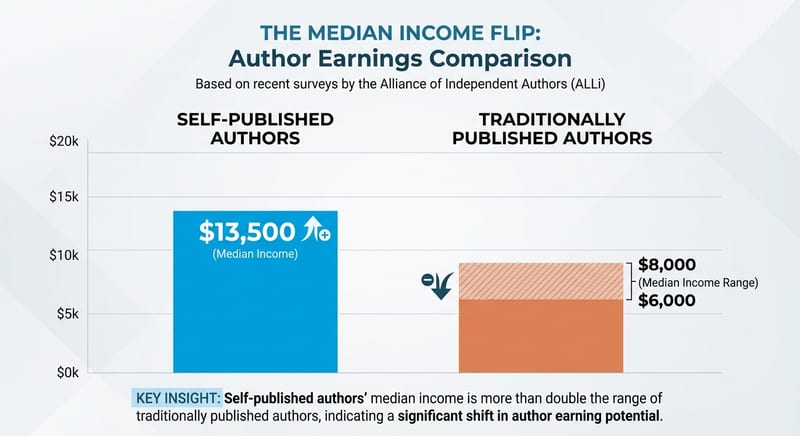
The professionalization of the indie sector has led to a surprising inversion in income statistics. While the 'starving artist' myth persists, data from professional associations reveals that the median income for self-published authors has surpassed that of their traditionally published peers. The gatekeepers, it seems, were also suppressing the wage ceiling.
This trend is particularly pronounced among marginalized groups. Without a subjective board of editors deciding what is 'marketable,' diverse voices have found their audiences directly. The elimination of the middleman has democratized profitability, rewarding those who treat their writing as an entrepreneurial venture rather than a lottery ticket.
"Self-publishing allows authors to retain full control and higher royalties... but requires upfront investment for editing, cover design, and marketing. - Reedsy Guide to Publishing"
Distribution: The Showroom vs. The Algorithm
The primary value proposition of traditional publishing remains physical distribution. Getting a book into Barnes & Noble or an airport kiosk is notoriously difficult for indies. However, one must question the ROI of this placement in 2026. Physical bookstores now function largely as showrooms; readers discover books online via algorithms and social proof, even if they eventually buy a physical copy.
For the independent author, 'distribution' is digital ubiquity. It is about metadata, keywords, and category dominance on Amazon, Kobo, and Apple Books. While traditional publishers excel at logistics (moving paper), they often lag in digital agility (moving data). An indie author can change their book's cover, blurb, or keywords instantly to react to click-through rate data—a pivot that would take a traditional publisher months of committee meetings to approve.
Hybrid Publishing: The Best of Both Worlds?
We are seeing the rise of the 'Hybrid Author'—someone who strategically uses both models. An author might sell the print rights of a breakout hit to a major publisher to secure airport distribution, while retaining the ebook and audiobook rights to maximize profit margin. This negotiation requires leverage, usually built through initial self-publishing success.
However, authors must be wary of 'vanity presses' masquerading as hybrid publishers. True hybrid arrangements are partnerships where the author retains rights and creative control. As Kindlepreneur warns, if you are paying the publisher and they are taking a percentage of royalties, you are likely in a predatory arrangement.
- Print Rights: Negotiate to license only physical formats to publishers.
- Foreign Rights: Sell translation rights by territory while keeping the English language master rights.
- Audio Rights: Never bundle these; the audio market is too valuable to sign away for a standard advance.
The Sovereign Author: Direct-to-Consumer Sales
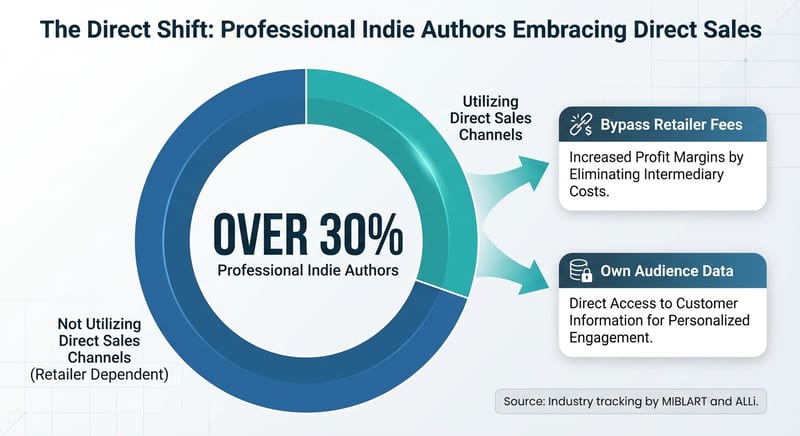
The final, and perhaps most critical, divergence is the ownership of the customer relationship. When a book is sold on Amazon (regardless of publisher), Amazon owns the customer data. The author receives a check, but no email address, no demographic data, and no ability to retarget that reader for the next release.
This has driven a massive migration toward Direct Sales. Authors are building Shopify or WooCommerce stores to sell signed paperbacks, special editions, and digital bundles directly to their fans. This method yields the highest possible royalty (often 90%+) and, more importantly, captures the customer email.
This strategy insulates the author from 'algorithm apocalypses.' If a retailer changes their ranking formula or ad pricing, the author with a direct list remains unaffected. They have built a sovereign ecosystem where they control the pricing, the delivery, and the user experience. It turns book publishing into true e-commerce.