The Immersive Imperative: Advanced Writing Tactics That Retain Readers

A white paper on engineering reader retention through Deep POV, algorithmic pacing, and the elimination of passive voice.
1. The Immersive Imperative: Deep Point of View
The most significant differentiator between amateur and professional fiction is the distance between the reader and the protagonist. Novice writers often rely on 'narrative filtering,' using phrases like 'she saw,' 'he felt,' or 'they wondered.' These filter words create a pane of glass between the reader and the experience. Deep Point of View (Deep POV) shatters this glass.
Deep POV removes the author as the intermediary. Instead of writing 'He felt cold,' you describe the sensation directly: 'The wind bit through his coat, stinging his exposed skin.' This technique forces the reader to inhabit the character's body, processing sensory input in real-time rather than being told about it.
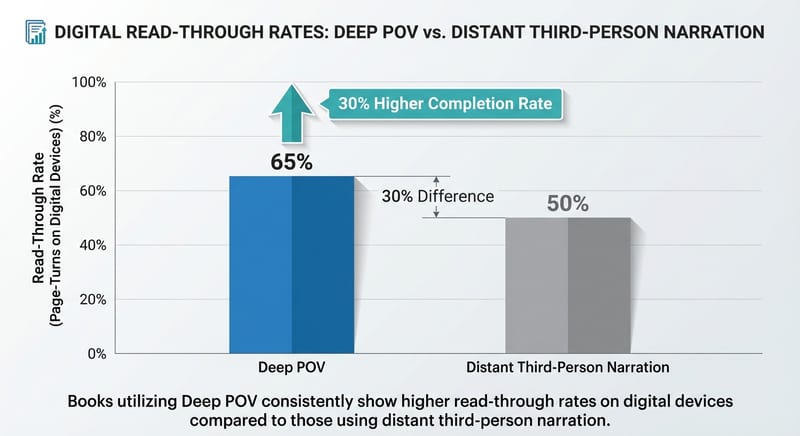
This is not merely a stylistic choice; it is a retention mechanism. When a reader is 'inside' the character, the cognitive load of interpreting the scene decreases, while the emotional impact increases. This frictionless immersion is what compels a reader to finish a book in a single sitting.
Nuance: The Filter Word Audit
The technical execution of Deep POV requires a rigorous audit of your manuscript for 'filter words.' Common offenders include: saw, heard, felt, wondered, realized, knew, and decided. Each of these words reminds the reader they are reading a book.
To fix this, you must rewrite the sentence to show the cause of the perception. 'She heard the door slam' becomes 'The door slammed, vibrating the floorboards.' The information remains the same, but the delivery shifts from reportage to experience.
2. Precision Prose: The 'Show, Don't Tell' Protocol
'Show, Don't Tell' is the oldest adage in writing, yet it is the most frequently misunderstood. It is not about describing every leaf on a tree; it is about providing evidence for your claims. If you tell the reader a character is 'angry,' you are asking them to take your word for it. If you describe the character's 'white-knuckled grip on the steering wheel,' you are providing sensory evidence that allows the reader to conclude the emotion themselves.
This participation is key. When a reader deduces an emotion or a plot point based on the clues you provided, they feel smart. They are engaged in the puzzle of the story. Telling them the answer robs them of this satisfaction and flattens the narrative into a lecture.
"Don't tell me the moon is shining; show me the glint of light on broken glass. - Anton Chekhov"
In non-fiction, this principle applies to authority. Do not tell the reader 'this strategy is effective.' Show them the case study, the data point, or the specific outcome. Abstraction is the enemy of persuasion.
Nuance: The Telling Necessity
A purely 'shown' narrative would be tedious and infinitely long. The technical skill lies in knowing when to break this rule. 'Telling' is efficient for transitions and summary. You do not need to show a character driving for four hours unless something happens on the drive. A simple 'Four hours later, he arrived' suffices.
The rule of thumb: Show the emotion, the climax, and the conflict. Tell the travel, the routine, and the passage of time.
3. The ROI of Verbs: Eliminating Passive Voice
Weak writing is characterized by an over-reliance on state-of-being verbs (is, are, was, were) and adverbs. These constructions dilute the power of the sentence. 'He was running quickly' is weaker than 'He sprinted.' The former relies on a helper verb and a modifier; the latter uses a specific, high-value verb.
We call this the ROI of Verbs. Every word in a sentence occupies cognitive real estate. Strong verbs deliver a high return on that investment by conveying action and manner simultaneously. Passive voice ('The ball was thrown by him') reverses the natural order of actor-action-target, forcing the reader to mentally rearrange the sentence to understand who did what.
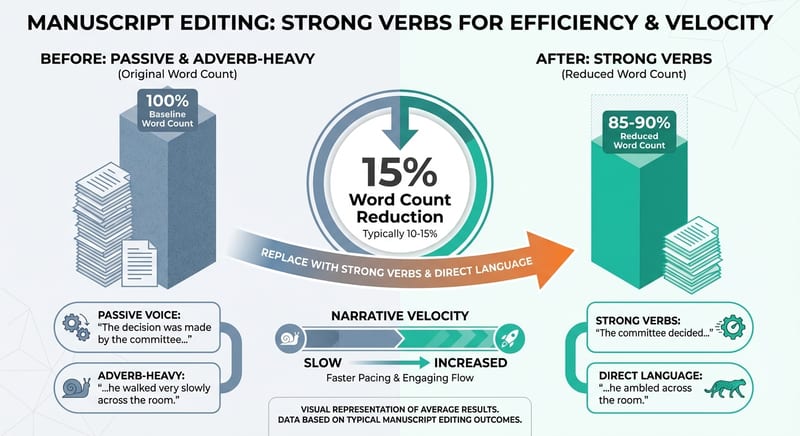
Active voice commands authority. In business writing, saying 'Mistakes were made' sounds evasive. Saying 'We failed to execute' sounds accountable. In fiction, active voice drives the plot forward; passive voice lets the plot happen to the characters.
Nuance: Strategic Passivity
Passive voice is not grammatically incorrect; it is stylistically weak unless the object is more important than the subject. 'The President was shot' is an appropriate use of passive voice because the news is about the victim, not the shooter. Use passive construction only when you specifically intend to hide the actor or emphasize the receiver of the action.
4. Algorithmic Pacing: Engineering Retention
Pacing is often viewed as an intuitive art, but it is actually a structural science. It is the control of the release of information. Fast pacing (thrillers) is achieved through short sentences, paragraph breaks, and withholding information to create questions. Slow pacing (literary) is achieved through complex sentence structures and deep introspection.
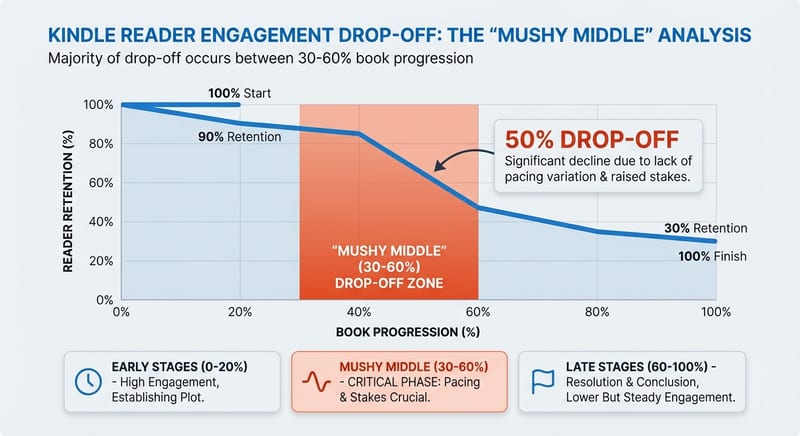
Effective narrative pacing requires a variation of these modes. A book that is 100% fast-paced exhausts the reader; a book that is 100% slow-paced bores them. The goal is a rhythm: tension (fast), release (slow), escalation (fast).
- Micro-Pacing: Removing conjunctions (and, but) to create staccato sentences during action scenes.
- Macro-Pacing: Ending chapters on 'hooks' or unresolved questions to force the page turn.
- Sequel Scenes: Intentionally slowing down after a climax to allow the character (and reader) to process the emotional fallout.
5. Kill Your Darlings: The Market Audit
The final stage of professional writing is the 'Kill Your Darlings' audit. This is the removal of any element—no matter how beautifully written—that does not serve the core narrative arc or the promise made to the reader. That witty dialogue exchange that stalls the plot? Cut it. That beautiful description of the sunset that has no thematic resonance? Delete it.
This requires emotional detachment. You are not just an artist; you are a product manager. Your product is the story, and anything that creates friction for the user (reader) must be eliminated to ensure market fit.
In non-fiction, this often means cutting anecdotes that are entertaining but tangential. If the reader forgets the point of the chapter because the story was too long, the writing has failed.