Viral Engineering: Why Story Architecture is the Ultimate Marketing Strategy

Marketing begins before the cover design. This white paper explores how 'Stakes,' 'Bonds,' and rigorous editing serve as the foundational drivers of word-of-mou
The Retention Economy: Why Read-Through is the New Click-Through
In the digital marketing landscape, we obsess over Cost Per Click (CPC) and Click-Through Rate (CTR). Yet, for the career author, these metrics are vanity compared to Read-Through Rate (RTR). If you pay $5.00 to acquire a reader for Book 1, and they do not immediately purchase Book 2, your business model is mathematically insolvent. The quality of the writing is the marketing funnel.
This shifts the burden of marketing from the ad manager back to the manuscript. As noted in Jerry Jenkins' analysis of industry advice, the 'ferocious' application of self-editing is not merely an artistic endeavor; it is a commercial necessity. A book that fails to hook a reader in the first chapter is a leaky bucket that no amount of ad spend can fill. The 'marketability' of a book is determined by its ability to force the reader to turn the page.
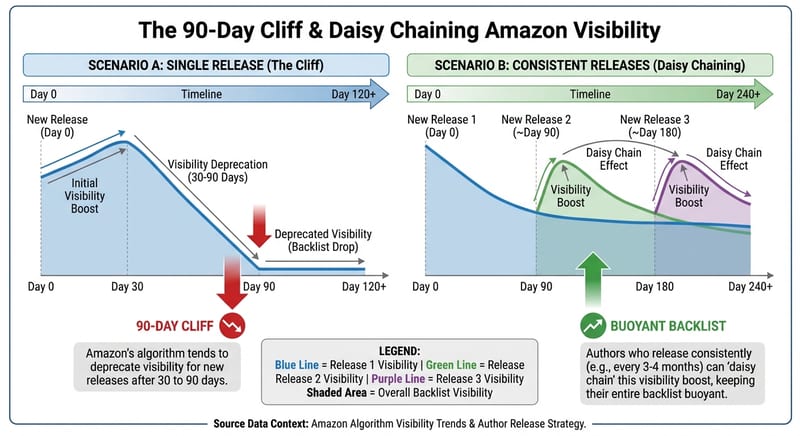
When we analyze this data point, the implication is stark: the most profitable marketing hour an author can spend is not on TikTok, but on tightening the plot of their current manuscript. The 'Long Tail' revenue model relies entirely on the product's inherent quality to facilitate organic customer lifetime value (LTV) expansion.
To achieve this, one must adopt the mindset of a 'User Experience' (UX) designer. The reader's journey through the text must be frictionless. Ambiguous stakes, slow pacing, or inconsistent character motivations are 'churn points' where readers drop off—and unlike a software subscription, once a reader churns from a book series, they rarely return.
UX Design in Fiction: The 'ferocious' Edit
The concept of 'ferocious self-editing' is often misunderstood as proofreading. It is not. It is structural engineering. It requires the author to ruthlessly cut scenes that do not advance the plot or reveal character, regardless of how beautifully written they are. This aligns with the advice to 'dream big but execute small'—focusing on the granular impact of every sentence.
By treating the manuscript as a product that requires optimization, authors can reduce the 'Time to Value' for the reader. The hook must be immediate. The inciting incident cannot wait for Chapter 4. In a world of infinite content alternatives, patience is a non-existent commodity.
Engineering Stakes: The Mechanism of emotional Investment
A common failure mode in book marketing is promoting a story where the audience simply doesn't care. The blurb screams 'The World is Ending!', but the reader scrolls past. Why? Because global catastrophe is a statistic; personal loss is a tragedy. To market a book effectively, the story must be built on 'Bonds,' not just threats.
Recent literary theory, highlighted by Katjo Lewis, adapts mechanics from tabletop gaming (like D&D) to explain this. 'Stakes' are not raised by increasing the size of the explosion, but by threatening the specific connections (Bonds) the protagonist has with people, places, or objects. This emotional specificity is what drives reviews and recommendations.
The 'Bond' Theory in Application
When an author establishes a clear Bond—say, a protagonist's promise to protect a younger sibling—the marketing copy writes itself. The hook becomes emotional: 'How far would you go to keep a promise?' This is infinitely more compelling than 'A hero fights a dragon.' The Bond creates the context for the conflict.
This approach also solves the 'mushy middle' problem that plagues so many books and kills read-through. By constantly threatening these Bonds, the author maintains tension. If the reader is worried about the safety of a beloved character, they will buy the next book to ensure that safety. This is monetization of empathy.
- Define the Bond: Explicitly state what the character loves (Person, Place, Ideal).
- Threaten the Bond: The antagonist's goal must directly endanger this specific love.
- Force the Choice: The climax must force the hero to choose between the Bond and their own safety.
Discipline as a Commercial Strategy
The romanticized image of the writer waiting for inspiration is a commercially fatal myth. In the volume-based business model of modern publishing, consistency is the primary driver of algorithmic favor. Algorithms on Amazon and Audible reward 'freshness' and 'frequency.' Therefore, a daily writing habit is not just a craft tip; it is a supply chain requirement.
Jerry Jenkins advises establishing a consistent daily routine. This predictability allows authors to plan release schedules years in advance, which is essential for coordinating marketing launches. If you cannot predict your output, you cannot book promo slots, coordinate with cover designers, or warm up your email list effectively.
"Amateurs sit and wait for inspiration, the rest of us just get up and go to work. - Stephen King, On Writing"
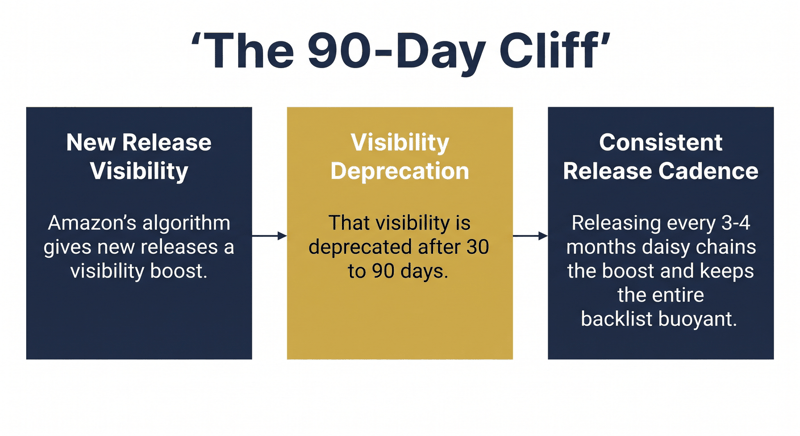
This data point underscores the necessity of discipline. A 'one-hit wonder' is mathematically impossible in the current ecosystem because the signal decay is too rapid. The only way to maintain a career is to constantly feed the machine with high-quality, 'Bond-driven' content.
The Psychology of 'Small Steps'
The psychological barrier to writing a 100,000-word novel is immense. Jenkins suggests dreaming big but executing small—focusing on the daily word count rather than the finished manuscript. This prevents 'paralysis by analysis,' a condition that kills more writing careers than bad reviews ever could.
From a marketing perspective, these 'small steps' can be content. Sharing your daily word count progress, your struggles with a specific chapter, or your research rabbit holes creates a 'Build in Public' narrative that engages readers before the book is even finished. It turns the solitary act of writing into a communal event.
Continuous Education: The R&D Department
No other industry assumes that one can achieve professional mastery without ongoing education. Yet, many writers believe that reading books on writing is unnecessary. This is a fallacy. The most successful authors treat their craft study as Research and Development (R&D). Reading masterworks like Stephen King’s On Writing or Anne Lamott’s Bird by Bird is not optional reading; it is competitive analysis.
Understanding the mechanics of story—how Stephen King constructs suspense, or how Lamott approaches the psychological honesty of a draft—gives the author a toolkit to diagnose why a scene isn't working. Without this vocabulary, an author is fumbling in the dark, wasting months on drafts that will require total rewrites.
This statistic validates the investment in education. The market is not saturated with great books; it is saturated with unfinished or unpolished drafts. By committing to being a student of the trade, you automatically place yourself in the top percentile of the market.