How Much Does Book Editing Cost? Real 2026 Rates for Indie Authors

Real 2026 numbers for hiring a book editor: EFA and Reedsy rate data, costs for an 80,000-word novel, why rates vary, and how to cut the bill without cutting qu
What does book editing cost per word in 2026?
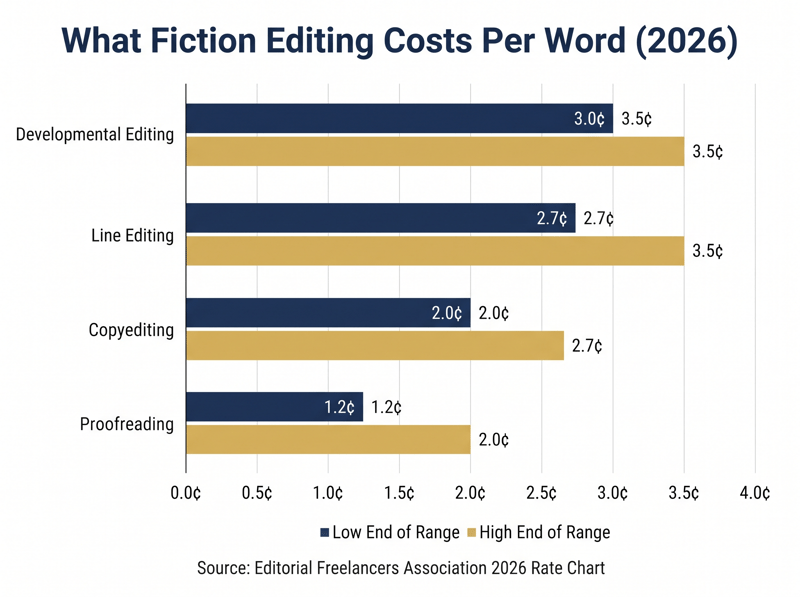
The most reliable public benchmark is the Editorial Freelancers Association 2026 Rate Chart. It is built from a survey of more than 1,100 EFA members, conducted from November 2025 through mid-January 2026, covering the rates those professionals actually charged during 2025. These are median ranges, not price tags; individual editors set their own rates based on experience, specialty, and turnaround time.
- Developmental editing (fiction): 3.0 to 3.5 cents per word||Line editing (fiction): 2.7 to 3.5 cents per word||Copyediting (fiction): 2.0 to 2.7 cents per word||Proofreading (fiction): 1.2 to 2.0 cents per word
Nonfiction consistently costs more. The same EFA chart lists nonfiction copyediting at 3.0 to 4.0 cents per word and nonfiction developmental editing at 4.0 to 5.0 cents, roughly a cent more per word than fiction at every stage. Memoirs sit in between, with developmental editing at 3.5 to 4.5 cents. If you prefer hourly math, EFA fiction copyeditors report $40 to $50 per hour and fiction developmental editors $52.50 to $70 per hour.
One structural note before you compare quotes: editors price in three ways. Per-word rates are the most predictable for authors, which is why this article leads with them. Hourly rates are common for messy manuscripts where the workload is hard to predict, and flat project fees dominate for short formats like picture books and for services like manuscript assessments. The EFA chart also lists per-page rates, where one page is standardized at 250 words. Always convert a quote back to your actual word count before comparing editors, because a low hourly rate on a slow edit can cost more than a high per-word rate on a fast one.
What are the four types of book editing?
Editing is not one service. It is four distinct passes, and each answers a different question about your book. Developmental editing tackles the big picture: story structure, plot logic, character arcs, and pacing. It is the most expensive stage because the editor is essentially re-engineering the book with you, and it always comes first. The EFA publishes plain-language definitions of each editorial service if you want the full breakdown.
Line editing works at the sentence and paragraph level: rhythm, word choice, clarity, and voice. Copyediting is more mechanical: grammar, punctuation, consistency of names, timelines, and style. Many authors conflate the two, and many editors offer a blended line and copy pass. They are priced differently for a reason, so ask any editor exactly what their quote includes.
Proofreading is the final safety net, done on the formatted book, hunting typos and layout glitches. It is also the cheapest pass. One editor on the Reedsy marketplace notes that authors often request both copyediting and proofreading because they assume the words are synonyms. They are not, and you should not pay for two stages when your manuscript only needs one.
How much does it cost to edit an 80,000-word novel?
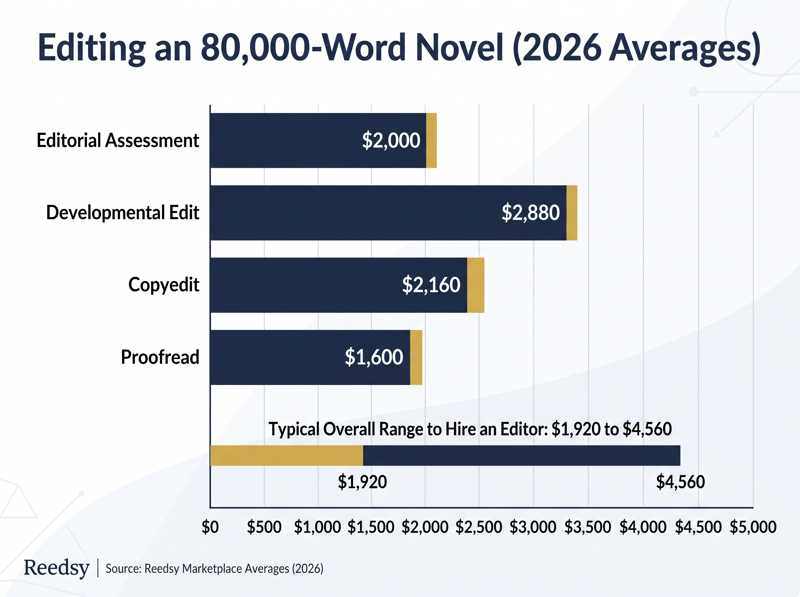
Reedsy, the largest freelance marketplace for publishing professionals, analyzed thousands of real editor quotes and published the results in its 2026 editing cost guide. The headline number: hiring an editor for an 80,000-word book costs between $1,920 and $4,560 in 2026. Broken down by service, the averages look like this:
- Editorial assessment: about $2,000 (at $0.018 to $0.029 per word)||Developmental edit: about $2,880 (at $0.026 to $0.053 per word)||Copyedit: about $2,160 (at $0.020 to $0.032 per word)||Proofread: about $1,600 (at $0.014 to $0.021 per word)
You almost certainly do not need every stage. A typical indie novel budget covers copyediting plus proofreading, which computes to $2,560 to $3,760 at EFA fiction rates. Stack all four stages at those same per-word ranges and an 80,000-word novel lands between roughly $7,120 and $9,360. That is why deciding which stages your book actually needs is the single biggest budgeting decision you will make.
What about shorter and longer books?
Everything scales with word count, so run your own numbers before you panic at the 80,000-word examples. Multiply your manuscript's word count by the per-word ranges above. At EFA 2026 fiction rates, here is what copyediting plus proofreading computes to at three common lengths:
- Novella (30,000 words): copyedit $600 to $810, proofread $360 to $600, combined roughly $960 to $1,410||Standard novel (80,000 words): copyedit $1,600 to $2,160, proofread $960 to $1,600, combined roughly $2,560 to $3,760||Epic fantasy (120,000 words): copyedit $2,400 to $3,240, proofread $1,440 to $2,400, combined roughly $3,840 to $5,640
Writing long is expensive. Every thousand words you cut in revision saves $20 to $27 on the copyedit alone at fiction rates, and more once proofreading and any developmental work are stacked on top. Trimming a bloated 100,000-word draft to a tight 85,000 is not just better storytelling; it is a few hundred dollars back in your pocket.
Why do editing rates vary so much?
Genre moves the needle first. Reedsy's data shows nonfiction costs more to edit than fiction because it is denser and more specialized, while romance, thrillers, and horror typically cost less. Worldbuilding-heavy genres like fantasy and science fiction, full of invented terms an editor must track, sit at the pricier end of fiction. Children's picture books flip the logic entirely: word counts are tiny, so editors usually charge a flat fee, commonly $300 to $500.
- Editor experience and track record: decades of in-house publishing experience commands premium rates||Manuscript cleanliness: editors quote higher when a sample edit reveals heavy correction work||Turnaround time: rush jobs attract rush fees, flexibility earns discounts||Genre complexity: technical subjects, dense worldbuilding, and specialized nonfiction cost more per word
Experience is the factor authors most often underestimate. Editors interviewed by Reedsy consistently describe quoting from a timed sample edit: they edit roughly a thousand words of your manuscript, measure how long it takes, and extrapolate. A polished manuscript literally costs less to edit than a rough one, which puts real money behind the advice to self-edit before you hire anyone.
How do you find and vet a book editor?
Knowing the fair price only helps if you can find professionals worth paying it. Three places consistently surface vetted editors: the EFA member directory, where you can filter by specialty and genre; the Reedsy marketplace, which screens applicants for verifiable publishing experience before listing them; and referrals from other indie authors in your genre, which is where author communities earn their keep. Genre fit matters as much as credentials. A brilliant thriller editor can be the wrong choice for a slow-burn romance, because pacing expectations differ by genre.
- Request a paid or free sample edit of about 1,000 words and compare how each editor handles your actual prose||Ask what the deliverables are: an editorial letter, in-line comments, a style sheet, or all three||Confirm genre track record with specific titles they have edited, not vague claims||Get a written agreement covering scope, deadline, number of passes, and payment schedule||Ask how they handle disagreements: good editors explain their reasoning and leave final calls to you
The sample edit is the single most useful filter. It reveals whether an editor sharpens your voice or flattens it into their own, and it lets the editor quote accurately instead of guessing. Any professional who refuses to show you what their work looks like on your pages is asking you to buy blind.
What do you actually get for each editing dollar?
Price only makes sense next to deliverables. A developmental edit should produce a detailed editorial letter diagnosing structure, character, and pacing, plus margin comments tied to specific scenes. A line or copy edit arrives as tracked changes in your manuscript file together with a style sheet, the document recording every spelling, hyphenation, and continuity decision so your future books stay consistent. A proofread returns final corrections marked on the formatted pages. If a quote does not spell out which of these you will receive, ask before you sign anything.
- Developmental edit: editorial letter plus scene-level margin comments||Line or copy edit: tracked changes and a style sheet you keep for the whole series||Proofread: final corrections on the formatted book, print and ebook||Any stage: a defined number of passes and a named point of contact
Budget calendar time along with money. Editors interviewed by Reedsy describe booking one to two months ahead, and a full-length edit is measured in weeks, not days. If you are working backward from a launch date, reserve your editor before the manuscript is finished and agree on the delivery window in writing. Compressing the schedule at the last minute is exactly what triggers rush fees.
How can you lower editing costs without wrecking quality?
The goal is not to skip editing. It is to make sure every dollar buys judgment you cannot get for free. Cheaper feedback layers exist below professional editing, and using them in the right order shrinks the expensive layers. Our guide to working with beta readers covers the first and cheapest layer in detail.
- Self-edit ruthlessly first. Cutting superfluous scenes directly cuts the per-word bill, and a cleaner manuscript earns lower quotes.||Run beta readers before any paid edit. EFA members price beta reading at 0.5 to 0.8 cents per word, with a median project fee of $150.||Buy a manuscript assessment before committing to a developmental edit. EFA median: $600. It tells you whether the $2,880 edit is even necessary.||Request sample edits from two or three editors and compare what each quote actually includes.||Only pay for the stage your book needs. Copyediting and proofreading are different services.||Ask about installment plans. Reedsy notes many editors will split payments or discount multi-book collaborations.||Stay flexible on schedule. Rush fees are real, and editors often book one to two months out.
"I have sometimes advised first-time authors to consider doing more self-editing before they turn a sloppy manuscript over to an editor... it will save them money as well as aggravation and result in a book that is more truly their own." Doreen M., editor on the Reedsy marketplace"

Vanity presses are the most common trap. They routinely bundle vaguely defined editing into publishing packages priced far above the market rates in this article, and the editing quality is rarely verifiable. Before signing with any paid publishing service, check the watchdog ratings maintained by the Alliance of Independent Authors, which grades services on transparency and author-friendliness.
Frequently asked questions
Is professional editing worth it for a self-published book? For most books headed to paying readers, yes, at least a copyedit and proofread. Reviews punish typo-ridden books quickly, and refunds and poor ratings cost more than the edit would have. The honest caveat: no edit fixes a story readers do not want, which is why cheap structural feedback should come before expensive polish.
What is the cheapest type of professional editing? Proofreading, at 1.2 to 2.0 cents per word for fiction on the EFA 2026 chart, or about $1,600 for 80,000 words on Reedsy averages. Below that sits beta reading (median $150 per project) and manuscript assessment (median $600), which are feedback services rather than corrections.
Can AI tools replace a human editor? Grammar and spelling checkers are genuinely useful for the self-editing pass, and cleaning your manuscript with them can lower your quotes. They do not replace developmental judgment: an algorithm cannot tell you a subplot is dead weight or that your midpoint arrives too late. Use them to reduce what you pay a human, not to skip the human.
How much should a first-time novelist budget for editing? Plan on $2,560 to $3,760 for copyediting plus proofreading of an 80,000-word manuscript at EFA fiction rates. Add roughly $600 for a manuscript assessment if beta readers flag structural problems, and scale up to a full developmental edit only if the assessment says the story needs it.
Do editors charge per word, per hour, or per project? All three exist in the EFA data. Per-word pricing is the easiest to budget because you know your word count upfront. Hourly pricing shifts the risk to you: a rough manuscript takes more hours. Flat project fees are standard for picture books, manuscript assessments, and beta reads. Whatever the structure, convert it to an effective per-word figure for your book so quotes are comparable.
When is it safe to skip developmental editing? When multiple independent readers report the story works: no sagging middle, no confusing motivations, no broken promises to the reader. Experienced authors with several published books in the same genre often replace developmental editing with strong beta feedback and a manuscript assessment. Skipping the copyedit or proofread is a different story; typo complaints in reader reviews are common, avoidable, and the cheapest problem to fix.
Where Read & Rate fits in your editing budget
The cheapest layer of the feedback ladder is real readers, and that is exactly what Read & Rate provides. Community reviewers read your book and leave honest reviews, plus a private comment visible only to you, the kind of candid reaction beta readers charge for elsewhere. Our book biometrics tools show you how readers actually move through your book, which is concrete evidence for deciding whether you need a $600 assessment or a $2,880 developmental edit.
You also get a community hub of fellow indie authors who have already hired editors in your genre and will tell you what they paid and who delivered. Start collecting real reader feedback before you spend a single editing dollar.