Beta Readers for Self-Published Authors (2026 Guide)

A practical guide to finding, briefing, and using beta readers as a self-published author. Where to recruit them, what to ask, and how to filter feedback.
What a beta reader actually does (and does not do)
A beta reader reads a near-finished manuscript and tells you what worked, what stalled, and where they got confused. They are not editors, not professional critics, and not your future audience after the book ships. They are a private test panel that catches the issues you stopped seeing 40,000 words ago.
The bar is reader experience, not line-level polish. A good beta reader can tell you that chapter 7 dragged or that the antagonist felt thin. They cannot reliably tell you whether your dialogue tags need rewriting or whether your prose runs purple. That is what professional editors do. According to Publishers Weekly's 2025 industry report, self-published titles now make up roughly 3.5 million of the 4.2 million books published annually in the US. That much volume means readers face an enormous slush pile, and a single weak chapter can cost you the rest of the read.
That ratio is why beta readers matter more in 2026 than they did five years ago. Discoverability is harder, attention spans are shorter, and the first three chapters carry almost the entire weight of converting a curious browser into a paying reader. Beta feedback on those chapters, before launch, is the cheapest insurance an indie author can buy.
Beta readers vs ARC readers vs editors: the timeline
Authors confuse these three roles all the time, and the confusion produces the wrong feedback at the wrong stage. Here is how the timeline actually works for a well-run indie launch:
- Self-edit and developmental editor: Round one. You polish the draft yourself, then a structural or developmental editor tells you whether the book works at the macro level (plot, pacing, character arcs).
- Beta readers: Round two. After your structural revisions, 3 to 5 readers in your target genre read the book as readers, not as editors. They flag confusion, drop-off points, and weak chapters.
- Line and copy editor: Round three. Sentence-level cleanup, grammar, consistency, fact checks.
- Proofreader: Round four. Final typo and formatting pass before publication.
- ARC readers: After your final manuscript is locked. They read the polished book and post public reviews on launch day or just before. Their job is reviews, not feedback.
Skip beta readers and you pay an editor to point out things 5 unpaid readers could have flagged for free. Skip an editor and your beta readers waste their time on prose-level issues instead of story-level ones. Both roles are necessary; neither replaces the other.
How many beta readers do you actually need
The honest answer is between 3 and 5 active readers. Below 3, you cannot tell whether feedback is one reader's opinion or a real pattern. Above 7, you drown in contradictory notes that take longer to sort than to write the next book. Reedsy's beta reader guide and most writing-craft sources converge on 3 to 5 as the working range, with one or two extras to cover for readers who ghost.
One operational rule: recruit 6 to 8 beta readers expecting 2 or 3 to never finish. Beta reader dropout rates are real. The readers who do finish are usually the ones whose feedback you should trust most, because they cared enough to keep going.
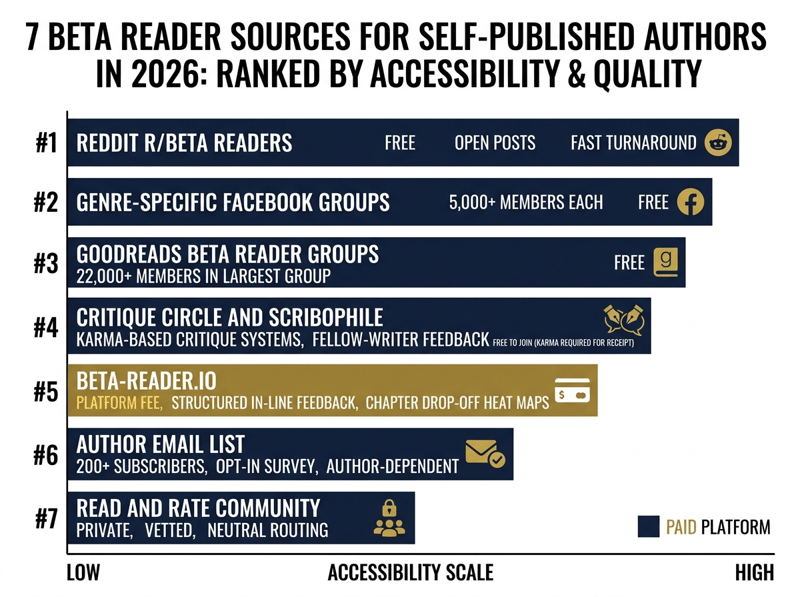
7 places to find beta readers in 2026
Stop posting on your personal Facebook asking friends to read it. Friends and family give comfort feedback, not honest feedback. Here are the 7 places where indie authors are actually finding qualified beta readers right now.
1. The Read & Rate community
Best for: Authors who want a closed, vetted community of readers and authors who already understand the indie process. Read & Rate runs a private community hub where members exchange beta feedback through neutral routing; readers see the manuscript, the author sees the feedback, but the two are not directly tied. That structure removes the social-pressure feedback that wrecks a typical friend-and-family beta round. The community also covers reviews, file watermarking, and review-platform routing, so the same readers who beta a draft can become legitimate reviewers post-launch.
2. BetaReader.io
Best for: Authors who want structured, in-line beta feedback with progress tracking. BetaReader.io is a dedicated platform that lets readers comment inside the manuscript, run polls and surveys, and shows you exactly where readers stop reading. The drop-off heat map alone is worth the platform fee for any author who needs to know which chapter loses the audience. The catch: you usually need to bring most of your readers because the platform marketplace is small.
3. Goodreads beta reader groups
Best for: Authors who write in well-defined genres and want free beta readers who already read in those genres. The largest Goodreads beta reader group has more than 22,000 members, plus smaller groups for romance, fantasy, sci-fi, thriller, and YA. The signal is mixed; you will need to vet readers carefully and expect a higher dropout rate. Quality varies. Treat the first round as a screening pass.
4. Reddit r/BetaReaders and r/selfpublish
Best for: Authors with a tight elevator pitch who can write a compelling 200-word recruitment post. r/BetaReaders matches authors with readers in a specific format (genre, length, content notes, deadline). r/selfpublish has a higher proportion of fellow authors who can read other indie work. Reddit is fast, free, and the moderation enforces honest practices. The trade-off is that responses skew toward authors-as-readers, which is useful at the structural stage but less useful as a stand-in for genuine target readers.
5. Genre-specific Facebook groups
Best for: Romance, fantasy, and thriller authors. Genre-specific Facebook groups remain where active genre readers congregate, particularly in romance subgenres (paranormal, dark, contemporary, regency). Look for groups with at least 5,000 members, active daily posting, and rules that distinguish beta readers from ARC readers. Search 'beta readers [genre]' inside Facebook search; expect to find 5 to 10 active groups in any major genre.
6. Critique Circle and Scribophile
Best for: Earlier-stage drafts that need fellow-writer perspective on craft. Scribophile and Critique Circle are critique communities, not beta reader communities. Members trade detailed chapter-level feedback inside a karma system. The feedback is more craft-heavy than genuine reader feedback, so use these platforms for the structural pass before your beta round, not as a substitute. Critiques tell you whether a chapter is well-written; betas tell you whether a chapter held the reader.
7. Your existing email list
Best for: Authors with at least one published book and a reader email list of 200 or more. Your most engaged subscribers are your highest-quality betas because they already know your voice and your genre. Send a short opt-in survey asking who would be willing to beta-read your next book in exchange for early access. The response rate from a small, engaged list is usually higher than the response rate from a large, cold one.
How to brief a beta reader so the feedback is usable
The single biggest waste in beta reading is bad briefs. A reader without a brief gives you generic feedback ('I liked it', 'the ending felt rushed') that you cannot act on. A reader with a focused brief gives you specific feedback you can actually use to revise. Write the brief first; recruit the readers second.
- Genre and comp titles: 'This is upmarket women’s fiction in the vein of Liane Moriarty and Taylor Jenkins Reid.' Comp titles set reader expectations from page one.
- Word count and timeline: 'The manuscript is 92,000 words. Please return feedback within 4 weeks.' Be specific about the deadline.
- What you want feedback on: Pacing, character motivation, plot believability, dialogue authenticity, ending satisfaction. Pick 4 to 6 focus areas.
- What you do not want feedback on: Typos, grammar, line edits. Tell readers explicitly that copy editing comes later.
- Content notes: Trigger warnings, content warnings, anything a reader needs to know before starting.
8 questions every beta reader brief should answer
- At what chapter did the story really start for you?
- Which chapter (if any) did you nearly put the book down on?
- Was there a character whose motivation did not make sense?
- Were any plot turns predictable in a bad way?
- Was the ending earned, rushed, or unclear?
- What did you think the book was about after the first 20 pages?
- Who would you recommend this book to (a specific kind of reader)?
- If you could change one thing about the story, what would it be?
How to filter contradictory beta reader feedback
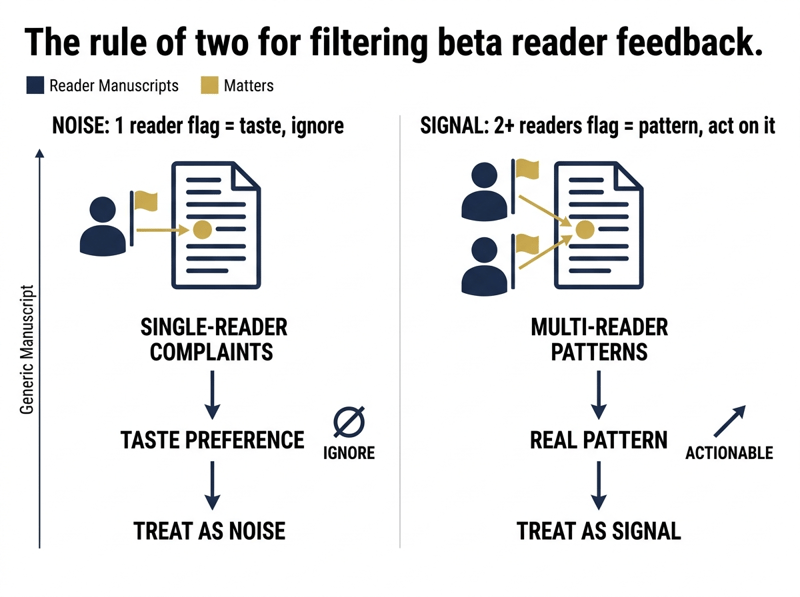
You will receive contradictory feedback. One reader says the ending is rushed; another says it is perfect. The rule is the rule of two: act on feedback only when at least 2 of your readers report the same issue. Single-reader complaints are taste; multi-reader patterns are signals.
That stat from the Written Word Media 2025 indie author survey matters because it explains why beta readers are undervalued. Authors are exhausted by the time they finish a draft and skip the beta stage to chase ads, social, and launch logistics. Resist that pull. The strongest marketing is a tight book; betas are how you tighten it.
Red flags and predatory beta reading services
The beta-reading space attracts scams. Watch for these red flags before you pay anyone or sign anything:
Specific red flags to avoid
- Promises a 5-star review: Beta readers do not write reviews. If a service mixes beta feedback with paid Amazon reviews, that violates Amazon’s terms of service and risks your KDP account.
- No NDA option: Reputable beta platforms let you send the manuscript with a basic non-disclosure agreement. If a service refuses, walk away.
- No contact with the actual reader: If you cannot communicate at all with the reader and only deal with a 'manager', the feedback quality is usually templated.
- One-day turnaround on novels: Real beta reading takes 2 to 4 weeks for a full novel. Speed is a red flag, not a benefit.
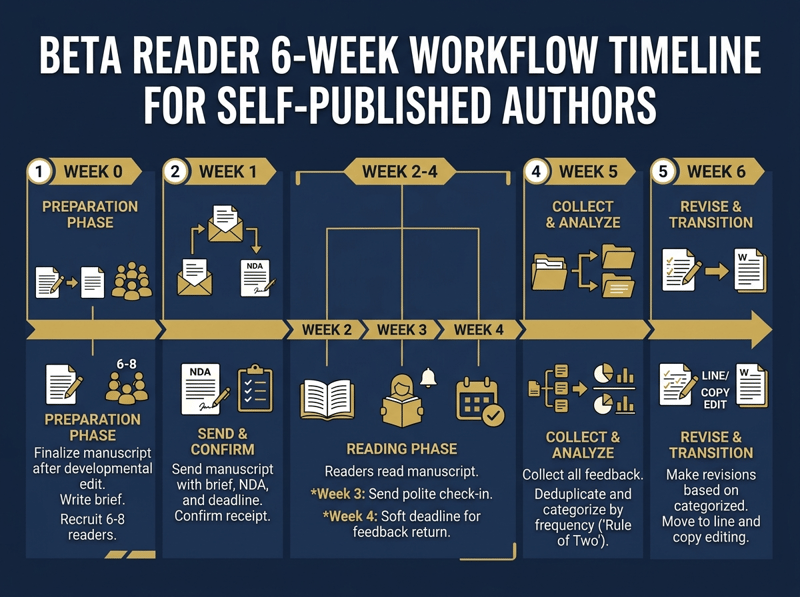
Beta reader timeline: a 6-week template
- Week 0: Finalize the manuscript after the developmental edit. Write the brief. Recruit 6 to 8 readers.
- Week 1: Send manuscript with brief, NDA, and deadline. Confirm receipt with each reader.
- Week 2 to 4: Readers read. Send one polite check-in around week 3 if you have not heard anything.
- Week 4: Soft deadline. Most readers return feedback within this window.
- Week 5: Collect, deduplicate, and categorize feedback by frequency (rule of two).
- Week 6: Revise. Then move to line and copy editing.
From beta readers to ARC reviewers: do not mix the roles
Some authors try to convert their beta readers directly into ARC reviewers to save time. This is a mistake. Beta readers read a draft. ARC readers read the polished book. The reading experiences are different, and asking the same person to do both leaves you with reviews that are colored by the rough version they saw months earlier. Treat them as two separate cohorts.
That said, your beta readers are your highest-affinity audience. After launch, you can ask them to leave a review on the published version, ideally after they re-read the relevant changed sections. Many will be flattered and willing. The line you do not cross is shipping a beta-tier draft and asking for a 5-star review on it.
How Read & Rate connects the full review pipeline
Read & Rate is built around the full review pipeline that indie authors actually run: beta feedback, ARC distribution, watermarked file delivery, multi-platform review collection, and a community hub where authors share strategy. PDF files are watermarked automatically when reviewers download them, so authors keep control of their manuscripts. Reviewers can route reviews not only to Amazon but to Goodreads, Kobo, BookBub, and other platforms; that breadth is rare in the indie tools market. The community side replaces the patchwork of Facebook groups, Reddit threads, and Discord servers most authors stitch together themselves.
"Beta readers do not save bad books, but they save good books from being rough. The cost of skipping that round is paid by your launch reviews."
Frequently asked questions about beta readers
Next steps for your manuscript
If your manuscript is structurally edited and waiting on its first real reader test, recruit 6 to 8 betas this week, send them a focused brief, and protect your file with a watermarked PDF. Read & Rate handles all three steps inside one platform: a closed reader community, automatic PDF watermarking, and routing for the reviews that follow your launch. Start a free trial and ship a tighter book.