ARC Book Reviews: The Complete Guide for Self-Published Authors (2026)

An advance reader copy program is one of the highest-ROI activities a self-published author can run before launch day. Here is exactly how to set one up and get
Most self-published authors know they need reviews to sell books. What fewer realize is that the timing of those reviews matters just as much as the count. Amazon's algorithm rewards early traction. A book that lands on the platform with 20 reviews on day one gets far more algorithmic visibility than one that slowly accumulates the same count over several months. An ARC program is how you engineer that early traction before launch day arrives.
An advance reader copy, also called an ARC or advance review copy, is a pre-release version of your book distributed to readers in exchange for an honest review. Traditional publishers have used ARCs for decades to build buzz among booksellers, librarians, and literary media before a title hits shelves.
Self-published authors now use the same strategy, adapted for digital distribution. Instead of physical galleys, you distribute a PDF or ebook file to a curated list of readers who agree to read the book and leave a review once it goes live on Amazon, Goodreads, or other platforms.
The key word in that exchange is honest. ARC programs do not guarantee positive reviews. They guarantee exposure to real readers who are incentivized to engage with your book and share their genuine reaction. That distinction matters both ethically and practically: Amazon actively removes reviews that appear coordinated or inauthentic.
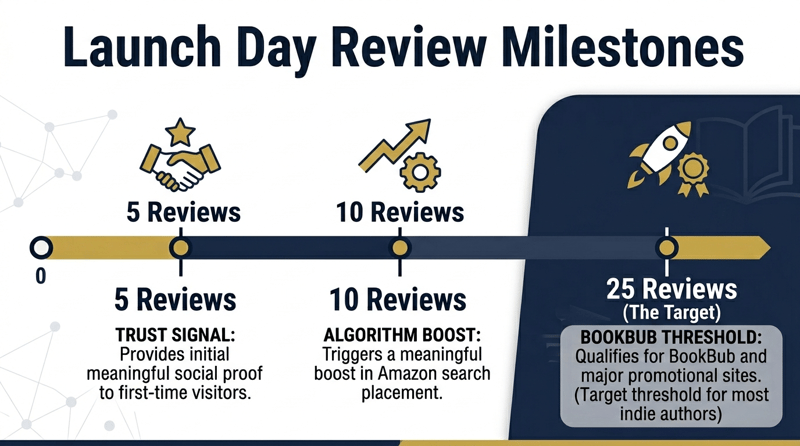
Amazon's algorithm monitors a book's first days and weeks extremely closely. It tracks page views, purchases, Kindle Unlimited page reads, and review velocity. A book that earns 10 or more reviews within its first week signals strong reader engagement, which prompts the algorithm to surface it in more search results and category pages.
Reviews also directly affect conversion rate. A visitor landing on your book page with 25 reviews is far more likely to click Buy than the same visitor landing on a page with zero. Since Amazon rewards pages that convert, the compounding effect of early reviews is significant.
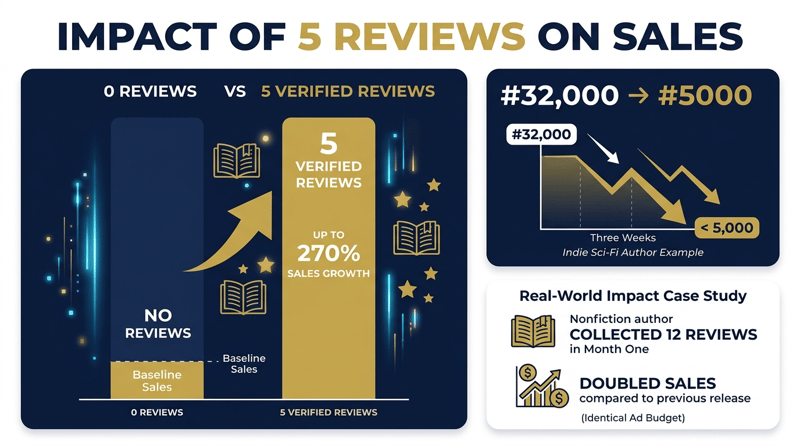
According to data from WriteStats, books with just 5 reviews see sales growth of up to 270 percent compared to books with no reviews at all. Every review earned at launch multiplies the impact of every other marketing effort you make.
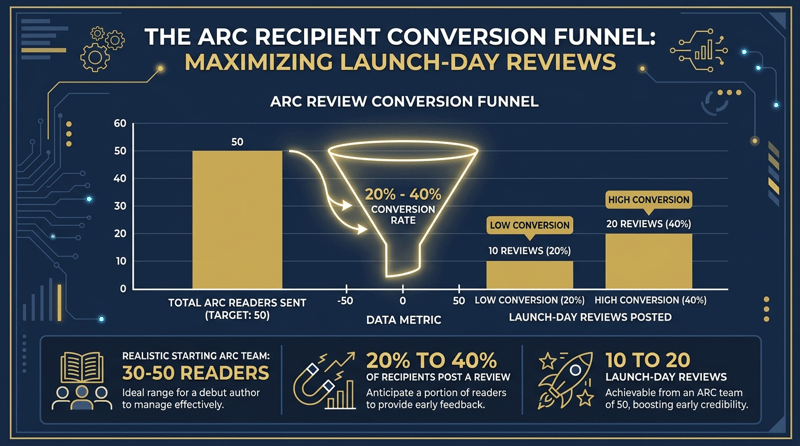
You do not need a large audience to run an effective ARC campaign. You need the right audience. A targeted list of 50 to 100 readers who genuinely read your genre will consistently outperform a scattered approach to 500 random contacts. Quality of engagement matters more than raw numbers.
There are three primary sources for ARC readers: your existing email list, social media communities (Facebook groups, Reddit forums, Goodreads groups specific to your genre), and dedicated ARC platforms that connect authors with pre-vetted reviewers.
For a first book, aim for a starting team of 20 to 50 ARC readers. As your audience and review history grow, you can scale the team up. Many authors with established readerships run ARC teams of 100 to 200 readers for each new release.
- Five steps to build your ARC reader team:\nAsk your email list first: if you have any subscribers, they are already interested in your work. A simple personal email asking for ARC readers will convert at a surprisingly high rate.\nPost in genre-specific communities: Facebook groups for readers in your niche, Goodreads groups, and Reddit communities (r/fantasywriters, r/romancebooks) are all valid channels for recruiting engaged readers.\nJoin a dedicated ARC platform: services like BookFunnel, BookSprout, BookSirens, and Read and Rate have built-in communities of reviewers actively looking for new books to read.\nVet your readers before adding them: check their review history on Goodreads or Amazon. Reviewers with a track record of actually posting reviews are worth ten times more than readers who sign up but never follow through.\nSet clear expectations upfront: tell readers the publication date, the format (PDF or ebook), which platforms you want reviews on, and that you are asking for honest feedback, not promotional praise.
Choosing the right ARC platform depends on your budget, genre, and whether you need a built-in reviewer community or just a secure distribution tool. Here is a clear breakdown of the main options.
BookFunnel is the most widely used ARC distribution tool among indie authors. It delivers your book securely to readers in their preferred format (EPUB, MOBI, PDF) and tracks who has downloaded your file. BookFunnel does not have a built-in reviewer community, so you supply your own readers. Plans start at $20 per year.
BookSprout launched in 2018 and has become a go-to platform for romance and fantasy indie authors. It has a built-in community of reviewers and lets you post ARC campaigns that readers can apply to join. A free plan is available with limitations; paid plans expand your reach.
BookSirens hosts over 20,000 active reviewers and automates much of the distribution and reminder process. It sends follow-up reminders to readers who have not yet posted, which improves your conversion rate without requiring manual follow-up from you.
NetGalley is the industry standard for traditional publishers. Direct listings cost $350 to $599 for a 3 to 6 month window. For most indie authors launching a debut, the cost-to-review ratio is harder to justify versus the indie-focused alternatives.
Hidden Gems claims an average review rate of 80 percent, far above the 20 to 40 percent industry average. They curate their reviewer pool carefully and charge per campaign, with fees varying by genre and reach.
StoryOrigin combines newsletter building, ARC distribution, and reader magnet swaps in one tool. It is a strong choice for authors who want to build their email list and collect ARC reviews simultaneously.
Read and Rate solves the most persistent problem with standard ARC campaigns: what happens after launch day. Using an InkDrops credit system with no direct swaps, it generates reviews on an ongoing basis from real readers who discover your book organically. Reviewers choose their platform, so you collect reviews across Amazon, Goodreads, Apple Books, Kobo, and more from a single campaign.
- Seven steps to run an ARC campaign:\nFinalize your ARC file: use a clean PDF or EPUB with your cover, complete content, and a review request page at the back. Include a short personal note thanking the reader and asking for an honest review with a direct link to your book page.\nSet your ARC distribution date: send ARCs 4 to 8 weeks before your publication date. This gives readers enough time to finish the book and post reviews on or before launch day.\nChoose your distribution platform: use BookFunnel for distributing to your own reader list, BookSprout or BookSirens for reaching new reviewers, and Read and Rate for sustained post-launch review generation.\nSet your team size target: for a debut book, 30 to 50 ARC readers is a solid starting point. Expect 20 to 40 percent to post a review.\nSend a personal recruitment message: a short personal email or social post that explains the book, the ask, and the deadline converts far better than a generic blast.\nFollow up once: send a single reminder two weeks before your publication date with a direct review link. One follow-up is enough. Repeated reminders damage the relationship you are building.\nSend a thank-you on launch day: acknowledge your ARC team whether or not they posted a review. The goodwill this builds pays forward to your next launch.
This is the most common frustration in ARC campaigns. You send 50 books, 12 readers post a review, and you are left wondering what happened to the other 38.
The reality is that most ARC readers have good intentions and poor follow-through. Life gets busy. The book sits in their digital stack. Some readers finished it and loved it but never made the effort to write the review.
The most effective approach is a single personal follow-up email sent about two weeks before your publication date. Keep it short. Remind them of the date, include a direct link to where they can leave their review, and thank them for their time regardless of outcome. Do not guilt-trip or pressure ARC readers. The exchange is a favor, not a transaction. Treat it that way, and your team members will want to join your next launch.
Amazon reviews are the priority for most indie authors, but limiting your review strategy to a single platform leaves real value on the table. Goodreads reviews influence readers who use it as their primary discovery tool. Apple Books reviews matter if you publish wide rather than staying exclusive to KDP. Kobo reviews reach Canadian and European readers who rarely use Amazon.
The challenge with multi-platform review collection is logistics. Most ARC tools distribute to one platform or require readers to manually navigate to multiple storefronts. Read and Rate solves this directly. When a reviewer downloads your watermarked book, they select which platform they want to post their review on. You get reviews distributed across platforms from a single campaign, without coordinating multiple separate workflows.
This is especially valuable for authors who have left Kindle Unlimited and gone wide. Instead of managing separate ARC campaigns for each retailer, one Read and Rate campaign generates reviews wherever your book actually lives.