Deconstructing Best-Sellers: The Engineering Behind 6-Figure Book Launches

An exhaustive analysis of successful book launches, from Scribe Media to Kindlepreneur. We decode the 'Book as Business Card' model and the mechanics of promo s
1. The 'Book as Business Card' Protocol
For non-fiction authors, particularly consultants and executives, the primary revenue metric is not royalties; it is client acquisition cost (CAC). The most successful campaigns documented by Scribe Media reveal a pivot in strategy: the book is a loss leader designed to establish unrivaled authority. By solving a specific, expensive problem for a niche audience, the book functions as a high-intent filter for premium services.
This strategy requires a fundamental shift in writing style. The content cannot merely be 'informational'; it must be 'diagnostic.' The text serves to diagnose the reader's pain so accurately that the author becomes the only logical prescription. This creates a psychological debt where the reader feels compelled to engage with the author's backend offers to implement the solution.
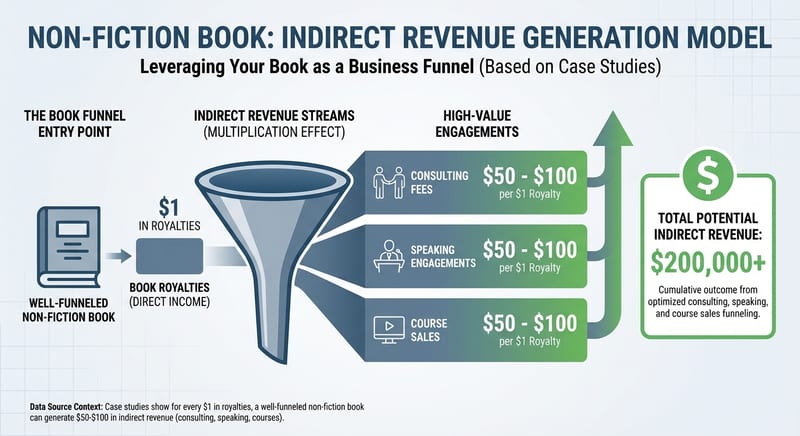
The data underscores that chasing best-seller lists with broad, shallow content is a vanity metric that often leads to bankruptcy. Conversely, a book that sells only 1,000 copies but is targeted at high-net-worth decision-makers can build a seven-figure enterprise. The 'bestseller' status is irrelevant; the 'authority' status is the asset.
Nuance: The Call-to-Action Architecture
The technical failure point for most 'business card' books is the friction between reading and converting. Simply putting a URL in the back of the book is insufficient. Successful execution involves embedding 'Reader Magnets'—checklists, video training, or templates—directly into the chapters.
This 'Content Upgrade' strategy moves the reader from a passive consumer of text (Amazon's customer) to an active subscriber on your email list (your customer). Without this bridge, the data moat discussed in previous reports remains empty.
2. The Mechanics of Promo Stacking
For fiction authors, where volume is the primary driver, the 'Promo Stacking' method remains the most reliable lever for rank manipulation. As detailed in Written Word Media's case studies, this involves coordinating multiple ad sites (like BookBub, Freebooksy, Bargain Booksy) to fire on consecutive days. The goal is not just a spike in sales, but the sustainability of the Amazon algorithm's attention.
A single day of high sales signals a 'flash in the pan' to the algorithm. A sustained, 5-day growth curve signals a 'trending product.' By stacking the smallest promo sites on day 1 and escalating to the largest (BookBub) on day 5, authors create an artificial velocity curve that triggers Amazon's internal recommendation engine to take over, promoting the book organically for weeks after the paid campaign ends.
"You don't buy ads to sell books. You buy ads to buy the algorithm's attention. Once you have that, the algorithm sells the books for you. - Self Publishing Formula Analysis"
This is a capital-intensive strategy that requires 'loss leader' mathematics. You may lose money on the front-end sales of Book 1 to acquire the reader, calculating that the read-through revenue of Books 2, 3, and 4 will yield a positive ROI within 30 days.
Nuance: The Category Relevance Factor
Promo stacking fails if the book is categorized incorrectly. If you drive 5,000 sales from a 'Cozy Mystery' email list to a book tagged as 'Hardboiled Thriller,' you pollute your 'Also Bought' data. The algorithm will subsequently show your book to the wrong audience, killing your conversion rate. Clean metadata is the prerequisite for paid traffic.
Advanced authors use tools like Publisher Rocket prior to a stack to ensure their categories align perfectly with the target audience of the promo sites they are booking.
3. Launch Engineering: The Pre-Order Paradox
The debate over pre-orders is settled by data: for indie authors without a massive existing fanbase, long pre-order periods can kill algorithmic momentum. Amazon credits pre-order sales to your *rank* at the moment of purchase, not on release day. This means 100 sales spread over 3 months creates a 'slow drip' that barely moves the needle. Conversely, 100 sales in 24 hours creates a spike.
However, BookLaunch.com strategies highlight a hybrid approach. Use a short pre-order window (1-2 weeks) strictly to capture early adopters and ensure the 'Also Boughts' are populated before the general public sees the page. This ensures that when the cold traffic arrives on launch day, social proof is already visible.
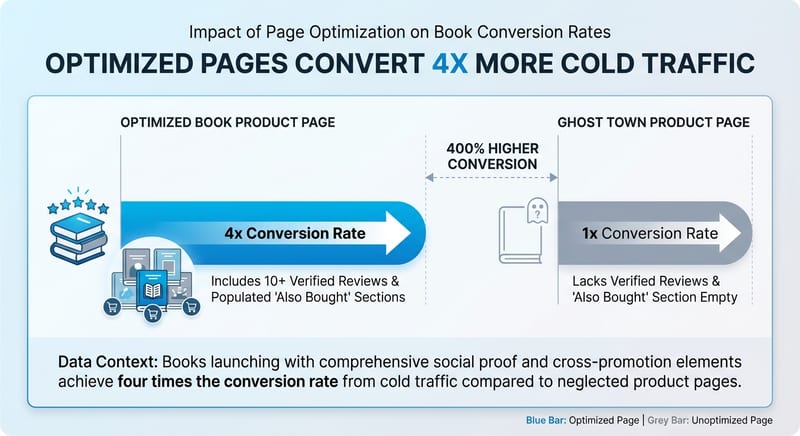
The engineering here is precise: The 'Street Team' (ARC readers) must leave reviews within 48 hours of launch. The email list is segmented to purchase on Day 1. The ads are scheduled for Day 3. This sequencing compresses the sales data into a window that forces the book onto the 'Hot New Releases' charts.
Nuance: The Newsletter Funnel
A launch is not an event; it is a sequence. The most effective launches begin 30 days prior with a 'warm-up' sequence. This involves sharing behind-the-scenes content, cover reveals, and sample chapters. By the time the 'Buy Now' email is sent, the open rate should be at its peak. Sending a sales email to a cold list that hasn't heard from you in months is the definition of marketing malpractice.
4. Optimization: The Search Engine of Retail
Amazon is not a bookstore; it is a search engine that happens to ship products. Therefore, visibility is a function of SEO (Search Engine Optimization), not literary merit. Kindlepreneur's case studies consistently demonstrate that changing a book's 7 backend keywords can revitalize a dead backlist title overnight.
The strategy involves targeting 'long-tail' keywords—phrases with lower competition but high intent. Instead of targeting 'Sci-Fi' (impossible to rank), you target 'Cyberpunk Detective Novel with Female Lead.' The search volume is lower, but the conversion rate is near 100% because the product perfectly matches the specific query.
- A/B Testing Covers: Using Amazon Ads to test two different cover concepts. The one with the higher CTR (Click-Through Rate) becomes the permanent cover.
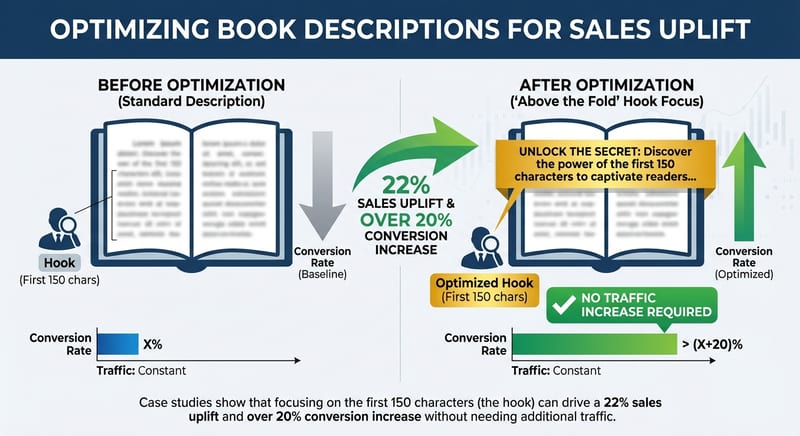
- Blurb Hooks: Rewriting the first sentence of the book description to ensure the 'Read More' tag is clicked (a crucial engagement signal for Amazon).
- Subtitle Stuffing: Legally adding keywords to the subtitle (for non-fiction) to index for more search terms.
5. The Career Author: From Hobby to Enterprise
The final evolution of the author strategy is the transition from 'launching books' to 'managing assets.' Interviews on The Self-Publishing Show highlight that 6-figure authors do not view their books as art pieces, but as SKUs (Stock Keeping Units). They rigorously track Read-Through Rate (RTR) from Book 1 to Book 2.
If the RTR drops below 60%, they do not write the next book; they rewrite the previous one. This ruthless adherence to data ensures that marketing dollars are only poured into a funnel that doesn't leak. It is the difference between a starving artist and a content CEO.
This mindset shift also enables 'Rapid Release' schedules—publishing a book every 30-60 days to dominate the 'New Release' charts. While grueling, this production schedule exploits the 30-day 'honeymoon period' Amazon grants to new titles, keeping the author permanently visible.