The Capital-Intensive Author: The 2026 Book Marketing Infrastructure Report

An exhaustive analysis of the rising costs of self-publishing, the shift from organic to paid acquisition, and the necessity of treating book proposals as busin
The Economics of Professional Entry
For the better part of a decade, the barrier to entry for publishing was effectively zero. That open door has now created a suffocation of quality, forcing serious authors to spend heavily to signal legitimacy. It is no longer possible to compete with a DIY cover and self-edited prose. The market effectively imposes a 'professional tax' on independent authors, requiring them to match the production values of the Big Five publishers to even secure a click.
Recent financial breakdowns paint a stark picture of this reality. According to Reedsy’s 2026 cost analysis, the financial floor for a professional launch has risen dramatically. This capital is not for vanity; it is for the essential services of developmental editing, copy editing, and cover design—components that algorithms now effectively 'read' to determine quality and placement.
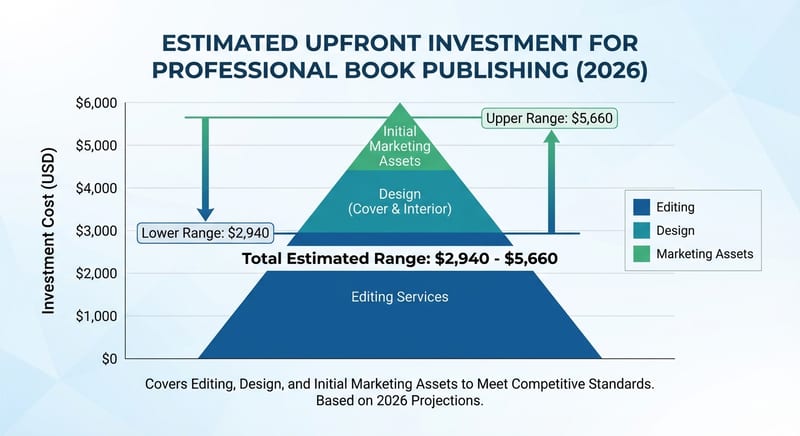
This data point ($5,660 at the high end) fundamentally alters the ROI calculation for new authors. If the average book earns $2-$4 in royalties, an author must move 1,500 to 2,500 units just to break even on production costs—before spending a single dollar on advertising. This necessitates a shift in strategy from 'publishing for visibility' to 'publishing for asset generation,' where the book serves as a loss leader for higher-ticket items or a backlist ecosystem.
Nuance: The Hidden Cost of 'Free'
A technical edge case often ignored is the 'opportunity cost' of going cheap. Authors who bypass professional editing often find their books 'shadow-banned' by poor engagement metrics. Retailer algorithms prioritize sell-through and read-through rates. A book that is returned frequently due to typos or poor formatting is algorithmically buried, rendering future marketing spend inefficient.
Therefore, the $5,000 investment is not just about aesthetics; it is about algorithmic survival. Spending less upfront often results in a higher Customer Acquisition Cost (CAC) later, as you are forced to pay more to convince readers to buy a sub-par product.
The Proposal as Business Logic
In the traditional sector, the manuscript is secondary to the market analysis. This mindset must now be adopted by independent authors. Writing a book without a validated market is a hobby, not a business strategy. As outlined by Jane Friedman’s rigorous guide, a book proposal is essentially a business case arguing for the commercial viability of an idea.
Friedman emphasizes that for nonfiction, the author’s platform is often the deciding factor. The question is not 'Is this well written?' but 'Who is waiting to buy this?' This shift requires authors to conduct competitive title analysis and audience profiling before drafting. It turns the creative process upside down: demand generation precedes product creation.
Nuance: The Platform-Dependent Advance
The technical reality of modern acquisitions is that advances are calculated based on existing audience data, not projected potential. Publishers risk-assess projects by looking at email list size and social engagement. If these numbers are zero, the acquisition is viewed as 'speculative' rather than 'investment-grade.'
This logic should apply to self-publishers as well. If you cannot fill out the 'Marketing Plan' section of a standard book proposal template, you are not ready to publish. You are ready to build an audience.
- Competitive Analysis: Identify 5 comparable titles published in the last 3 years and define exactly why yours is different.
- Target Audience: Move beyond demographics (e.g., 'women over 40') to psychographics (e.g., 'executives dealing with imposter syndrome').
- Pre-Order Strategy: Define how you will generate sales before day one.
The Illusion of Platform Ownership
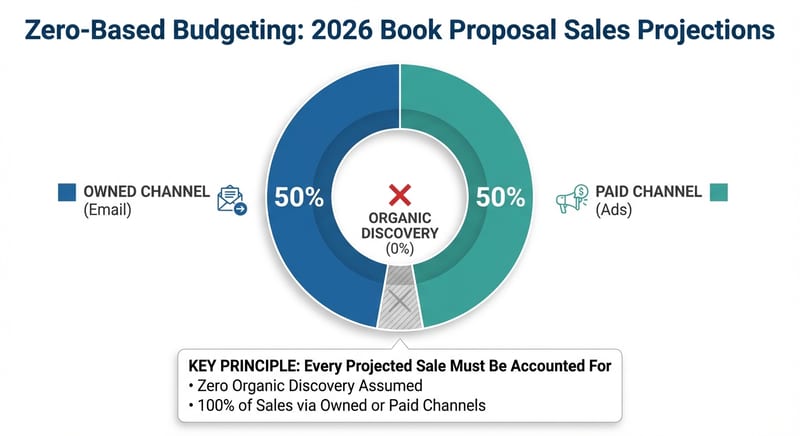
A critical realization for the 2026 market is the distinction between 'audience' and 'traffic.' Social media followers are traffic; email subscribers are audience. However, even the inbox is becoming contested ground. As noted in Inbox Collective’s 2025 retrospective, the uncomfortable truth is that authors do not truly own their audience—the reader owns the relationship.
This implies that simply having an email list is insufficient. The metric of success has moved from 'list size' to 'retention rate.' With AI-driven filters aggressively sorting inboxes, the challenge is no longer delivery, but attention. Authors must niche down aggressively, providing value that transcends the 'buy my book' pitch.
"You don't own the audience. The reader decides if you deserve space in their life. - Inbox Collective"
Nuance: The Algorithm of the Inbox
Email providers (Gmail, Apple Mail) are evolving into gatekeepers similar to Facebook's feed algorithm. They track engagement signals (opens, replies, moves to folders) to determine if your next email lands in 'Primary' or 'Promotions.' This means that 'list hygiene'—deleting inactive subscribers—is now a growth strategy.
Sending to 10,000 people with a 10% open rate damages your domain reputation. Sending to 2,000 people with a 50% open rate signals high value, ensuring future deliverability. The 'vanity metric' of a large list is a liability in 2026.
The Reality of 'Lackluster' Results
Even with perfect execution, the market is volatile. It is vital to study transparent failure as closely as success. Joanna Penn’s 2025 year-in-review offers a sobering case study. despite being a top-tier authority, she candidly reported 'lackluster results' in direct book marketing, contrasting this with growth in community-funded models like Patreon.
This signals a broader trend: the decoupling of 'income' from 'book sales.' For many mid-list authors, the book is no longer the primary revenue driver; it is the marketing flyer for a membership, a course, or a consulting gig. The volatility of retail sales makes them a poor foundation for a mortgage.
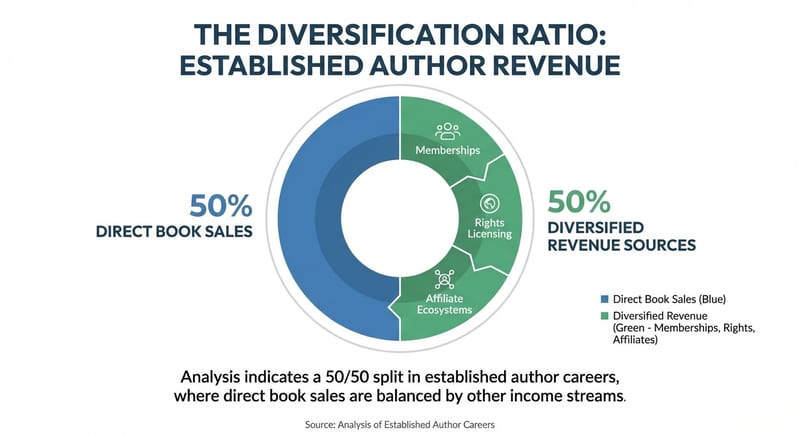
Ultimately, BookBub’s data-driven insights reinforce that marketing is an iterative process of testing and failure. There is no 'set it and forget it' strategy. The authors who survive 2026 will be those who treat their publishing career as a diversified investment portfolio rather than a lottery ticket.