Amazon KDP Royalties Explained: What You Actually Earn Per Sale (2026)
A complete breakdown of Amazon KDP royalty rates in 2026: the 70 and 35 percent ebook plans, the June 2025 print royalty change, printing cost formulas, Kindle
How do Amazon KDP ebook royalties work?
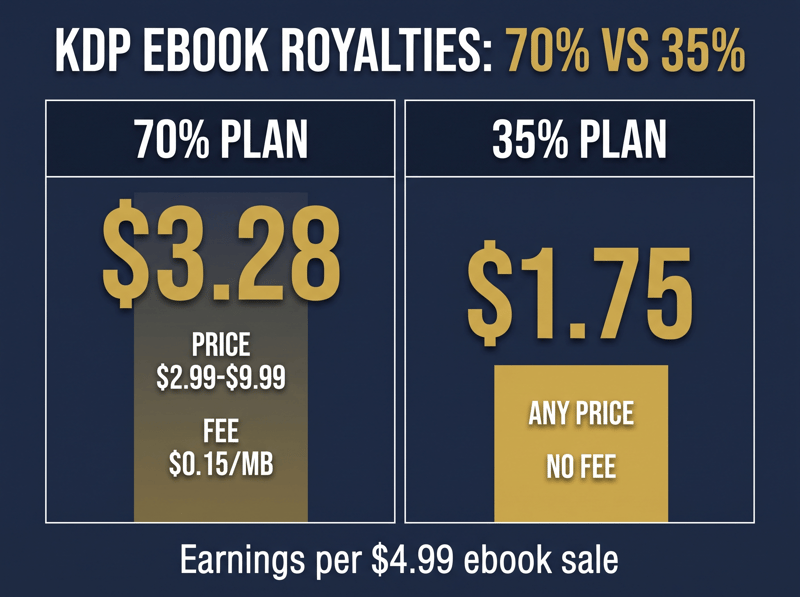
KDP offers two ebook royalty plans, and you choose one per book. According to Amazon KDP's official ebook royalty documentation, the 70 percent plan pays 70% of your list price minus a delivery fee, while the 35 percent plan pays a flat 35% of list price with no delivery fee. The catch is that the 70 percent plan comes with conditions.
- Your list price must sit between $2.99 and $9.99 (US marketplace; other marketplaces have equivalent bands)||Amazon deducts a delivery fee of $0.15 per megabyte of file size on every 70% sale||In Brazil, Japan, Mexico, and India, the 70% rate additionally requires enrollment in KDP Select||Price your book outside the $2.99 to $9.99 band and the sale automatically drops to the 35% plan
Here is the math on a typical novel. A $4.99 ebook with a 2 MB file pays a $0.30 delivery fee, so you earn (4.99 minus 0.30) times 0.70, which is $3.28 per sale. The same book on the 35 percent plan earns $1.75. Pricing above the band hurts more than most authors expect: a $12.99 ebook earns $4.55 at 35 percent, while a $9.99 ebook with a small file earns $6.89 at 70 percent. The cheaper book pays you more per copy.
What changed for print royalties in June 2025?
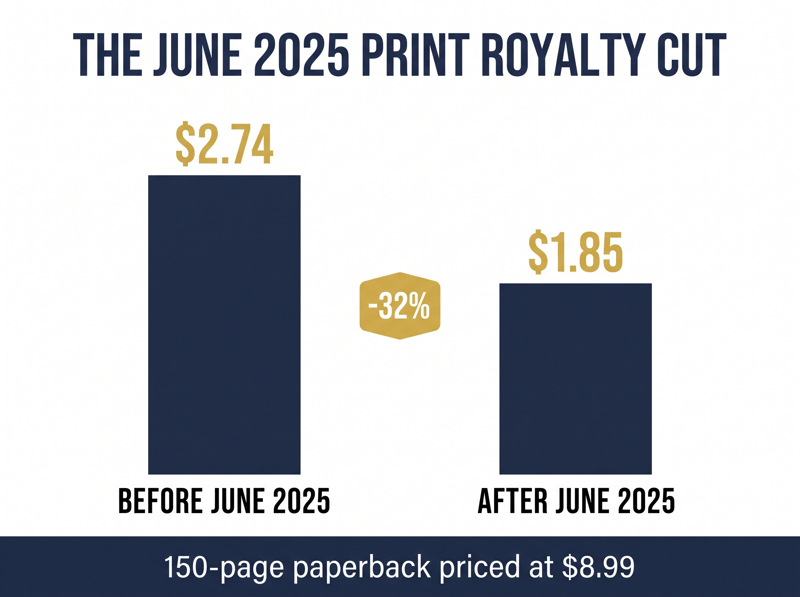
On June 10, 2025, Amazon cut the print royalty rate for low-priced books. As Jane Friedman reported, paperbacks and hardcovers priced below $9.99 USD dropped from 60 percent to 50 percent of list price, minus printing costs. Books priced at $9.99 or above still earn the full 60 percent. The thresholds vary by marketplace: 7.99 GBP on Amazon.co.uk and 13.99 CAD on Amazon.ca mark the 60 percent line.
The impact on short, cheap books is brutal. Friedman's worked example: a 150-page paperback priced at $8.99 carries a $2.65 printing cost. Before the change it earned $2.74 per sale at 60 percent. After the change it earns $1.85 at 50 percent, a 32 percent pay cut on the same book at the same price. The change only affects print editions; ebook royalties did not move.
How are paperback printing costs calculated?
For a standard black ink paperback of 60 to 828 pages printed for the US store, KDP charges a fixed cost of $0.85 plus $0.012 per page. A 300-page novel therefore costs $4.45 to print, and that amount comes off the top of every royalty calculation. Color is far more expensive: premium color runs $1.00 fixed plus $0.07 per page, which is why photo-heavy books need much higher list prices to break even.
- 300-page paperback at $12.99: royalty of $3.34 per sale (60% tier minus $4.45 printing)||Same book at $10.99: royalty of $2.14 per sale||Same book at $9.99: royalty of $1.54 per sale, still on the 60% tier||Same book at $8.99: royalty of $0.05 per sale on the 50% tier, essentially break-even
The lesson: page count sets your pricing floor. Every 100 pages adds $1.20 to your printing cost, so a long book priced low can earn almost nothing per copy. If print is a serious part of your strategy, compare Amazon's rates with IngramSpark's before committing; our IngramSpark vs KDP Print comparison covers the trade-offs in detail.
How does Kindle Unlimited pay authors?
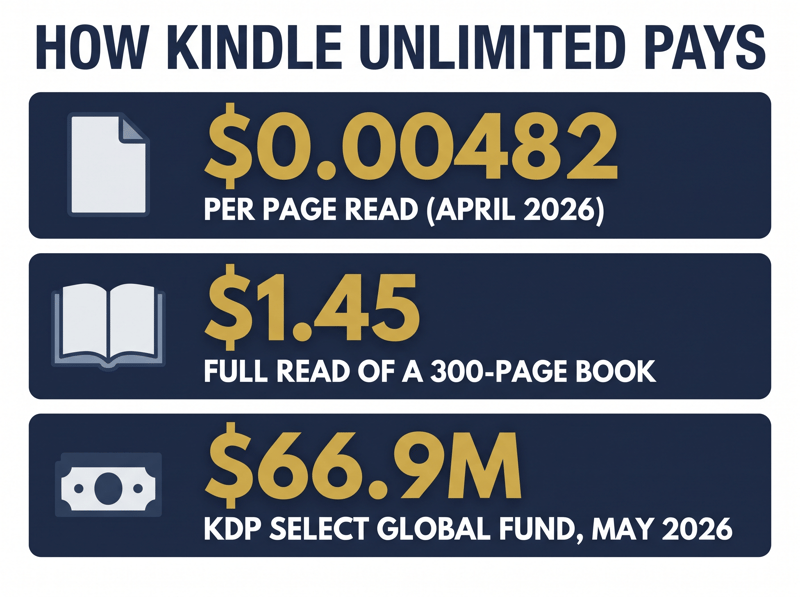
Kindle Unlimited does not pay a percentage at all. Books enrolled in KDP Select earn from the KDP Select Global Fund based on pages read. According to Written Word Media's payout tracker, the fund reached $66.9 million in May 2026, and the per-page rate in 2026 has ranged from roughly $0.0038 to $0.0052. At the April 2026 rate of $0.00482 per page, a complete read of a 300-page book pays about $1.45.
Amazon counts pages using its own KENPC standard, which normalizes font and formatting differences, so your KENPC page count usually differs from your print page count. Whether those page reads beat the sales you give up by staying exclusive to Amazon is the real strategic question; our Kindle Unlimited vs going wide guide works through that decision.
What about Expanded Distribution and hardcovers?
Expanded Distribution pushes your paperback to bookstores, libraries, and other retailers through wholesale channels, and it pays 40 percent of list price minus the same printing cost. That 300-page paperback at $12.99 earns just $0.75 per Expanded Distribution sale, compared with $3.34 on Amazon. Hardcovers follow the same tiered logic as paperbacks: 60 percent of list minus printing at or above the threshold, 50 percent below it, with higher fixed printing costs than paperback. Treat Expanded Distribution as visibility, not income.
How should you price your book to maximize royalties?
- Keep ebooks inside the $2.99 to $9.99 band unless you have a specific reason not to; the 70% plan nearly doubles your per-sale income||Never price print a few cents under a threshold: $9.99 beats $9.98 by a dollar per copy on a 300-page book||Compress your ebook file; every megabyte costs $0.15 per sale on the 70% plan, and image-heavy files add up fast||Check KDP's printing cost preview before setting a print price, and make sure list price covers printing plus a real margin||Recheck your royalties whenever you change page count; a longer second edition can quietly shrink every future payment
Two deliberate exceptions are worth knowing. A $0.99 launch promo earns only $0.35 per copy at 35 percent, but many authors accept that as a paid ranking boost for a few days. And for very large files, such as children's picture books, the delivery fee can eat so much of a 70 percent royalty that the 35 percent plan, which charges no delivery fee, actually pays more. Run both formulas for your own file size before choosing a plan.
Frequently asked questions
Is the 70 percent plan always better than 35 percent? Almost always, if your price fits the $2.99 to $9.99 band and your file is reasonably small. The exceptions are books priced outside the band, territories where your book is not 70 percent eligible, and very large files where the $0.15 per megabyte delivery fee erodes the advantage. Compute both: 70% of (price minus delivery fee) versus 35% of price.
When does Amazon actually pay royalties? Roughly 60 days after the end of the month in which the sale occurred, provided you have met the minimum payment threshold for your payment method. A book sold in January is paid at the end of March. Plan cash flow around that lag, especially ahead of a launch.
Did the June 2025 change affect ebook royalties? No. The 50 percent tier applies only to print editions priced under the marketplace threshold. Ebook plans, price bands, and delivery fees were untouched. If your income dipped after mid-2025 without a sales drop, low-priced print editions are the first place to look.
Does the Kindle Unlimited rate change every month? Yes. Amazon sets the fund size and the resulting per-page rate monthly, and rates also differ slightly by marketplace. In 2026 the US rate has moved between roughly $0.0038 and $0.0052 per page. Track the monthly figure rather than assuming last month's rate.
Where reviews fit into your royalty math
Royalty rates decide what you earn per sale. Reviews decide how many sales you get to multiply that rate by. A well-priced book earning $3.34 per copy still earns nothing if shoppers scroll past a page with three reviews. That is the problem Read & Rate solves: a community of readers who review your book honestly, on Amazon and on the other platforms you choose, plus a private comment only you can see. Your files stay protected with automatic watermarking, and the numbers stay visible through book biometrics. Just make sure every review you gather stays inside Amazon's review rules.