The 2026 Book Marketing Protocol: Capital Efficiency in the Age of AI

A definitive analysis of 2026 book marketing trends. We examine the shift from organic reach to paid acquisition, the weaponization of audio for AI search, and
The New Financial Baseline: Professionalization or Perish
The democratization of publishing has paradoxically led to its gentrification. As the market floods with millions of AI-assisted titles, the minimum viable product (MVP) standard for a commercially successful book has skyrocketed. Readers, burnt by low-quality content, now demand traditional-level editing and cover design as a baseline for trust. This shift has turned self-publishing from a low-cost experiment into a capital-intensive startup venture.
Authors can no longer bootstrap with zero budget and expect visibility. The financial reality of 2026 dictates that capital must be deployed upfront to secure a competitive product. According to Reedsy’s 2026 Cost Analysis, the ecosystem has stabilized around specific price points for professional quality. The days of the $500 launch are effectively over; the market now punishes under-investment with invisibility.
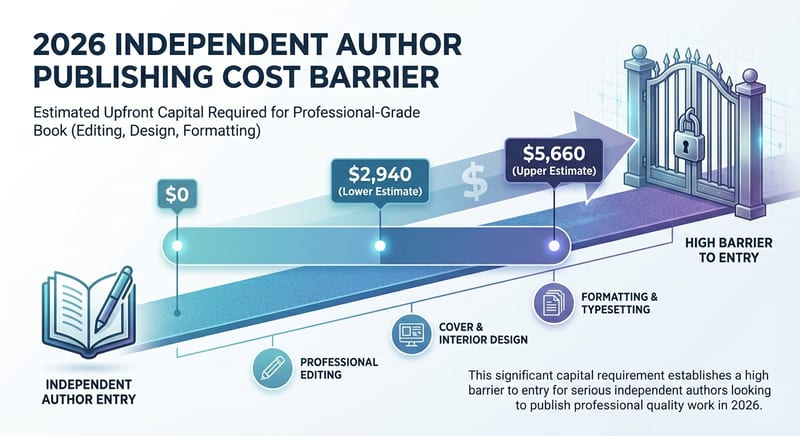
This capitalization requirement filters out hobbyists, leaving a field of 'author-entrepreneurs' who treat their books as assets. The data suggests that cutting costs on the production side—specifically developmental editing and cover art—drastically increases the cost of customer acquisition later. You cannot market a poor product; you can only accelerate the market's rejection of it.
Nuance: The AI Arbitrage in Audio
While core production costs have risen, a massive deflationary pressure has hit the audiobook sector. Historically, producing an audiobook cost between $2,000 and $5,000 for human narration. In 2026, high-fidelity AI narration has democratized this format. Authors are now leveraging tools that cost approximately $50/month to produce audio assets that are 95% indistinguishable from human narration for non-fiction titles.
This allows for an 'asset-heavy' strategy where every book is launched simultaneously in ebook, print, and audio, maximizing the surface area for revenue without the crippling upfront costs of the past decade.
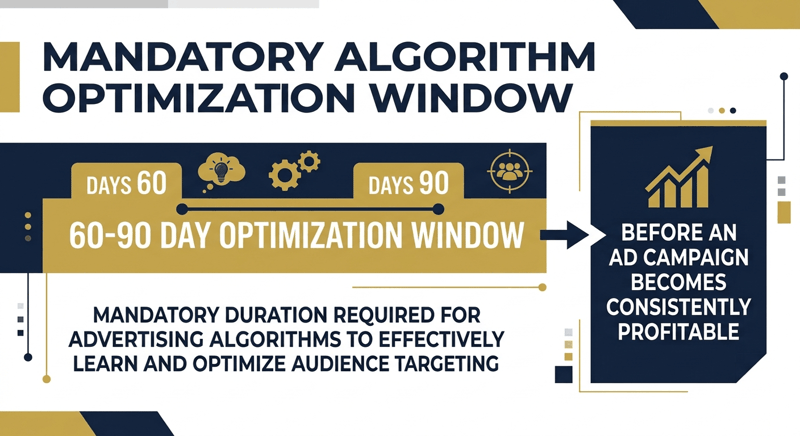
Paid Acquisition: The 90-Day Learning Curve
Organic reach on social platforms is mathematically insignificant for new accounts. The 2026 marketing protocol accepts that visibility must be bought. However, the 'boost post' mentality is insufficient. Successful authors are operating complex ad stacks on Amazon and Facebook, treating data modeling as a core competency. The objective is not immediate profit, but the acquisition of data.
A critical error novice authors make is cutting ad spend too early. Recent analysis on ad effectiveness highlights that algorithms require a significant gestation period to identify the ideal reader profile. Turning off an ad set after three days because it hasn't yielded a profit is akin to pulling a sapling out of the ground to check the roots.
Technical Reality: Series Read-Through Optimization
The metric of success has shifted from Return on Ad Spend (ROAS) on a single book to the Customer Lifetime Value (CLV) of a series. Authors are willing to break even—or even lose money—on Book 1, provided the 'read-through' rate to Books 2 and 3 is calculated accurately. This requires granular tracking and a willingness to operate in the red during the initial acquisition phase.
This strategy demands a 'loss leader' mentality, common in retail but often foreign to creatives. The ad is not selling the book; the ad is buying a customer for the ecosystem.
- Amazon Ads: Best for 'Discovery' (targeting specific comp titles). High intent, lower volume.
- Facebook/Meta Ads: Best for 'Scaling' (targeting interest groups). Lower intent, massive volume.
- Attribution Lag: Realize that sales reported on dashboards often lag 24-48 hours behind spend.
Search 3.0: Feeding the Gemini/GPT Ecosystem
SEO has evolved beyond keywords on a webpage. In 2026, search is dominated by AI agents (Gemini, ChatGPT) that index multimedia content. Industry leader Joanna Penn has identified a critical pivot: uploading full-length audiobooks to YouTube. The goal is not ad revenue from views, but to provide the AI with a massive corpus of text (via transcripts) to index.
When a user asks Google/Gemini, 'What is a good mystery novel about art history?', the AI scans YouTube transcripts to find semantic matches. If your book is locked behind a paywall on Audible, the AI cannot 'read' it. By sacrificing the unit sale on YouTube, authors gain the recommendation slot in the AI's answer, driving sales of physical copies and direct ecosystem entry.
"Direct sales and Kickstarter remain vital, but the strategic play is leveraging free audio on YouTube to train the search algorithms on your content. - Joanna Penn"
The Human Differentiator
As AI content floods the zone, 'proof of humanity' becomes a premium marketing asset. This is why automated newsletters are failing, while personal, voice-driven correspondence is thriving. The strategy is to use AI for the backend (audio production, ad targeting) while doubling down on the human frontend.
This bifurcation—Machine Efficiency vs. Human Connection—is the only sustainable model. Readers will consume AI content for utility, but they will pay premiums for human connection, shared values, and authentic voice.
The Offline Pivot: High-Touch in a Low-Touch World
Counter-intuitively, as the digital world becomes saturated, the highest ROI activities are moving offline. We are seeing a resurgence of the 'hand-sell.' Authors like Susan Berliner document that success at craft fairs and local events is no longer about just having books on a table. It is about creating an experience that stops the 'scroll' of real life.
The winners in this space are merchandising their IP. They aren't just selling paperbacks; they are using 'magnets instead of bookmarks' to secure permanent real estate on the reader's refrigerator. They are using coloring pages and crayons to engage parents. This is guerrilla marketing adapted for 2026—bypassing the algorithm entirely to secure a physical foothold in the reader's home.
The Budgetary Reality
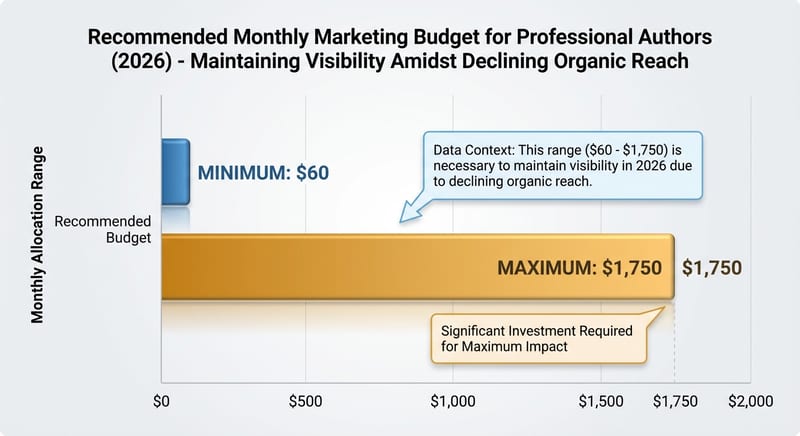
This mix of high-tech ad stacks and high-touch offline events requires a dedicated budget. Marketing can no longer be an afterthought or a 'time-only' investment. It is a line item that must be protected. The synthesis of ad spend and physical event costs creates a burn rate that must be managed carefully.
Authors must view this spend not as a loss, but as the cost of shelf space—both digital and physical. Without this allocation, the book exists in a vacuum.