Audible's New Royalty Model: What ACX Authors Must Do (2026)

Audible is retiring the flat 40 percent exclusive and 25 percent non-exclusive ACX royalty structure by the end of 2026 and replacing it with a pooled Member Va
What exactly is changing on ACX?
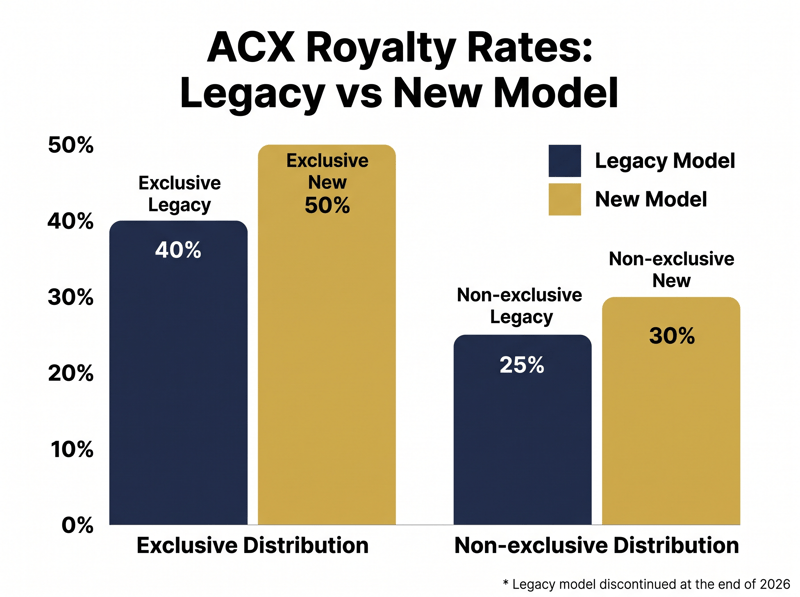
For most of ACX's history the royalty math was simple. You picked exclusive distribution and took 40 percent of each sale, or non-exclusive and took 25 percent. That is the model being retired. According to Audible's official ACX announcement, posted April 28, 2026 and updated May 26, 2026, enrollment in the new model is now open to every ACX creator, and the legacy model will be discontinued by the end of the year.
Two things change at once, and it is important to separate them. First, the headline royalty rates increase: exclusive distribution to Audible, Amazon, and Apple Books now pays 50 percent instead of 40 percent, and non-exclusive pays 30 percent instead of 25 percent. Second, the way membership listening is calculated changes from a per credit payout to a pooled share of what Audible calls Member Value. Cash purchases, what ACX calls a la carte sales, keep the same calculation method, which means those sales simply pay more under the higher rates.
How does Member Value actually work?
Member Value is the core of the new system, and it works nothing like the old credit payout. ACX defines it as the price of a listener's monthly membership plan minus taxes and fees. If that member buys additional credits during the month, the value of those credits is added on top. The resulting pool is then divided proportionally among every title the member engaged with that month, weighted by each title's a la carte price. Your share of that pool is multiplied by your contractual royalty rate to produce your payment.
- Your payout is no longer tied to a single credit redemption. It is a proportional share of one listener's monthly spend||Titles compete for share within each listener's month. The more titles a member engages with, the smaller each slice||Price still matters, because the split is weighted by a la carte price. A higher priced title claims a larger proportion||You now earn from all-you-can-listen activity, which under the legacy model paid nothing on a per credit basis||Cash purchases are unaffected in method, but pay more because the underlying rate rose
The practical consequence is that your audiobook income becomes harder to forecast per unit and easier to grow through breadth of listening. A backlist that gets sampled by many members can now earn on that engagement. A single title that used to depend on credit redemptions alone loses its guaranteed floor. If you want the full mechanics straight from the source, ACX publishes them in its Help Center article on the new royalty model.
Is the audiobook market worth this disruption?
The numbers say yes, which is exactly why the terms are being rewritten. The Audio Publishers Association's annual sales survey, reported by Publishers Weekly, put United States audiobook sales at $2.43 billion in 2025, up 9 percent year over year. Digital audiobooks drove essentially all of it, accounting for 99 percent of revenue and growing 10 percent. Supply grew faster than revenue: publishers reported more than 750,000 active titles in 2025, a 43 percent jump from 2024.
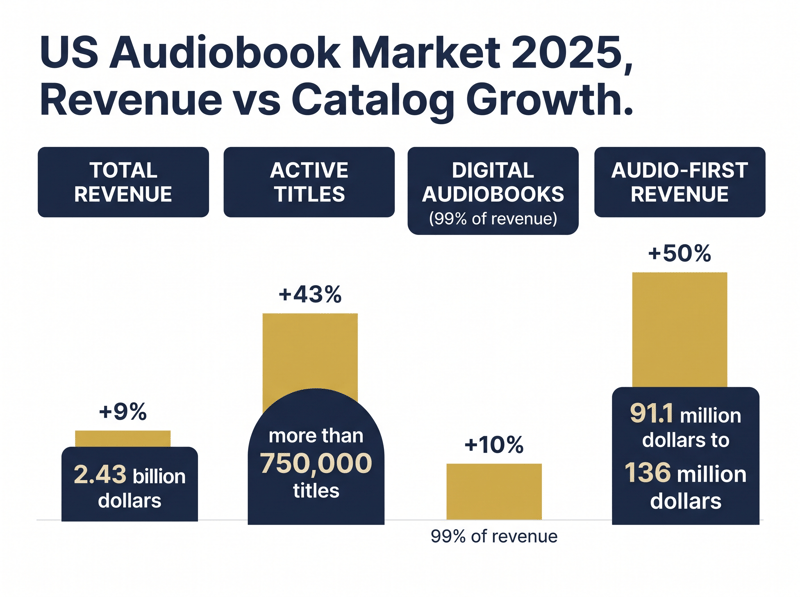
Read those two figures together and the strategic picture is clear. Revenue grew 9 percent while the catalog grew 43 percent, so the average title is competing for a smaller slice of a slowly expanding pie. That is the environment the pooled model was designed for, and it explains why discoverability, not just production, is now the constraint on audiobook income. For context on how catalog growth pressures individual titles, our breakdown of the vital metrics indie authors should track covers the same dynamic on the ebook side.
What new levers does the model give you?
- Higher contractual rates: 50 percent for exclusive distribution to Audible, Amazon, and Apple Books, or 30 percent for non-exclusive||All You Can Listen opt-in: you can nominate titles for the AYCL catalog inside the Premium membership plan, though Audible curates which opted-in titles are actually included||Suggested pricing: you can propose a price for your audiobook across all marketplaces. Audible treats it as one factor and reserves the right to sell at a different price||More detailed earnings statements, including the Member Value figure for each offering
The AYCL opt-in is the most consequential of these. Under the legacy model, subscription listening outside of credit redemption generated no royalty for ACX creators at all. Now it does. Audible cites early access creators including urban fantasy author Hunter Blain, who reported that the changes improved both monetization and visibility across his catalog, and sci-fi author Bruno Miller, who described seeing a quicker return through AYCL. Those are Audible's own selected testimonials rather than independent data, so treat them as directional, not as a forecast for your titles.
Why are some authors pushing back?
The change is not landing evenly. As Kindlepreneur documented in its breakdown of the royalty changes, a Change.org petition started by Robin Sullivan, business manager for author Michael J. Sullivan, has gathered close to 30,000 verified signatures. The core argument is that pooling dilutes the value of a credit and shifts revenue away from titles outside the Plus catalog toward titles inside it. The petition proposes keeping Premium credit revenue separate from Plus listening revenue.
The second complaint is about visibility. Audible has not published a typical Member Value range, so authors cannot model their expected earnings before enrolling. A higher percentage of an undisclosed number is not the same as a raise. That is the honest read: the rates went up, and the denominator became opaque. Both statements are true at the same time, and which one dominates your income depends on how your listeners consume, which you will only learn after enrollment.
Where is audiobook listening leaking away?
One finding from the same APA research cycle deserves more attention than it gets. Edison Research data cited alongside the 2025 survey found that 45 percent of audiobook listeners have listened to an audiobook on YouTube, up from 35 percent in 2024. The APA notes that many of those recordings are pirated from legitimate rights holders. That is a ten point jump in a single year, and none of that listening pays a royalty under any model, pooled or otherwise.
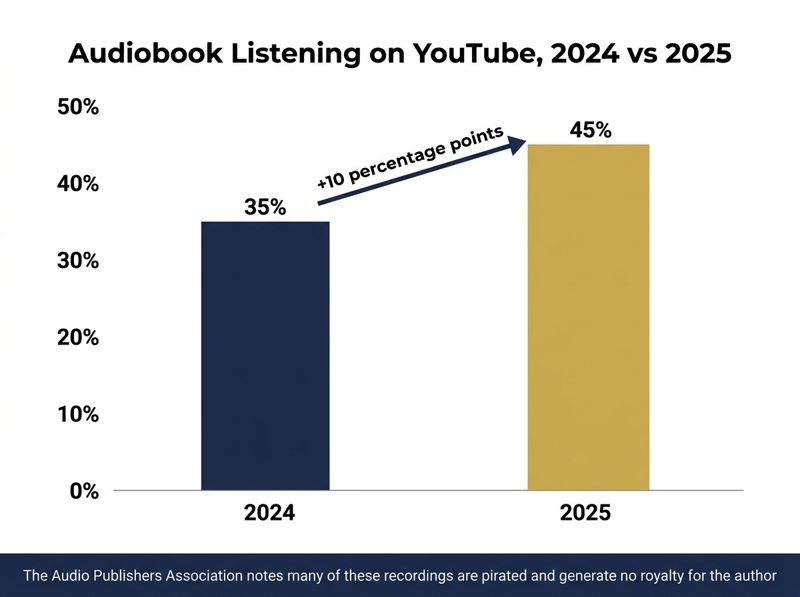
Royalty percentages are a fight over the money that reaches the ledger. Leakage is a fight over the money that never gets there. Both matter, and the second one is more within your control than most authors assume. If audio piracy is new territory for you, our guide to protecting your book from piracy as an indie author covers takedown workflow, file traceability, and what actually deters redistribution.
Is virtual voice a shortcut worth taking?
If you have never produced an audiobook, you are in the majority. Amazon states plainly on its KDP help page for audiobooks with virtual voice that only 5 percent of all books on Amazon are released as audiobooks. That gap is the reason virtual voice exists. The beta lets eligible KDP authors generate a computer narrated audiobook from an existing ebook, choosing from 80 voices across American English, Latin American Spanish, Castilian Spanish, Australian English, British English, French, and Italian, with the option to set a different voice per chapter.
The economics are different from ACX and worth understanding before you choose a path. Virtual voice titles are priced between $3.99 and $14.99 and pay a 40 percent royalty on a la carte sales, below the 50 percent an exclusive ACX title now earns. Titles created from ebooks enrolled in KDP Select are also included in Audible's Plus catalog, with listening paid from a fund separate from the Kindle Unlimited pool. The program remains an invite-only beta limited to the United States marketplace. If exclusivity is the deciding factor for you, our comparison of Kindle Unlimited versus going wide applies the same trade-off to your ebook.
What should you do before December?
- Export your last twelve months of ACX earnings now, while legacy statements still exist. You need a baseline to measure the new model against||Decide exclusivity deliberately. The gap between 50 and 30 percent is wider than the old 40 versus 25 split, which raises the cost of going wide||Enroll a small subset of titles first if your catalog allows it, and compare a full month of statements before moving everything||Review any pending marketplace offers. Offers sent to producers after May 26, 2026 fall under the new model automatically||Set your suggested prices before enrolling, since a la carte price weighting affects your share of the Member Value pool||Do not wait until December. Enrollment takes effect on the first of the following month, so a late decision costs you a full month
The one thing not to do is treat this as paperwork. The rate change alone shifts a meaningful percentage of every sale, and the pooling change alters which titles in your catalog earn the most. Authors who enroll early and read their statements carefully will have real data by autumn. Authors who wait until the deadline will make a permanent decision with no evidence at all.
Frequently asked questions
What happens if I do not enroll my titles by the end of 2026? ACX states that by the end of the year you must either enroll your titles in the new model or discontinue distribution. There is no option to stay on the legacy 40 and 25 percent structure. Doing nothing is a decision to stop distributing.
Does the new model change how a la carte sales are calculated? No. ACX confirms the calculation method for non-member and member cash purchases is unchanged. Because the underlying royalty rates rose to 50 and 30 percent, those sales pay more than they did under the legacy model. Only membership offerings move to the Member Value calculation.
Do I have to opt into All You Can Listen? No. AYCL is an opt-in for titles already enrolled in the new royalty model, and Audible curates which opted-in titles actually appear in the catalog. Enrolling in the new model is mandatory; opting into AYCL is your choice.
Will my suggested price be the price Audible sells at? Not necessarily. ACX describes the suggested price as one factor among several, and Audible reserves the right to adjust pricing at any time, including for sales, promotions, or to match a third party. Price weighting still matters, because your share of the Member Value pool is calculated using a la carte price.
Is now a bad time to produce my first audiobook? Not on the numbers. The market grew 9 percent to $2.43 billion in 2025 and only 5 percent of Amazon books have an audiobook edition. The catalog is growing faster than revenue, so discoverability is the harder problem, which is an argument for building reviews and audience before you spend on narration.
Reviews still decide who gets heard
Whatever percentage Audible pays, it is a percentage of listening you first have to earn. With active titles up 43 percent in a single year, the constraint on audiobook income is no longer production cost. It is whether a listener picks your title over the 750,000 others competing for the same monthly Member Value pool. That decision is made on the product page, where reviews, ratings, and social proof do the work. Read & Rate helps you build that proof across multiple platforms, not just Amazon, with watermarked review copies that stay traceable and private reviewer feedback only you can see.