The 2026 Book Marketing Protocol: From Direct Sales to Agentic Commerce

A definitive white paper on the shift to direct-to-consumer ecosystems, AI-driven 'Agentic Commerce,' and the stratification of the book market in 2026.
The Unit Economics of Direct Sales Ecosystems
The defining shift for authors and publishers in 2026 is the migration from 'retailer dependence' to 'retailer independence.' For over a decade, the industry accepted a 30-70% royalty split as the cost of doing business. However, with rising ad costs eroding margins on third-party platforms, the mathematical argument for Direct Sales has become irrefutable. Selling direct is not merely about higher royalties; it is about data sovereignty and the ability to retarget customers without paying a toll to a gatekeeper.
This transition requires a fundamental restructuring of the author's business model. It moves the author from a 'supplier' of content to Amazon, to a 'merchant' managing their own storefronts on platforms like Shopify or WooCommerce. The friction of purchase has decreased significantly, and reader willingness to buy direct—often incentivized by bundles, early access, or special formats—has normalized.
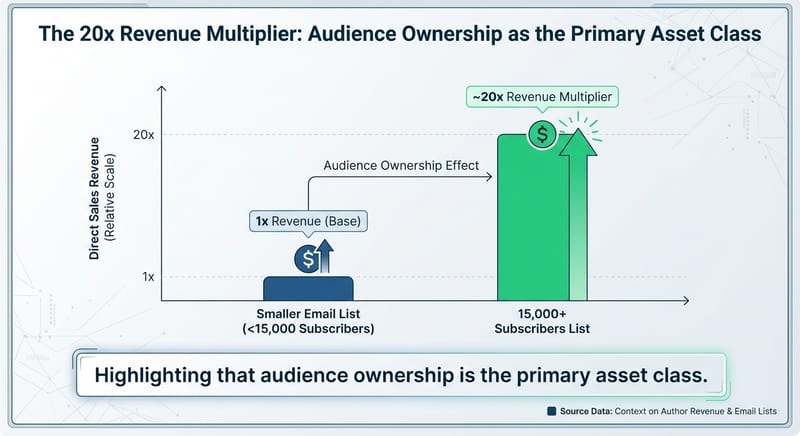
The data above illustrates a stark reality: direct sales are not a passive income stream but a function of audience loyalty. The correlation between list size and revenue is exponential, not linear. This suggests that marketing spend in 2026 should not be directed toward selling a single book on a third-party retailer, but rather toward acquiring a subscriber who can be monetized repeatedly over a customer lifecycle.
Nuance: The 'Whale' Backlist Requirement
While the allure of direct sales is strong, the technical reality introduces a barrier to entry: inventory depth. A store with a single SKU (stock keeping unit) struggles to achieve a profitable Average Order Value (AOV). The economics of direct advertising only stabilize when an author can bundle products or upsell a backlist.
High-performing direct stores leverage 'series read-through' to subsidize customer acquisition costs. If it costs $5 to acquire a customer who buys a $4.99 ebook, the model breaks. However, if that same customer is funneled into a 10-book bundle priced at $40, the unit economics suddenly become highly favorable.
Agentic Commerce: Preparing for the Non-Human Customer
We are witnessing the sunset of traditional SEO (Search Engine Optimization) and the dawn of GEO (Generative Engine Optimization). As noted by industry futurists like Joanna Penn, the customer journey is increasingly mediated by AI agents. By 2026, many 'readers' searching for books will actually be personal AI assistants tasked with finding 'a sci-fi novel similar to Dune but with a female protagonist.'
This shifts the marketing objective from catching a human eye with a cover to satisfying an algorithm's query with data. If your book's metadata is not structured in a way that Large Language Models (LLMs) can parse, categorize, and recommend, you are effectively invisible to the high-intent queries of the future.
Nuance: Conversational Metadata
Traditional keywords are static. Conversational metadata is dynamic. Authors must now optimize their descriptions not just for keyword density, but for semantic context. This means creating content on your website that explicitly answers questions an AI might ask about your book's themes, tropes, and emotional payoff.
The 'context window' of these AI models allows them to ingest vast amounts of data. Authors should provide detailed 'About the Book' pages that function almost as API documentation for the book's content—detailing character archetypes, plot structures, and comparable titles in plain, structured text.
"The shift towards 'Agentic Commerce' means AI bots will purchase on behalf of users. Optimization is no longer about human psychology alone; it's about machine readability. - Joanna Penn, The Creative Penn"
Algorithmic Authenticity: The BookTok Paradigm
Despite the rise of AI, the counter-trend is a craving for raw, unfiltered humanity. BookTok remains the dominant discovery engine for fiction, specifically because it rewards authenticity over production value. In 2026, the 'glossy' marketing trailer is dead; the viral currency is the emotional reaction video or the candid author diary.
The algorithm has evolved to penalize overt selling. Content that feels like an advertisement is swiftly deprioritized. Instead, successful marketing strategies pivot to 'Live Selling' and behind-the-scenes documentation, where the commercial intent is secondary to the parasocial connection established with the viewer.
Nuance: The 80/20 Content Split
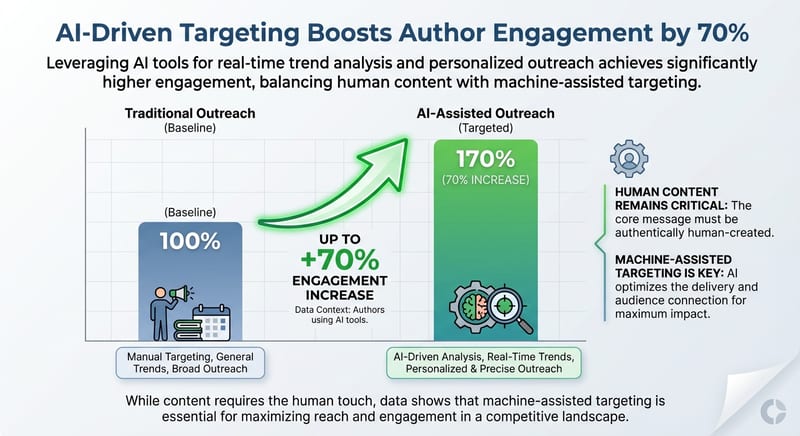
To maintain algorithmic favor while actually driving sales, a strict operational discipline is required. The consensus strategy is the 80/20 split: 80% of content must be purely value-add or entertainment (tropes, reaction videos, aesthetic montages) without a direct Call to Action (CTA).
The remaining 20% leverages the accumulated 'trust capital' to ask for the sale. Violating this ratio results in 'ad fatigue,' causing the algorithm to stop serving your content to new potential readers (the 'For You' page).
- Trend Jacking: Rapidly adapting meme formats (e.g., 'Books that made me cry') to your specific title.
- Cross-Purposing: Automatically stripping metadata from TikToks to repost as Instagram Reels and YouTube Shorts.
- The Hook: Ensuring the first 1.5 seconds of video contains a visual or auditory 'pattern interrupt.'
The Premiumization of Physical Formats
As digital content becomes infinite and cheap (thanks to AI generation), physical scarcity becomes a luxury asset. We are seeing a massive resurgence in 'special editions'—hardcovers with sprayed edges, foil stamping, and exclusive artwork. This is particularly prevalent in the Romantasy genre, where the book is not just a vessel for text, but a collectible artifact.
This trend validates the 'Kickstarter-first' launch strategy. By pre-selling high-margin, premium physical editions directly to superfans, authors can fund the production costs of the wider release. It effectively turns publishing into a venture-backed model where the readers are the investors.
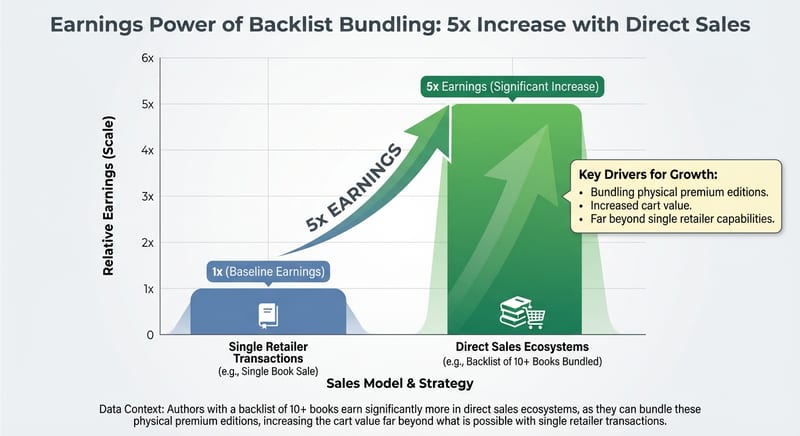
The data reinforces the strategy: release the digital 'loss leader' (cheap ebook) to capture the mass market, but monetize the 'true fans' through expensive, limited-run physical upgrades. This segmentation maximizes revenue from every tier of the audience.
Nuance: The Logistics of Special Editions
Executing a special edition strategy is operationally complex. It moves the author into the realm of manufacturing and supply chain management. The nuance here is print-on-demand vs. offset printing. While POD lowers risk, it cannot produce the high-end finishes (sprayed edges, ribbons) that drive the collectible market.
Successful authors in 2026 are using 'batching' models: collecting pre-orders via Kickstarter or their own site for 30 days, then commissioning a single offset print run to fulfill demand. This creates artificial scarcity and urgency while eliminating the risk of unsold inventory rotting in a garage.