The 2026 Author Protocol: Building a Sovereign Business in the Age of AI

A definitive white paper on the shift from platform dependence to agentic commerce, direct sales data moats, and sovereign audio distribution.
1. The Direct Sales Data Moat: Ownership Over Visibility
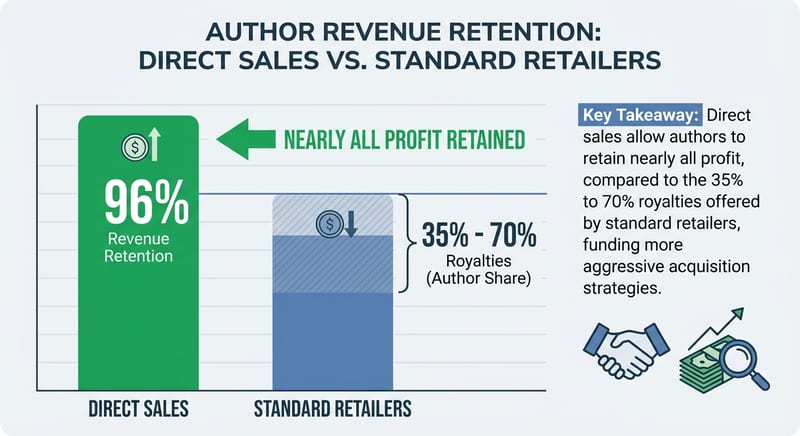
For the last decade, the predominant advice for independent authors has been to maximize 'visibility' on major retailers. This strategy is fundamentally flawed in the current landscape. When you sell strictly through a third-party retailer, you are not acquiring a customer; you are fulfilling an order for *their* customer. You receive a royalty check, but you are denied the most critical asset in modern business: the transactional data.
The pivot to 2026 requires treating Direct Sales not merely as a margin play, but as a defensive data moat. By processing transactions on your own domain, you capture email addresses, reading habits, and retargeting pixels that no algorithm update can strip away. This is the difference between building a business on rented land and owning the deed.
We are witnessing a bifurcation in the market. Authors who rely solely on retailer organic reach are seeing diminishing returns as paid ad inventory cannibalizes organic slots. In contrast, those building direct ecosystems operate outside this volatility, insulated by their proprietary audience data.
Nuance: The Logistics of Friction
The primary counter-argument to direct sales has historically been 'friction'—the idea that readers will not leave their preferred ecosystem to sideload an ebook. This assumption is outdated. The friction of sideloading has evaporated with the advent of seamless delivery services (like BookFunnel) and the normalization of direct creator support via platforms like Patreon and Substack.
Furthermore, the 'convenience' of retailers comes at the cost of silence. You cannot upsell, cross-sell, or recover abandoned carts on Amazon. On your own Shopify or WooCommerce store, these standard e-commerce practices become automated revenue generators.
- Customer Lifetime Value (CLV): Track exactly how much a reader spends over years, not just a single transaction.
- Pixel Control: Feed high-quality purchase data back to Meta/Google ads to optimize targeting (impossible with retailer sales).
- Bundle Economics: Create higher AOV (Average Order Value) packages that don't exist on standard retailers.
2. Agentic Commerce: Automating the Author Business
We must distinguish between 'Generative AI' (creating text/images) and 'Agentic AI' (executing tasks). While the industry obsesses over AI-written content, the true revolution for the professional author lies in Agentic Commerce. This involves deploying AI agents to manage the complex web of wide distribution, inventory management, and ad optimization.
Managing a catalog of 50+ books across 12+ global platforms is a logistical nightmare that typically forces authors into exclusivity deals for simplicity's sake. Agentic workflows dismantle this constraint. Automated systems can now ingest metadata updates, price changes, and promotional scheduling, propagating them across all channels instantly.
This shifts the author's role from 'Administrator' to 'Director.' Instead of manually uploading files, you define the parameters of a campaign, and the agents execute the logistics. This capability is what allows a single-person publishing house to compete with the operational throughput of a mid-sized traditional publisher.
Nuance: The Human-in-the-Loop Necessity
Automation is not abdication. The risk of Agentic Commerce is the potential for high-velocity errors—an incorrect price propagated to 20 platforms in seconds. The 'Human-in-the-Loop' protocol is essential. Authors must establish review gates where strategic decisions are approved before the agents execute the tactical rollout.
Furthermore, while agents can manage logistics, they cannot manage relationships. The nuanced communication required for high-tier networking or sensitive reader interactions remains a strictly human domain.
"Automation frees the author to focus on the only two things that truly matter: the quality of the writing and the connection with the reader. - PublishDrive Analysis"
3. Sovereign Audio: Bypassing the Gatekeepers
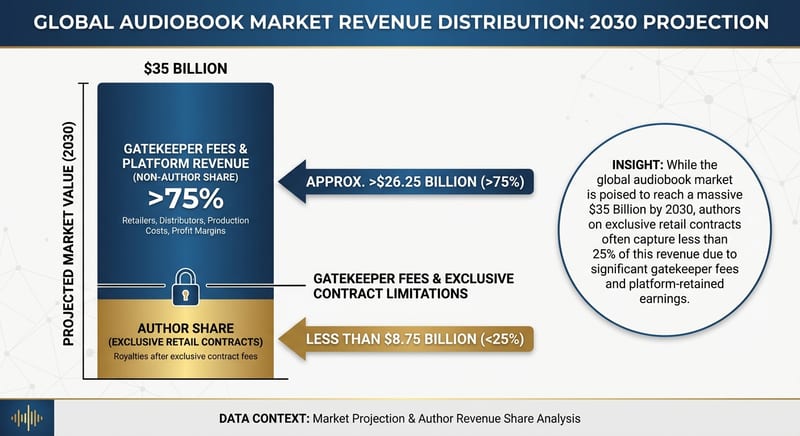
The audiobook market is the fastest-growing segment in publishing, yet it remains the most gatekept. The 'Sovereign Audio' movement is a direct response to this imbalance. Rather than accepting exclusivity deals that lock content into a single ecosystem for meager royalties, authors are leveraging direct-to-listener sales channels.
This strategy involves selling audiobooks directly through your website, utilizing apps that allow for secure, enjoyable listening experiences (e.g., BookFunnel, Soundwise). This removes the 'credit model' limitation where your $25 audiobook competes with a $15 monthly subscription credit, devaluing your work.
Sovereignty also extends to production. With the rapid maturation of AI-narrated audio, the cost barrier to entry has collapsed. While human narration remains the gold standard for fiction, AI narration unlocks the viability of backlist titles and non-fiction translations that were previously ROI-negative to produce.
Nuance: The Discovery Problem
The challenge with Sovereign Audio is not delivery, but discovery. Audible and Spotify are search engines; your website is not. Therefore, this strategy relies heavily on the 'Newsletter OS' (discussed below) to drive traffic. You cannot expect organic footfall on a direct audio store.
Successful implementation often looks like a hybrid model: Use retail platforms for the first book in a series (the 'loss leader' for discovery) and direct readers to your sovereign store for the subsequent, higher-margin sequels.
4. The Newsletter as Operating System
In 2026, the newsletter ceases to be a mere marketing channel; it becomes the Operating System of the author business. It is the only platform where algorithm changes cannot silence you. The modern newsletter is a storefront, a community hub, and a serialization engine all in one.
The trend moves away from 'news'—which is often boring—toward 'value.' Curated content, exclusive serialized chapters, and behind-the-scenes insights turn subscribers into members. This creates a recurring revenue model (subscriptions) that smooths out the 'feast and famine' cycle of book launches.
5. GEO: Optimizing for Answer Engines
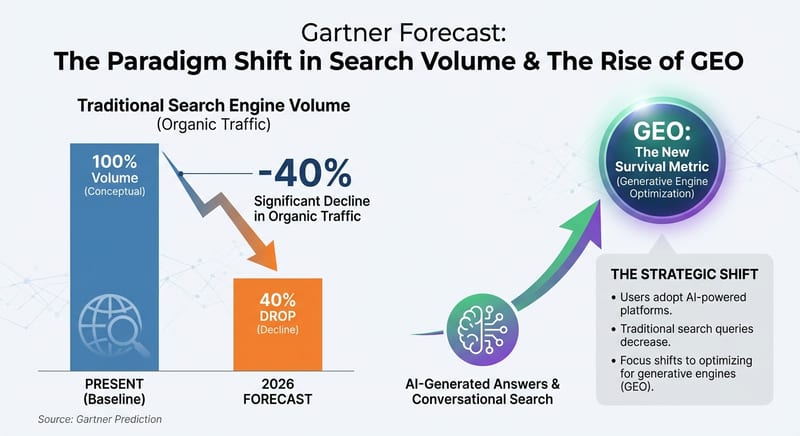
Traditional SEO (Search Engine Optimization) focuses on ranking ten blue links. The future is GEO (Generative Engine Optimization). As users turn to AI tools like ChatGPT and Perplexity for recommendations, your goal shifts from 'being clicked' to 'being cited.' GEO strategies prioritize structured data and semantic authority.
This means your author website must clearly define *entities*—who you are, what you write, and the themes you cover—in a format AI can easily parse. Ambiguity is the enemy. If an AI cannot confidently connect your name to your genre, you simply will not exist in the generated answers.
The content strategy here involves creating definitive guides and 'white paper' style content (like this article) that Answer Engines view as authoritative sources. Fluff content generated by AI will be ignored by AI; only high-density information will be cited.
Nuance: The Citation Economy
The currency of GEO is the citation. Unlike a backlink, which transfers 'juice,' a citation establishes facts. To optimize for this, authors need to ensure their knowledge panels are claimed and accurate, and that they are referenced in third-party authoritative sources (interviews, guest posts on high-DR sites).
It is a game of digital PR. The more independent sources that verify your expertise and book catalog, the higher the probability that an Answer Engine will surface your book as the solution to a reader's prompt.