The ROI of Sovereignty: Advanced Book Marketing Strategies for 2026

In 2026, the 'publish and pray' method is dead. This white paper analyzes the shift to high-ROI direct sales, the economics of crowdfunding, and the resurgence
The Capital Requirement: The Cost of Doing Business in 2026
For years, the narrative of self-publishing was one of 'low barriers to entry.' While technically true—anyone can upload a file—the barrier to *competitiveness* has risen dramatically. In 2026, the market does not forgive amateur production values. A professional book launch is no longer a creative endeavor alone; it is a startup capital investment that requires a clear path to recoupment.
Recent financial analysis confirms that the 'bootstrapping' myth is fading. According to Reedsy's 2026 breakdown of publishing costs, the specialized labor required for editing, design, and initial marketing has created a new financial floor for serious authors. Understanding these numbers is the first step in formulating a marketing strategy that focuses on net profit rather than vanity metrics.
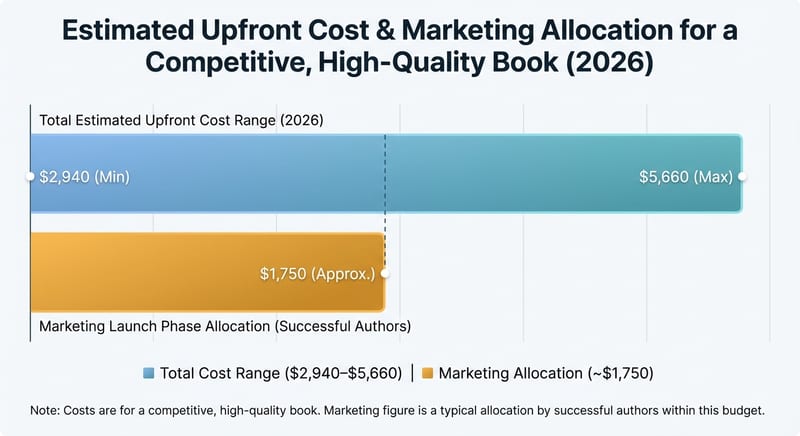
This data point is critical. If your marketing plan does not account for a four-figure negative cash flow in month one, you are undercapitalized. However, this expenditure is not a loss; it is the cost of acquiring an asset. The strategic shift for 2026 is moving from 'spending money to sell books' to 'investing money to acquire customers' whose lifetime value (LTV) exceeds the initial setup cost.
The Nuance: Launch Budget Allocation
The complexity lies in where that $1,750 marketing budget goes. In 2020, it might have gone entirely to Facebook Ads. In 2026, the savvy allocation is diversified. It funds a 'launch team' infrastructure, influencer outreach (sending physical ARCs), and newsletter swaps. It is less about buying clicks and more about buying social proof.
The most efficient use of this capital is often 'asset creation'—creating high-quality images, trailers, and A+ content for Amazon pages—rather than fleeting impressions. Assets remain on the sales page forever, increasing conversion rates for years, whereas an ad impression vanishes the moment the budget runs out.
- Editing & Design (60%): The product must be flawless to convert.
- Launch Marketing (30%): ARCs, promo sites, and initial CPC data testing.
- Infrastructure (10%): Website hosting, email service providers, and direct sales cart fees.
The Algorithm Breakers: Paid Acquisition at Scale
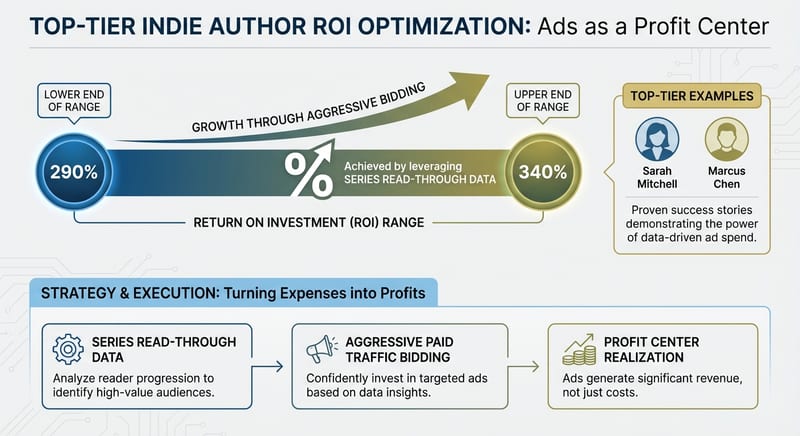
Once the asset is created, traffic must be acquired. While organic reach is the dream, paid acquisition is the reality for scaling. The difference in 2026 is that we have moved past 'testing' into 'optimization.' Authors are no longer guessing if ads work; they are engineering specific ROI targets based on series read-through rates.
This engineering approach is evident in recent 2026 case studies from Manuscript Report. The data shows that successful campaigns are not necessarily selling Book 1 for a profit. They are selling Book 1 at a break-even (or slight loss) to unlock the profit of Books 2, 3, and 4. This 'Loss Leader' strategy requires the author to have a deep backlist and the confidence to float the cash flow delay.
The Nuance: Platform-Specific Creative
The nuance of 2026 ad strategy is the divergence of creative assets. Amazon Ads remain text-heavy and keyword-focused—essentially a search engine marketing game. However, Meta (Facebook/Instagram) and TikTok have pivoted entirely to video creatives. Authors reusing their book cover image for all platforms are seeing diminishing returns.
High-performing authors are now functioning as media production houses, creating 'hook-based' short-form video content for ads. These videos rarely mention the book's price or features; they sell the emotion of the story. The click is the goal; the sales page handles the transaction.
- Amazon Ads: High intent, low volume. Best for 'sniping' competitor book titles.
- Facebook/Meta: Lower intent, infinite scale. Best for broad targeting using video hooks.
- BookBub: High volume, short duration. Best for price-drop spikes to trigger algorithms.
The Pre-Order Economy: Crowdfunding as a Paycheck
The traditional publishing model pays the author months or years after the work is done. The 'Sovereign Author' model flips this dynamic through crowdfunding. Platforms like Kickstarter have evolved from 'fundraising for help' to 'pre-ordering for premium access.' This shift allows authors to monetize their super-fans immediately, generating significant capital before the book is even available on Amazon.
Industry leader Joanna Penn highlighted this in her 2025 creative goals review, noting that a single title campaign raised over £10,000. This is effectively a self-paid advance. By selling special editions, signed copies, and early access directly to readers, authors capture the 'consumer surplus'—the extra money super-fans are willing to pay above the $9.99 retailer price point.
The Nuance: The 'Windowing' Strategy
The technical execution of this strategy relies on 'Windowing.' This is the practice of making the book available exclusively to backers for a period (e.g., 3 months) before releasing it to the general public on retailers. This scarcity drives the urgency of the campaign.
Windowing protects the value of the direct sale. If a reader knows they can get the book for $4.99 on Kindle next week, they won't pay $25 for the Kickstarter paperback. You must offer a temporal or physical exclusivity that Amazon cannot replicate.
"I am doubling down on being human, selling direct first, and creating premium products... This strategy validates the 'death of viral' by focusing on deep, owned relationships. - Joanna Penn, The Creative Penn"
The Tangible Pivot: High-Touch Offline Marketing
In a digital world saturated with AI content, the physical world has become a 'blue ocean' for marketing. While scalable digital ads are powerful, they are also noisy. Authors are finding surprising success by returning to high-touch, offline sales channels where the competition is non-existent. This is the 'Artisan' approach to bookselling.
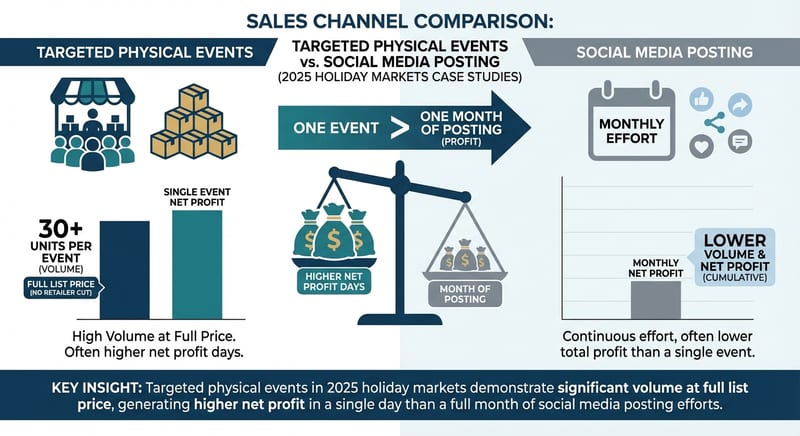
This isn't just about book signings at bookstores. It's about non-traditional venues. As documented in Susan Berliner’s 2025 event evaluation, targeted craft fairs and holiday markets often outperform broad digital efforts. In these environments, the book is sold as a gift or a physical object of art, and the author's presence closes the sale in a way a Facebook ad never could.
The Nuance: Conversion Rates vs. Scalability
The trade-off here is time vs. conversion. Online ads have low conversion but infinite scale. Offline events have zero scale but massive conversion. A conversation with a potential reader at a fair yields a sale 30-50% of the time, compared to 1-2% online.
For authors with a local focus or those burned out by social media, this offers a viable revenue stream. It also builds a 'sticky' local fanbase that is immune to Amazon algorithm changes. However, it requires inventory management and physical stamina that digital sales do not.
The synthesis of these strategies—high-tech digital ads, community-funded launches, and high-touch physical sales—creates a resilient author business. In 2026, success is not found in choosing one path, but in layering these revenue streams to build an ecosystem that pays you to create.