Beyond the Algorithm: The 2026 Protocol for High-Volume Book Sales

A definitive analysis of the shift from algorithmic dependency to direct-to-consumer ecosystems, Agentic Commerce, and Generative Engine Optimization (GEO).
The Collapse of Algorithmic Discovery
For the past decade, the dominant strategy for authors was simple: feed the algorithm. Whether via Amazon Ads, Facebook pixels, or keyword stuffing, the goal was to signal relevance to a retailer's search engine. However, as we approach 2026, this mechanism is experiencing catastrophic failure due to saturation. The barrier to entry for content creation has dissolved, leading to a flood of synthetic material that chokes traditional discovery channels.
This is not merely anecdotal frustration; it is a measurable market shift. The sheer volume of AI-generated content creates a noise-to-signal ratio that traditional SEO cannot parse. Authors relying solely on visibility within retailer ecosystems like Amazon are finding their margins eroded by the necessity of increased ad spend just to maintain baseline visibility. We are witnessing the transition from an era of 'search' to an era of 'saturation'.
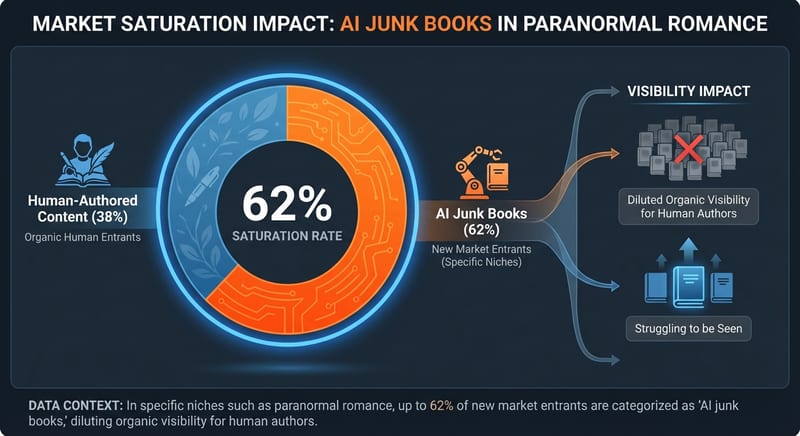
This statistic, highlighted in recent industry forecasts for 2026, illustrates the futility of competing on volume. When a machine can publish a thousand titles in the time it takes a human to draft one chapter, the 'long tail' strategy becomes a liability. The algorithm, unable to distinguish quality at scale, defaults to recency and ad spend, effectively taxing human creativity.
Nuance: The Rise of Agentic Commerce
The response to this saturation is not better SEO, but a fundamental shift in who buys the book. We are entering the age of 'Agentic Commerce,' where AI personal assistants (bots) execute purchases on behalf of human users. In this paradigm, your marketing materials must convince a machine, not a human, that your book is the correct solution.
Traditional keywords are insufficient for this. Large Language Models (LLMs) function on semantic understanding and context, not keyword density. Marketing assets must be restructured to provide deep, contextual metadata that an AI agent can ingest and verify against its user's preferences. This creates a winner-take-all dynamic where only 'verified' human authorities are recommended by the agent.
The Economics of the Direct Sales Ecosystem
As third-party platforms become pay-to-play arenas, the 'Direct Sales First' model transitions from an alternative income stream to a survival necessity. However, the discourse around direct sales often lacks financial rigor. It is not a magic bullet; it is a business model with strict operational requirements. The romanticized notion of selling PDF files from a WordPress site ignores the complexities of international tax compliance, customer support, and digital fulfillment.
Furthermore, Joanna Penn's analysis of 2026 trends correctly identifies direct sales as an 'advanced author strategy.' It requires a shift in mindset from 'author' to 'ecommerce manager.' The data suggests that this model is predatory for novices but highly lucrative for established veterans with deep backlists.
Nuance: The Volume Threshold for Viability
The failure rate in direct sales is high because authors underestimate the 'Volume Threshold.' A direct sales store incurs fixed monthly overheads—Shopify fees, email service provider costs, and transaction fees. Without a sufficient catalogue to drive average order value (AOV) and repeat purchases, these costs devour margins. A single book cannot sustain a direct sales ecosystem.
Recent case studies reveal a stark dividing line between those who dabble and those who profit. The critical differentiator is the size of the backlist. Authors attempting to drive paid traffic to a store with fewer than five items rarely achieve a positive Return on Ad Spend (ROAS). The economics only stabilize when bundling strategies and upsells can be leveraged to increase the lifetime value (LTV) of the customer.
"The most successful direct sellers treat retailers like Amazon not as the destination, but as spokes leading back to the hub they own. - ALLi Advisors"
- Minimum Viable Backlist: Data indicates 5+ titles are required to make monthly platform fees negligible against revenue.
- The Shopify Trap: Novice authors often sign up for $39/mo platforms before they have the traffic to justify the expense, bleeding resources that should be allocated to production.
- Data Ownership: The primary asset is not the royalty, but the email address and purchase history, which allows for retargeting without ad spend.
The financial data supports this 'barrier to entry' hypothesis rigorously. It is not enough to simply open a store; one must have the inventory to stock the shelves.
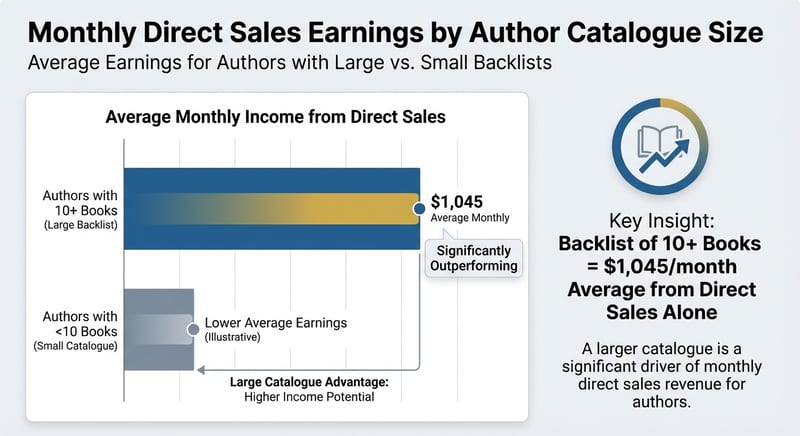
This figure, derived from Kindlepreneur's extensive case study of over 500 authors, serves as a benchmark. It confirms that direct sales is a volume game. If you have not yet published your tenth book, your primary marketing strategy should likely remain on retailers to build momentum, while your direct channel remains a passive capture mechanism until your inventory matures.
Generative Engine Optimization (GEO)
If SEO was about satisfying an algorithm, GEO (Generative Engine Optimization) is about training an intelligence. As forecasted in ALLi's 2026 outlook, discoverability is moving to chat interfaces. When a reader asks an AI, 'What is the best book on modern Stoicism?', the AI does not scan a list of keywords; it synthesizes a consensus from its training data.
Therefore, marketing in 2026 requires authors to pollute the training data with positive, authoritative citations. This involves securing coverage on high-authority domains (Wikipedia, major media outlets, reputable blogs) that LLMs weigh heavily during their training or retrieval-augmented generation (RAG) processes. An author's digital footprint must resemble a 'knowledge graph' rather than a sales page.
Nuance: The Focus Imperative
The temptation with these emerging technologies is to attempt omnipresence—being everywhere at once. This is a fatal error. The 'spray and pray' approach dilutes the signal strength required for GEO. To be cited by an AI as an authority, you must consistently dominate a specific semantic niche. Wandering between genres or topics prevents the 'deep groove' of data required for an LLM to associate your name with a specific topic.
Effective marketing now implies constraint. It is the refusal to chase viral trends on TikTok in favor of creating a dense, interconnected web of content around a single subject. This 'staying put' strategy builds the authority that smart nonfiction authors leverage to become the default answer for AI inquiries.
The Traffic Engine: Social vs. Search
While we optimize for AI on the backend, the frontend traffic driver remains surprisingly human. Despite the complaints about reach reduction, social media remains the primary liquidity provider for direct sales ecosystems. The distinction in 2026 is that social media is no longer used for 'awareness'; it is used for 'extraction'—moving users immediately from a rented platform to an owned list.
The data shows a clear hierarchy in traffic sources. While paid ads scale, organic social interaction converts better because it mimics the 'word of mouth' data that AI agents look for. The successful author uses social platforms not to broadcast announcements, but to demonstrate the expertise that validates the price point of a direct sale.
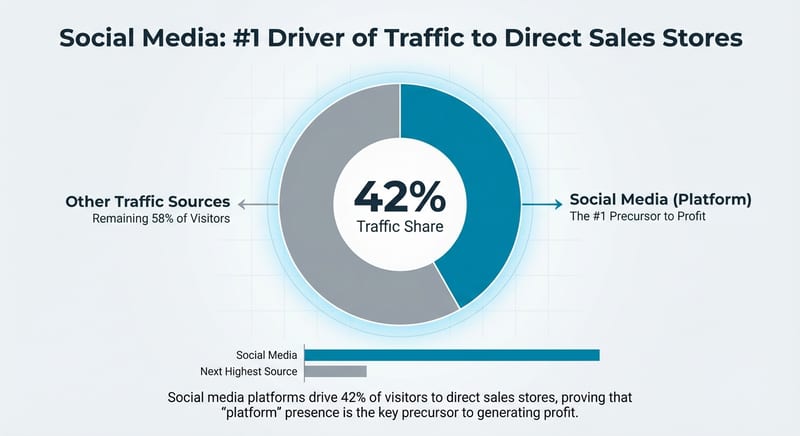
This metric from the Kindlepreneur study underscores a critical reality: you cannot automate relationships. Even in an age of Agentic Commerce, the initial spark of interest often comes from a human connection on a social platform. The workflow is: Human Interaction (Social) -> Data Capture (Email) -> Agentic Verification (AI/GEO) -> Transaction (Direct Store).
Conclusion: The Infrastructure of Independence
The 2026 landscape is hostile to the hobbyist. The convergence of AI saturation and complex direct sales logistics demands that authors treat their publishing efforts as a scalable startup. The winners will not be those who write the best prose, but those who build the most robust infrastructure—one that can bypass gatekeepers, speak the language of AI, and monetize a loyal audience directly.
To survive, you must move from 'marketing books' to 'managing data.' Your email list, your backlist metadata, and your direct sales customer profiles are the only assets that cannot be devalued by an algorithm update. Build the walls of your own castle, or be washed away by the tide of synthetic content.