The Death of Hustle: Why 2026 is the Year of Strategic Focus for Authors
The era of 'being everywhere' is over. In 2026, successful authors are pivoting to direct sales, owned data, and the 'Artisan Author' model.
The Great Realignment: Escaping the Algorithmic Trap
For the better part of a decade, the prevailing wisdom in independent publishing was predicated on velocity: rapid releases, daily social media content, and a 'spray and pray' approach to advertising. By 2026, this model has not only plateaued; it has collapsed under the weight of market saturation and AI-generated noise. The authors winning today are those who have stopped trying to feed the algorithm and started building their own ecosystem.
The core issue is dependency. When an author relies exclusively on retailers for discovery and sales, they are effectively renting their audience. As noted in recent analysis by PublishDrive's 2026 Predictions, we are entering a period of 'strategic focus,' where the most profitable action is to stop 'doing all the things' and double down on channels where you control the relationship.
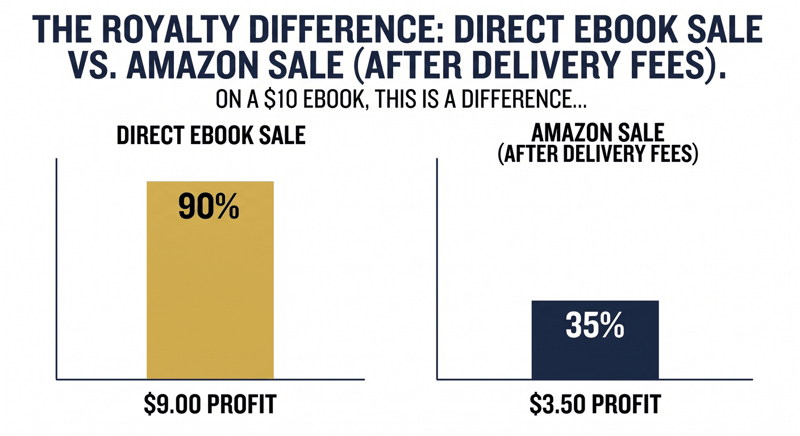
This is not merely a philosophical shift; it is a survival mechanism. With advertising costs on platforms like Meta and Amazon rising year-over-year, the margins on a standard $4.99 eBook sold through a retailer—where you lose 30% to 70% in royalties plus ad spend—are becoming mathematically unsustainable for mid-list authors.
The Nuance: Discovery vs. Conversion Channels
A common misinterpretation of the 'Direct Sales' movement is the belief that authors should abandon retailers entirely. This is binary thinking in a nuanced world. The strategic author in 2026 treats Amazon and Kobo not as the end destination, but as discovery engines. These platforms are vast search engines filled with high-intent buyers.
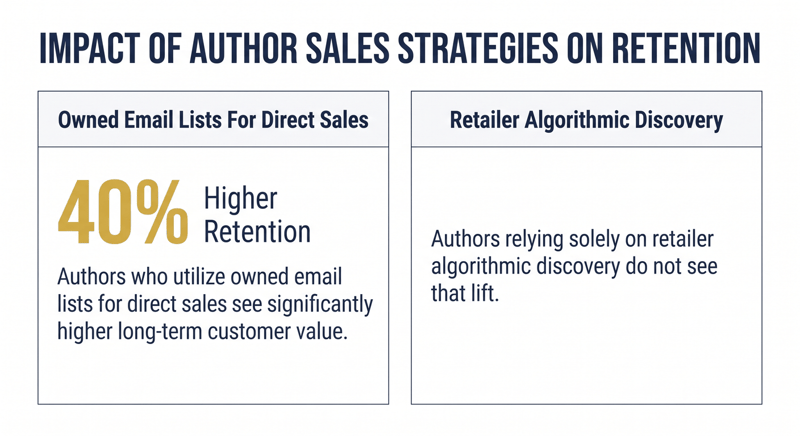
The goal is to acquire the reader on the retailer platform (Discovery) and move them to your owned ecosystem (Conversion) via lead magnets within the book. Once they are on your list, the shift to an 'Author Platform' allows for higher-margin sales without the 'tax' of retailer royalties. You must distinguish between where a reader finds you and where they transact with you long-term.
Infrastructure of Sovereignty: The Direct Sales Stack
The 'Hustle' culture of the 2010s was driven by the fear that if you stopped posting, you disappeared. The 'Sovereignty' culture of 2026 is driven by the confidence of ownership. Direct sales provide three critical assets that Amazon denies you: higher margins, immediate cash flow, and—most importantly—customer data.
Implementing this requires a robust technical stack. As highlighted in guides on selling books without Amazon, the modern author business is an e-commerce business. It relies on integrating a storefront (Shopify or WooCommerce) with a specialized fulfillment partner.
The Nuance: The Logistics of Print-on-Demand (POD)
Selling eBooks direct is simple file delivery. Selling print direct is a logistical challenge. The nuance lies in choosing a POD partner that integrates seamlessly with your store to automate shipping. You cannot be packing boxes in your garage if you intend to scale.
Services like Bookvault have emerged as leaders here, offering better margins and quality than standard KDP print. According to Reedsy's analysis of book printing services, the choice between IngramSpark (distribution focused) and Bookvault (direct-sales focused) is the single most important supply chain decision an author makes.
- Shopify + Bookvault: The gold standard for maximum margin and automated fulfillment.
- Payhip: Lower barrier to entry, excellent for digital-only or simple setups.
- Kickstarter: The 'event-based' direct sales model for funding print runs and special editions.
"Direct sales offer control, data, and relationships"
The Transformation Economy: Moving Beyond Information
In 2026, information is free and abundant, largely thanks to AI. Consequently, selling 'information' (how-to books, basic non-fiction) has become a commodity race to the bottom. To sustain a career, authors must pivot to the 'Transformation Economy.' This concept, championed by industry leaders, suggests that readers are no longer paying for data; they are paying for an experience, a connection, or a specific outcome.
Joanna Penn's creative goals for 2026 emphasize this shift: doubling down on 'being human' and creating premium products. If AI can write a mystery novel, the value is no longer just the story—it is the human author behind it, the community around it, and the physical artifact of the book itself.
The Nuance: Premium Products & AOV
The metric of success is shifting from 'Units Sold' to 'Average Order Value' (AOV). In a direct sales environment, you are not limited to a $15 paperback. You can upsell workbooks, audio commentary, courses, or special hardbacks. The strategic focus here is serving the 'superfan' deeply rather than serving the masses shallowly.
This approach insulates authors from market volatility. 1,000 true fans purchasing a $50 bundle generate more revenue—and significantly more profit—than 10,000 strangers buying a $0.99 eBook. The economics favor depth over width.
- Special Editions: Foil stamps, ribbon markers, signed bookplates.
- Bundles: 'The Complete Series' (Ebook + Audio) sold at a discount vs retailers.
- Digital Extras: Director's commentary, character art, or deleted scenes.
The Artisan Author vs. The AI Flood
The proliferation of AI-generated content has created a bifurcation in the market. On one side, there is mass-produced content designed to satisfy algorithms. On the other, there is the 'Artisan Author'—creators who prioritize craft, voice, and human connection. 2026 is the year where 'human-made' becomes a premium marketing differentiator.
Marketing in this environment requires a departure from automation. It requires showing the messy process of creation. Readers are craving authenticity. The 'hustle' of scheduling 50 tweets a day is being replaced by the slower, more deliberate work of writing comprehensive newsletters or hosting live Q&As.
The Nuance: The Audio Frontier
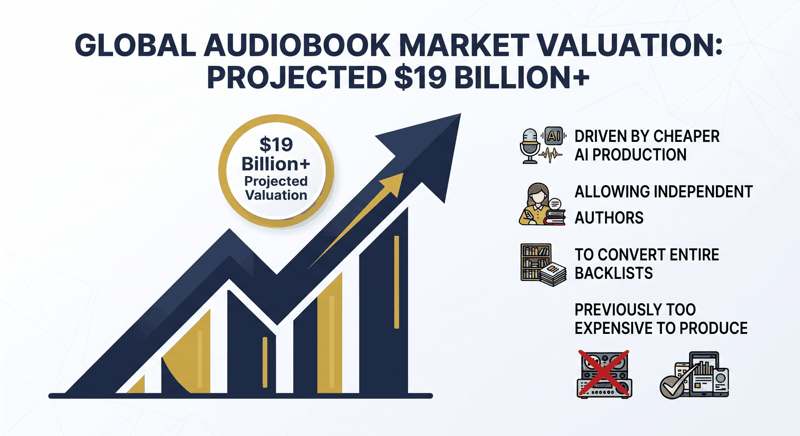
While AI floods the text market, audio remains a bastion of deep connection. However, even this is changing. The 'Audiobook Explosion' predicted for 2026 involves a split: AI narration for backlist/low-cost content, and premium human narration for frontline releases. The strategic author uses AI tools to lower production costs on secondary products while investing heavily in human performance for their flagship works.
The path forward is clear. The 'hustle'—defined as frantic, low-leverage activity designed to appease opaque algorithms—is dead. It has been replaced by a business model built on direct relationships, owned infrastructure, and premium experiences. 2026 is not about doing more; it is about doing what matters, on your own terms.