The 2026 Book Marketing Protocol: Profitability, Direct Sales, and the Death of "Viral"

A definitive guide to book marketing in 2026. Moves beyond vanity metrics to focus on direct sales, algorithmic insulation, and backlist asset management.
The Economic Baseline: Marketing Budget Realities
To discuss strategy without addressing capital is professional malpractice. In 2026, book marketing is not a lottery; it is an investment vehicle. The misconception that 'good books sell themselves' has been thoroughly debunked by the sheer volume of content flooding the market. Authors must now approach their launch with a defined Customer Acquisition Cost (CAC) and a clear understanding of the financial barrier to entry.
Recent industry data suggests that relying solely on organic reach is a strategy for obscurity. Professional authors are now budgeting for visibility across multiple channels, including editorial reviews, targeted PPC (Pay-Per-Click) campaigns, and email list stewardship. According to Reedsy's analysis of publishing costs, the financial commitment required to launch a competitive title has stabilized but remains significant.
This figure—$1,180—represents only the strategic foundation. It covers the intellectual labor of positioning the book, not the tactical execution of ads or the purchasing of newsletter slots. When authors attempt to bypass this strategic phase, they often burn significantly more cash on inefficient ad spend. The market effectively imposes a tax on ignorance; you either pay for strategy upfront or you pay for failed experiments later.
Nuance: The Micro-Budget Misconception
A common error is conflating 'low budget' with 'no budget.' While it is possible to bootstrap, the allocation of funds must be surgical. In 2026, the smartest micro-budget allocations are shifting away from broad awareness campaigns (like generic Facebook boosts) toward high-credibility signals.
For example, allocating $50 for an editorial review or $15-$120 for a targeted price promotion slot yields a higher ROI than dumping $500 into a poorly optimized Amazon Ad campaign. The goal is to purchase social proof and visibility that remains attached to the book page, rather than paying for fleeting impressions.
- Editorial Reviews ($50+): Permanent credibility markers that improve conversion rates on cold traffic.
- Targeted Digital Ads ($5/day): A 'slow drip' approach to maintain consistent visibility rather than a launch-week blitz.
- Email Marketing Tools ($0-$300/yr): The infrastructure for retention, often starting free but scaling with list size.
The 'Profitable Over Popular' Paradigm Shift
For the last decade, the industry was obsessed with 'Rank.' Hitting the USA Today list or achieving an Amazon #1 Bestseller orange tag was the primary KPI. In 2026, the sophisticated author has abandoned vanity metrics in favor of net profit. A bestseller tag lasts for 24 hours; a profitable sales funnel lasts for years.
This shift is driven by the volatility of social algorithms. As noted by experts at Publish a Profitable Book, the chasing of 'viral' moments is resource-intensive and unreliable. Instead, the focus has moved to consistent, lower-volume sales that compound over time, ensuring that the cost of acquisition never exceeds the royalty payout.
"We need to shift away from a 'viral' vanity metrics mindset toward a 'profitable over popular' mindset. Focus on direct messaging workflows and daily soft selling that feels natural. - Jenn Hanson-dePaula"
Nuance: The 'Two Sales a Day' Mathematics
The 'Two Sales a Day' strategy sounds deceptively simple, but it is mathematically powerful. Selling two books a day equates to roughly 730 sales a year. If those readers are funneled into a newsletter and subsequently buy from the backlist, the Lifetime Value (LTV) of that cohort grows exponentially. This approach removes the pressure of five-figure launch weeks.
Implementation of this strategy requires simplified link paths. Rather than complex multi-stage funnels with upsells and downsells that confuse the mobile user, authors are using direct links and 'soft selling' in Direct Messages (DMs). The friction is removed. You have a conversation, you offer a link, you close a sale.
Direct Sales: The Margin Protection Strategy
The most significant structural change in the 2026 market is the exodus from exclusive retailer dependency. With platforms like Amazon taking substantial cuts (often 30-70%) and retaining customer data, authors are pivoting to Direct Sales. This is not merely a trend; it is a survival mechanism to preserve margins and own the customer relationship.
Selling direct allows the author to capture the email address immediately—something Amazon prohibits. This data ownership enables retargeting and higher conversion rates on future releases. According to Miblart's report on self-publishing trends, this shift is gaining critical mass as technology lowers the barrier to entry for setting up author-owned storefronts.
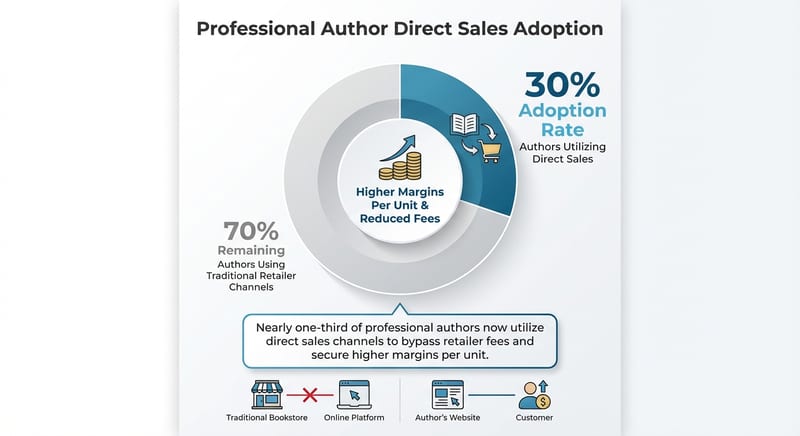
While 30% might seem like a minority, it represents the upper echelon of earners. These are the authors who have realized that a $4.99 ebook sold directly yields significantly more profit than the same book sold through a retailer, once delivery fees and exclusivity constraints are removed. Furthermore, direct sales facilitate the bundling of formats (ebook + audiobook) which increases the average order value.
Nuance: The Friction of Direct Commerce
The challenge with direct sales is user friction. A reader can buy on Amazon with one click; on your site, they must enter credit card details. To combat this, successful direct sellers must offer incentives that retailers cannot match. This is where 'exclusive content' and 'early access' become currency.
You are not just selling a file; you are selling a premium experience. The strategy involves guiding your most loyal readers (Superfans) to your direct store while leaving the casual readers on Amazon. You do not need to convert 100% of your audience to direct sales—only the top 20% who generate 80% of your revenue.
- Platform Independence: Immunity to sudden retailer account bans or algorithm changes.
- Instant Cash Flow: Receive payouts daily or weekly via Stripe/PayPal, rather than waiting 60 days for retailer royalties.
- Higher Margins: Keep 90-95% of the revenue compared to 35-70% on retailers.
Neuromarketing: Reducing Cognitive Load
As the market crowds, the window for persuasion shrinks to milliseconds. This has led to the rise of Neuromarketing in book blurbs and cover design. It is no longer enough to write 'good copy'; the copy must be engineered to align with how the brain processes information and makes decisions under pressure.
Concepts like 'Friction' and 'Nudge Theory' are now essential. Convertize highlights that reducing the cognitive effort required to understand a book's premise creates a 'sliding' effect towards the buy button. If a reader has to read a sentence twice to understand the genre, you have lost the sale.
Nuance: The 'Pre-Suasion' of Visual Storytelling
Pre-suasion involves setting the context before the ask is made. In book marketing, this is achieved through visual storytelling on platforms like Instagram and TikTok. Trends identified by Smith Publicity indicate that authors are moving away from static images of book covers toward dynamic visual narratives that evoke the *feeling* of the book.
This aligns with the 'Allyship in Action' trend, where marketing is community-focused. By visually demonstrating the lifestyle or values associated with the book, authors reduce the psychological risk for the buyer. The transaction feels like joining a tribe rather than purchasing a product.
The Asset Mentality: Backlists and Income Scaling
Finally, the most mature strategy in 2026 is the treatment of a book catalog as an investment portfolio. The 'one-hit wonder' model is obsolete. Sustainable income is derived from a deep backlist where new releases serve primarily as marketing events for older titles. This is the 'waterfall' effect of book sales.
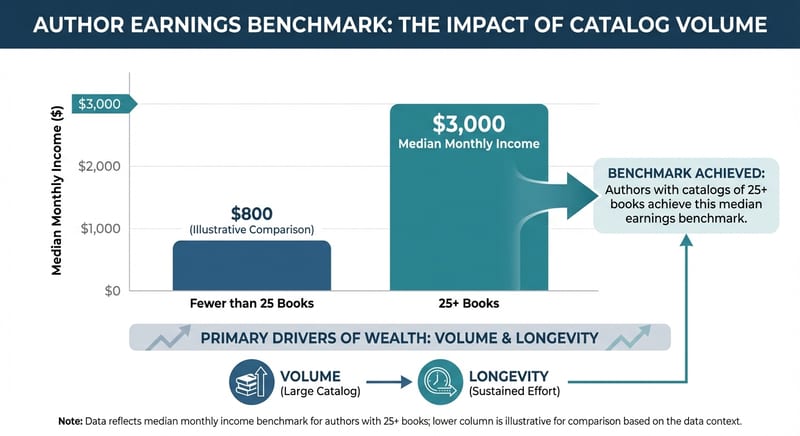
Data indicates a strong correlation between catalog size and median income. Authors who persist past the initial struggle and build a library of intellectual property see a compounding return on their marketing efforts. A single ad for book one can trigger a read-through chain of ten books, increasing the allowable acquisition cost ten-fold.
This statistic is the ultimate rebuttal to the 'get rich quick' narrative. Writing 25 books is a multi-year endeavor. It requires discipline, systems, and a rejection of short-term gratification. However, once that threshold is crossed, the income stabilizes, and the marketing flywheel begins to spin with significantly less friction.