Book Marketing Strategies 2026: The Shift to Sovereign Systems

A definitive analysis of the 2026 book marketing landscape. We explore the transition from retailer reliance to direct-to-consumer ecosystems, the death of vira
The Pivot to Direct Sales Sovereignty
For the last decade, book marketing was synonymous with 'Amazon optimization.' That era is closing. The primary strategy for 2026 is the establishment of direct sales channels. This is not merely about higher margins—though avoiding the 30-65% retailer tax is significant—it is about data ownership. When a reader buys from a retailer, they are the retailer's customer. When they buy direct, they are yours. As noted in recent industry analysis, this shift is the only hedge against platform enshittification.
The operational reality, however, is that direct sales require a shift in mindset from 'writer' to 'e-commerce operator.' It demands a robust infrastructure capable of handling transactional emails, tax compliance, and digital delivery. According to Miblart's 2026 Trends Report, this is no longer a fringe theory but a statistical inevitability for career authors.
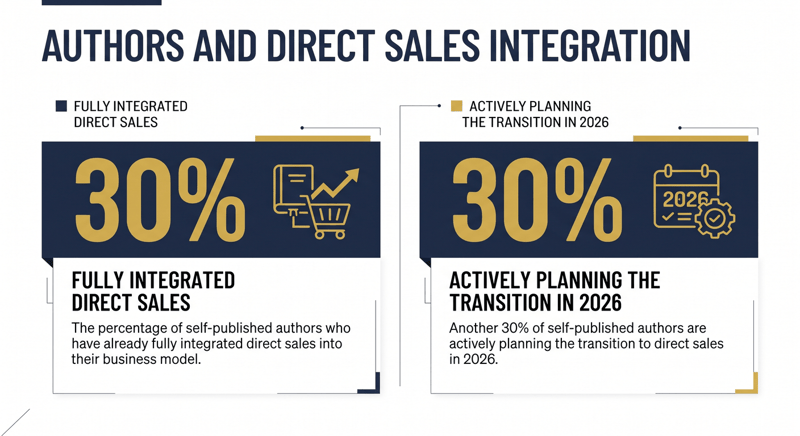
This 30% adoption rate signals the 'crossing of the chasm.' Early adopters have ironed out the technical friction, and tools like Shopify and WooCommerce have standardized the integration for booksellers. The data suggests that we are approaching a tipping point where direct availability will be a reader expectation, not just an author preference.
Nuance: The Merchant of Record Barrier
The most overlooked complexity in direct sales is the 'Merchant of Record' (MoR) liability. Selling a PDF or EPUB to a reader in the EU, UK, or various US states triggers digital sales tax nexus obligations immediately. Many authors launch stores assuming their payment processor (Stripe/PayPal) handles this. They do not.
To mitigate this without hiring a dedicated accounting firm, the 2026 standard is to utilize specialized MoR platforms or plugins that calculate and remit taxes automatically. Ignoring this technical nuance creates a ticking time bomb of tax liability that can bankrupt a scaling author business.
- Shopify + Tax Jar: High control, higher complexity. Best for authors earning $50k+ annually.
- Payhip/Lemon Squeezy: Acts as the MoR. Lower control, but handles VAT/Sales Tax automatically.
- WooCommerce: Maximum ownership, requires significant maintenance.
The 'Death of Hype' and Rise of Systems
The 'viral launch' model—characterized by massive, condensed effort to spike retailer algorithms—is yielding diminishing returns. Algorithms have become too volatile and paid advertising costs too high to sustain a business on spikes alone. The prevailing philosophy for 2026 is the construction of sustainable marketing systems.
This systemic approach focuses on 'always-on' visibility rather than launch-week hysterics. It prioritizes the backlist over the frontlist. Joanna Penn's 2025 Review highlights this critical mindset shift: the move away from the 'hamster wheel' of constant content creation toward asset sweating—ensuring every book already written continues to generate revenue.
"The death of hype is not the death of sales. It is the maturation of the industry. We are moving from a lottery-ticket mentality to an investment-portfolio mentality. - Joanna Penn, The Creative Penn"
Nuance: The 'Frankenstein' AI Workflow
While 'systems' sounds efficient, the implementation is often messy. The current trend involves what experts call 'Frankenstein' AI workflows—cobbling together disparate tools for drafting, audio narration, and ad copy. These systems promise efficiency but often introduce quality control bottlenecks.
The successful marketer in 2026 does not automate strategy, only execution. Using AI to generate ad variations is standard; using AI to determine your market positioning is fatal. The nuance lies in retaining human oversight on the 'why' while outsourcing the 'how' to software.
Email: The Only Algorithm You Control
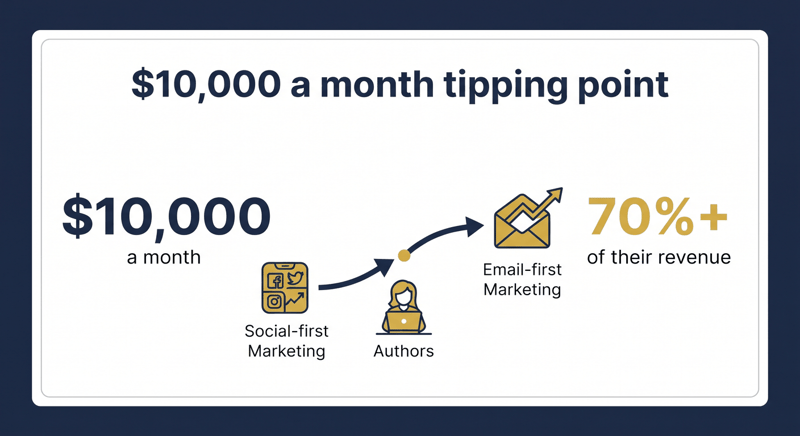
Despite the proliferation of social platforms, email remains the single highest ROI channel for authors. Social media is 'rented land' where visibility is taxed via ad spend. Email is 'owned land.' The core competency of a 2026 author is not writing tweets, but managing list hygiene and segmentation.
The disparity in effectiveness is stark when analyzing income brackets. As outlined in Manuscript Report's 2026 Guide, low-earning authors tend to prioritize social media engagement, while high-earning authors prioritize list growth and auto-responder sequences.
Nuance: Behavioral Segmentation
The 'batch and blast' newsletter method is obsolete. Modern email marketing requires behavioral segmentation. If a reader clicks a link for a thriller but not a romance, they should be tagged accordingly. If they buy Book 1 direct, they should enter a specific onboarding flow that upsells Book 2 immediately.
This level of granularity allows for 'micro-launches'—selling specific products to specific sub-segments of your list without burning out the entire audience. It increases open rates and drastically reduces unsubscribe rates.
Metadata: The Silent Salesman
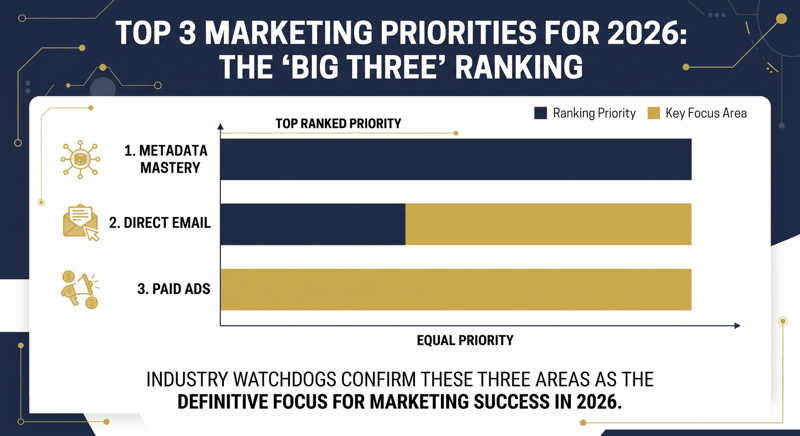
Metadata is the infrastructure of discoverability. It includes your keywords, categories, subtitles, and blurb hooks. In an environment flooded with content, excellent books fail daily because their metadata does not signal relevance to the search algorithms of Amazon or Google.
Updating metadata is not a 'set and forget' task. It is a quarterly maintenance requirement. Trends shift—the keywords that defined 'Urban Fantasy' in 2024 may be obsolete in 2026. Kindlepreneur’s analysis suggests that keeping metadata fresh is as impactful as running continuous ads.
Nuance: The Subtitle SEO Strategy
A specific, often underutilized tactic is the SEO-heavy subtitle. While the main title can be artistic or abstract, the subtitle must be functional. For non-fiction, it must state the promise clearly (e.g., 'How to...'). For fiction, it should signal the sub-genre immediately to prevent 'click-bouncing.'
Retailers index the subtitle heavily. Placing high-volume keywords here (e.g., 'A Regency Romance') carries more algorithmic weight than stuffing them into the backend keyword slots. However, this must be balanced with readability to avoid looking like spam.
The Diversified Stack: Ads and Services
Finally, we must address the role of paid acquisition. Organic reach on platforms like Amazon is near zero for new releases without a sales velocity history. Therefore, a professional 'marketing stack' involves a blend of continuous background ads and spiked promotional services.
As reviewed by Barker Books, services like BookBub remain the gold standard for 'spikes'—short-term velocity boosts designed to hit charts. However, they must be paired with 'sustenance' ads (Amazon/Facebook) that run daily to maintain rank. Relying on one without the other leads to the 'pop and drop' phenomenon.
- Amazon Ads: Essential for protecting your own product page from competitors.
- Facebook/Instagram Ads: The most effective tool for driving traffic to Direct Sales stores (Shopify).
- BookBub/Written Word Media: Best for list-building and temporary rank spikes.