The Artisan Author: Book Marketing Strategies for the Post-Algorithm Era (2026)

2026 marks the end of 'hustle culture' in publishing. Discover why the most successful authors are pivoting to direct sales, owned data, and the 'Artisan' model
The Sovereignty Shift: Direct Sales as Infrastructure
For over a decade, the 'retailer-first' model (Amazon KDP, Apple Books) was the undisputed king of self-publishing. However, rising ad costs and opaque algorithm changes have exposed the fragility of this approach. In 2026, the strategic pivot is toward 'Sovereignty'—owning the transaction, the customer data, and the platform. This is not just about higher margins; it is about survival in an ecosystem where retailers effectively rent you your own audience.
As highlighted in PublishDrive’s 2026 predictions, direct sales are no longer a niche experiment but a primary revenue stream. The logic is mathematical: relying on third-party platforms subjects authors to a 'discovery tax' (royalties + ads) that is becoming unsustainable for mid-list creators.
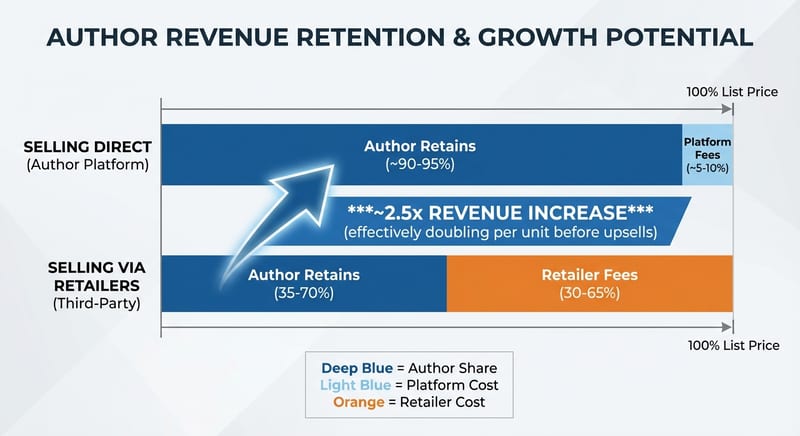
The data above illustrates a stark reality: to earn $50,000 in profit, a retailer-dependent author must move nearly three times the volume of a direct-sales author. This volume requirement forces them into a cycle of aggressive, low-ROI advertising. The direct model breaks this cycle by prioritizing 'Average Order Value' (AOV) over mere unit velocity.
The Nuance: Friction vs. Freedom
The technical counter-argument to direct sales has always been 'friction.' Amazon's 1-Click checkout is a formidable competitor. However, the friction gap has closed significantly with the adoption of digital wallets (Apple Pay, Shop Pay). The modern reader is comfortable buying directly from creators, provided the experience is seamless.
Furthermore, successful implementation requires a mindset shift regarding the purpose of retailers. In 2026, Amazon is not the store; it is the lead generation tool. Smart authors use Amazon's massive traffic to acquire new readers, but use interior book magnets to siphon those readers immediately into their owned ecosystem.
- Shopify: The enterprise standard for authors building full e-commerce brands with merchandise and physical books.
- Bookvault: The essential print-on-demand partner for direct sales, offering higher quality and integration than KDP Print.
- Kickstarter: The 'event' layer of direct sales, used to front-load revenue for special editions before general release.
The Death of Cold Traffic: Warmth as Currency
The era of 'arbitrage advertising'—buying cheap clicks to sell cheap books—is over. AI-generated content has saturated ad networks, driving costs up and click-through rates down. As noted in copywriting trends for 2026, 'warm traffic' strategies utilizing email and community building are significantly outperforming cold direct-response ads. Readers have developed a thick skepticism toward hype-filled ads.
Marketing in 2026 requires a return to 'boring' fundamentals: relationship building. The goal is no longer to interrupt a stranger's scroll, but to nurture a subscriber's trust. This aligns with the broader shift in the Creator Economy toward 'community, credibility, and craft' rather than viral hits.
The Nuance: The Newsletter as a Media Asset
Most authors treat newsletters as notification systems ('My book is live!'). The successful 2026 author treats the newsletter as the product itself. It is a media asset that provides value independent of the book. This retention-first approach insulates the author from platform volatility.
When you treat your email list as a community rather than an ATM, open rates stabilize and churn decreases. This 'warm' audience becomes the engine for launching books, guaranteeing that the algorithm sees a spike in engagement on launch day without spending a dime on ads.
"The focus will shift from visibility and viral hits to 'community, credibility, and craft,' with long-term ROI driving brand investment. - ExchangeWire"
The Audio Explosion: Hybrid Production Models
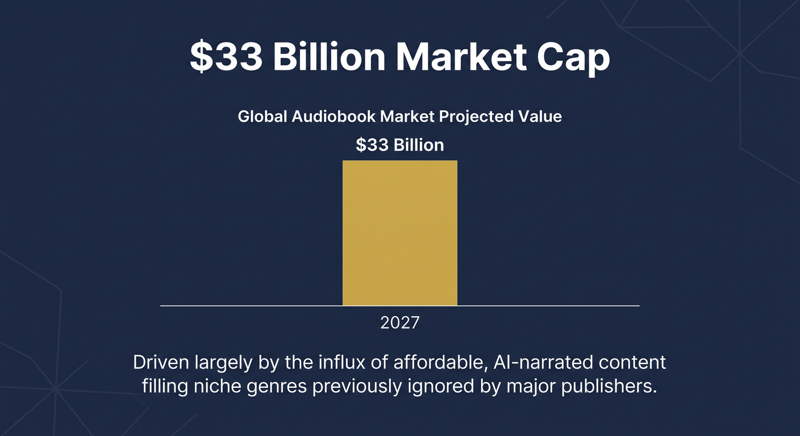
Audiobooks have transitioned from a secondary format to a primary consumption method for millions. Historically, the high cost of production ($300-$500 per finished hour) limited authors to producing audio only for their bestsellers. In 2026, the democratization of AI narration has changed the calculus entirely.
We are witnessing the rise of a 'Hybrid Audio Strategy.' Authors are continuing to invest in premium human narration for flagship titles (frontlist) while utilizing high-quality AI narration for backlist titles, foreign translations, or lead magnets that would otherwise never be profitable to produce. This allows for total catalog exploitation.
The Nuance: Rights and Voice Branding
The technical danger in this new era is rights management. Many early contracts with AI audio platforms claimed ownership of the generated files or even the 'voice' used. The nuanced author ensures they own the 'Master' files of their AI audio, just as they would with a human narrator.
Furthermore, 'Voice Branding' is becoming a marketing asset. Authors are licensing specific AI voices to maintain consistency across a series, or even cloning their own voices to narrate non-fiction, creating a deeper personal connection at scale.
The Artisan Author: Combatting the Commodity Flood
As AI models become capable of generating passable fiction, the market is flooding with commodity content. In response, a bifurcation is occurring. At the bottom, there is cheap, algorithm-generated content. At the top, there is the 'Artisan Author'—a premium status defined by human craft, tangible artifacts, and authentic connection.
Marketing in 2026 is less about 'content' and more about 'context.' Readers are willing to pay a premium for the story *behind* the story. This is why we see a resurgence in physical luxury goods—special editions, signed hardcovers, and print-only bonuses. As AdAge notes, in an AI world, 'trust' and 'human creativity' become the ultimate differentiators.
The Nuance: The Transformation Economy
The economic model is shifting from the 'Information Economy' to the 'Transformation Economy.' Information is free (ask any LLM). Transformation—the feeling of change, belonging, or emotional journey—is scarce. Authors must position their books not as $9.99 files, but as gateways to an experience.
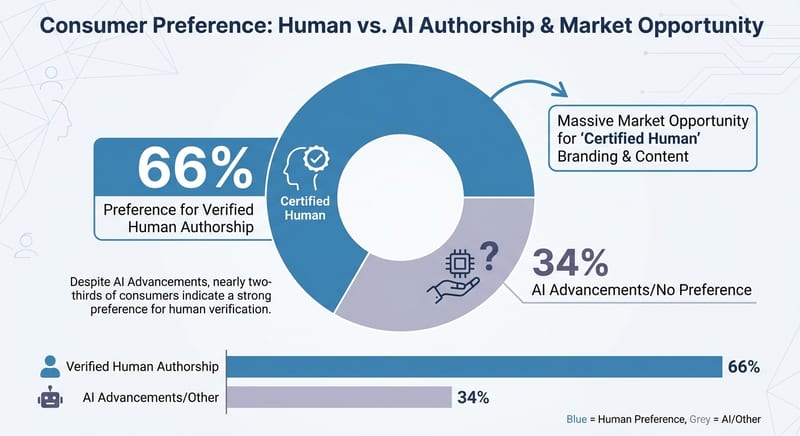
This data point underscores the viability of the Artisan model. While AI can produce volume, it cannot produce the provenance that high-value readers crave. Your marketing must pivot to highlight the struggle, the process, and the humanity of your work.
The path forward is clear: Do not compete with robots on speed. Compete on humanity. Build the infrastructure to sell direct, own your data, and create work that is unmistakably yours. In 2026, the most effective marketing strategy is simply being a human worth connecting with.