The Equity Equation: Valuation and Sovereignty in the 2026 Publishing Model

A definitive white paper analyzing the shift from institutional validation to IP equity. We deconstruct royalties, speed-to-market moats, and the hybrid paradox
1. The Equity Equation: Renting vs. Owning IP
To understand the modern publishing landscape, one must strip away the romance of the 'book deal' and analyze the underlying contract as a financial instrument. Traditional publishing contracts are essentially call options on your intellectual property. You license the exclusive rights to your work to a corporation in exchange for capital (the advance) and distribution services. In contrast, independent publishing is an equity play where the author retains full ownership and captures the majority of the upside.
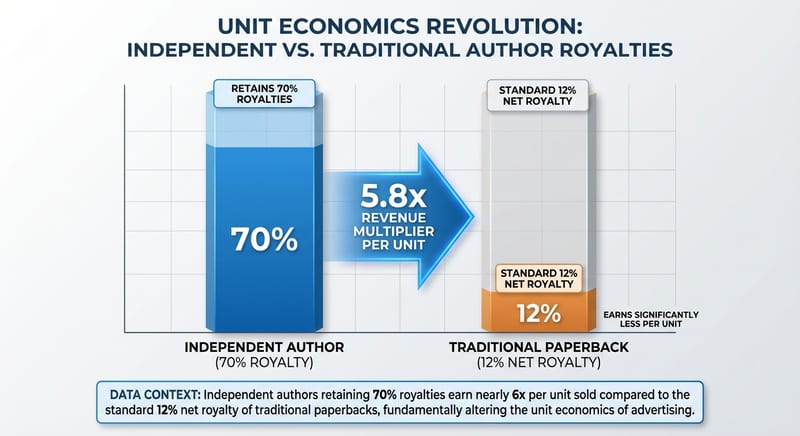
The divergence in financial outcomes is stark. As noted in recent analyses of royalty structures, the independent model offers a margin profile that allows for aggressive reinvestment in marketing—a luxury traditional authors rarely possess. When an author retains 70% of the gross revenue, the break-even point on paid acquisition is significantly lower than for an author retaining 10-15%.
This is not merely about income; it is about valuation. A backlist of independently published titles is a transferable asset with a calculable valuation based on monthly recurring revenue. A backlist of traditionally published titles is a passive income stream controlled by a third party, often with no clear path to rights reversion.
Nuance: The Rights Reversion Trap
The most dangerous clause in a traditional contract is not the royalty rate, but the 'out of print' definition. In the digital age, a book never technically goes out of print. As long as the ebook is listed on Amazon, the publisher retains the rights in perpetuity, even if sales have flatlined to zero.
Sophisticated authors negotiating traditional deals in 2026 are demanding revenue thresholds for reversion. If the book does not earn $X per year, rights must revert. Without this clause, your IP is effectively locked in a zombie state—generating too little for the publisher to care, but legally inaccessible for you to revitalize.
2. Speed as a Strategic Moat
In the information economy, speed is a proxy for relevance. The traditional publishing supply chain, optimized for physical logistics and seasonal catalogs, operates on a timeline that is increasingly incompatible with the pace of modern discourse. For non-fiction authors specifically, the gap between manuscript completion and shelf availability can render the content obsolete before it is ever purchased.
We define this as the Agile Advantage. Independent authors can pivot, update, and publish within weeks. This agility allows for 'newsjacking'—releasing content that addresses an immediate market need or cultural conversation. While a traditional publisher is scheduling meetings to discuss cover art for a book launching in two years, the indie author has already captured the market share.
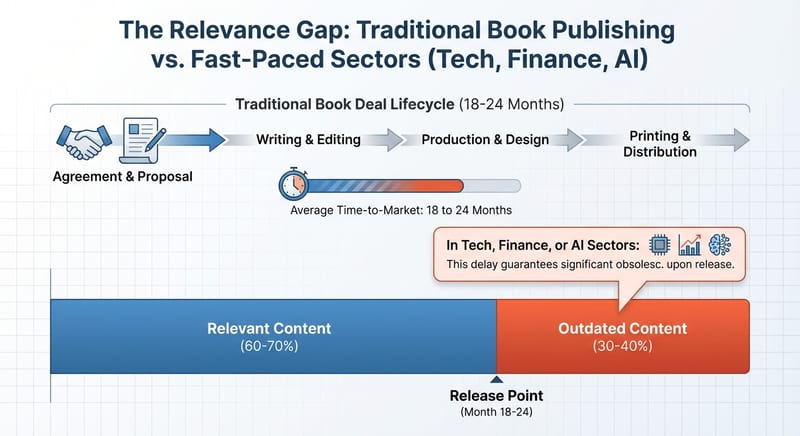
This timeline disparity creates a 'content arbitrage' opportunity. By the time the definitive traditional book on a new topic (e.g., a specific AI tool) hits the shelves, indie authors have already dominated the Amazon search algorithms with five agile iterations on the subject.
Nuance: Iterative Publishing
The software industry does not release 'finished' products; they release MVPs (Minimum Viable Products) and iterate. Independent publishing allows for this same methodology. An author can release a 'Version 1.0,' gather reader feedback, and upload a 'Version 2.0' with corrections and expansions the very next day. Traditional print runs lock errors and omissions in place for years.
This dynamic capability turns the book into a living document rather than a static artifact. For technical or instructional books, this is not just a feature; it is a requirement for maintaining authority.
3. The Distribution Fallacy
The primary value proposition of the traditional publisher has historically been physical distribution. The argument is that only they can get you onto the table at Barnes & Noble. While true, one must question the *value* of that placement in 2026. Physical bookstores act increasingly as showrooms for digital purchases, and the volume of sales occurring in brick-and-mortar locations continues to contract relative to online channels.
Furthermore, distribution reach is no longer a binary of 'in stores' or 'not.' The rise of Print-on-Demand (POD) technology through IngramSpark allows independent authors to be listed in the same wholesaler catalogs as the Big Five. A bookstore *can* order an indie book just as easily as a Penguin Random House title; the difference is simply that the publisher is not paying for shelf rental.
"Distribution is no longer the bottleneck. Attention is the bottleneck. Being available everywhere is easy; being noticed somewhere is the challenge. - MasterClass Analysis"
Nuance: The Agentic Economy
As we move toward an 'Agentic Economy' where AI agents perform search and discovery for users, physical availability matters even less. An AI summarizing the 'best books on leadership' does not care which distributor shipped the unit; it cares about semantic relevance, review sentiment, and digital authority. In this arena, the metadata optimization available to indie authors often outperforms the legacy data structures of traditional houses.
The battleground is shifting from physical shelf space (finite) to digital semantic space (infinite but crowded). Traditional distribution creates a physical moat, but it is a moat around a shrinking castle.
4. Marketing Autonomy vs. The Rescue Fantasy
A pervasive myth persists that signing a traditional deal absolves the author of marketing duties. This is the 'Rescue Fantasy.' The reality, confirmed by marketing data across the industry, is that publishers are primarily manufacturers and distributors. They are not boutique marketing agencies. Unless an author receives a lead-title advance (typically high six-figures), the internal marketing budget allocated to the book will be negligible.
Current marketing realities dictate that the author must build the platform, nurture the email list, and drive the initial sales velocity regardless of the publishing model. The difference is that in a traditional model, you are doing 100% of the work for 15% of the profit. In the independent model, that same labor yields 70%.
5. The Hybrid Protocol: Diversified Assets
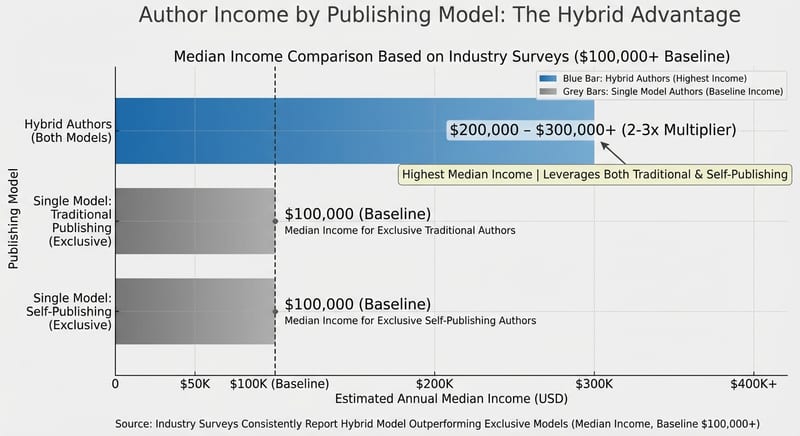
The most sophisticated operators in 2026 do not choose sides; they play the field. The 'Hybrid Author' utilizes traditional contracts for specific purposes—usually to capture the print market and mainstream prestige—while retaining digital and audio rights for direct monetization. This diversified approach mitigates risk.
For example, an author might sell the print rights of a lead magnet book to a major publisher to gain access to airport bookstores (branding play), while self-publishing the accompanying course materials, workbooks, and audio-first sequels (revenue play). This maximizes the Total Addressable Market while keeping the high-margin products in-house.
- Print-Only Deals: Negotiating to sell only the print rights while keeping ebook/audio (rare, but possible for high-leverage authors).
- Foreign Rights Splintering: Self-publishing in your home language while selling translation rights to foreign publishers.
- Format Arbitrage: Using the prestige of a traditional deal to drive traffic to a high-ticket backend funnel.
Nuance: The Non-Compete Clause
The obstacle to the hybrid model is the 'Non-Compete' or 'Option' clause in traditional contracts. Publishers often demand the right of first refusal on your *next* work, or ban you from publishing 'competing works' during the contract term. These clauses can effectively freeze your independent business for years. The strategy here is to narrow the definition of 'competing work' to the specific genre and format, ensuring you remain free to publish in other lanes.