The Sovereign Author: 2026 Book Marketing Strategies for Direct Sales

A definitive white paper on the shift from Amazon dependence to Direct-to-Consumer (DTC) ecosystems. Learn the infrastructure, economics, and marketing protocol
The Macro Shift: The Death of the Middleman
For the last decade, the publishing industry has operated on a wholesale model that prioritized convenience over control. Authors happily ceded 40-60% of their revenue and 100% of their customer data to giants like Amazon in exchange for distribution. However, the economic winds have shifted. As outlined in recent market analyses on the death of the middleman, the new imperative is vertical integration. Manufacturers—in this case, authors—are reclaiming the supply chain to secure brand narrative and longevity.
This is not merely a preference; it is a survival mechanism. Relying on third-party algorithms for discovery creates a single point of failure. When a retailer changes their organic reach algorithm or increases ad costs, the 'tenant' author loses their livelihood. The 'sovereign' author, by contrast, owns the transaction, the customer email, and the retargeting pixel. This shift mirrors the broader DTC trends in e-commerce, where 'owned audiences' are valued significantly higher than 'rented audiences' on social platforms.
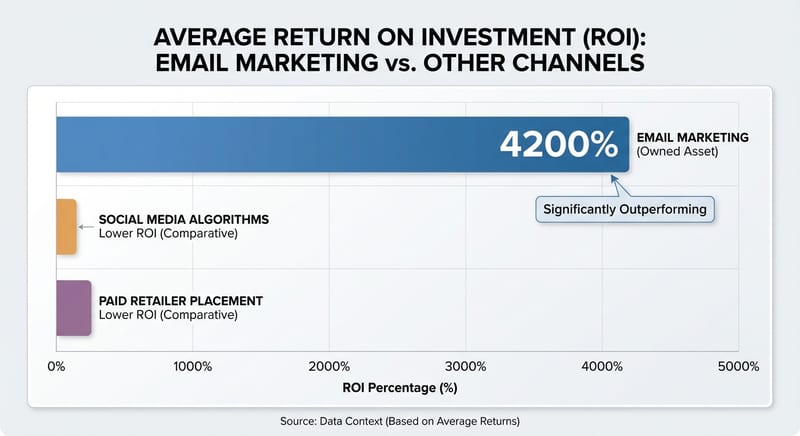
The statistic above is not an anomaly; it is the mathematical reality of direct access. When you remove the algorithmic gatekeeper, your marketing cost stabilizes while your Customer Lifetime Value (CLV) compounds. In a direct sales environment, a reader is not a one-time purchaser but a recurring subscriber to your intellectual property. This distinction is the foundation of the 2026 marketing playbook.
Infrastructure: The Advanced Direct Sales Website
To execute a sovereign strategy, your digital presence must evolve from a brochure to a marketplace. The days of a simple 'About Me' page with external links to Amazon are gone. According to Kindlepreneur's guide to author websites, the standard for 2026 is the 'Advanced Direct Sales Website.' This infrastructure allows you to process transactions globally, manage inventory, and bundle digital and physical goods in ways retailers prohibit.
Platforms like Shopify and WooCommerce have democratized enterprise-grade e-commerce tools for authors. By utilizing these platforms, authors can implement upsells (e.g., 'Add the audiobook for $5') and cross-sells at the point of checkout—tactics that increase Average Order Value (AOV) but are impossible to execute on Amazon. This control over the 'checkout flow' is arguably more valuable than the sale itself.
Nuance: The Technical Reality of Sales Tax
While the benefits of direct sales are clear, the administrative burden is the primary barrier to entry. Selling directly means you are the 'Merchant of Record.' You are responsible for collecting and remitting sales tax in jurisdictions where you have a nexus. This complexity often deters authors who prefer the 'set it and forget it' nature of KDP.
However, solutions like TaxJar or merchant-of-record services (like Lemon Squeezy or Paddle) handle this compliance automatically. The 'Nuance' here is that you must view your writing career as a small business operation. The cost of these tools is a fraction of the 40% royalty cut you save by selling directly. Ignorance of tax law is not a strategy; automation is.
- Transactional Control: Ability to offer bundles (Ebook + Signed Paperback).
- Data Harvesting: Pixel tracking for Facebook/Google Ads retargeting.
- Margin Protection: Eliminating the 30-65% retailer cut.
- Speed to Market: Instant updates without 72-hour review wait times.
The Economics of Sovereignty: Print-on-Demand Evolution
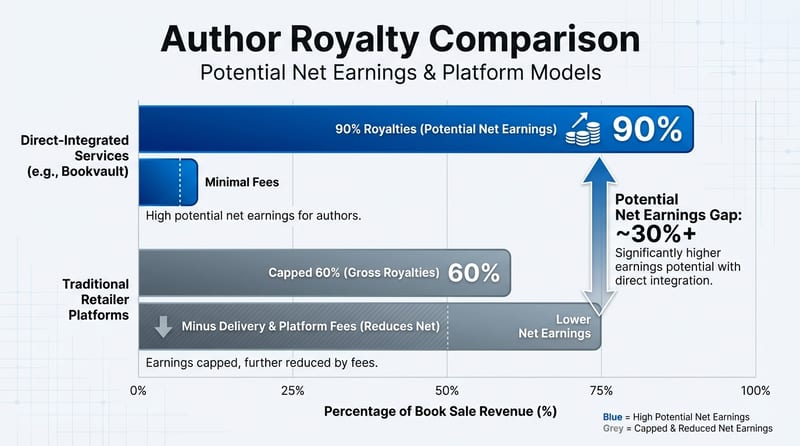
The supply chain has finally caught up to the direct sales ambition. Historically, selling direct meant ordering 500 copies, storing them in a garage, and driving to the post office daily. This is no longer the case. Services identified by Reedsy's analysis of printing services, such as Bookvault, integrate directly with your website to print and ship orders on demand, completely bypassing Amazon's ecosystem while offering superior royalty structures.
This integration allows for a 'virtual warehouse' model. When a customer buys a book on your site, the order is automatically routed to the printer, who prints, packs, and ships it white-labeled (appearing to come from you). The author touches nothing but the profit margin. This effectively replicates Amazon's logistics network but retains the customer relationship for the author.
The financial implications of this shift are drastic. When selling through a retailer, you are subject to distribution fees, wholesale discounts, and retailer cuts. When selling direct via a modern POD service, your only costs are printing and shipping. The remaining revenue is yours.
"Success comes from 2-3 core strategies, not everything. Focusing on an owned asset to drive sales directly bypasses the volatility of algorithms. - Manuscript Report Strategy Guide"
Audience Retention: The "Owned Asset" Protocol
Marketing is often confused with 'visibility.' In 2026, visibility is cheap; attention is expensive. The core objective of your marketing funnel must be to move casual browsers from 'rented land' (social media, Amazon product pages) to 'owned land' (your email list). Manuscript Report emphasizes that the email list is the only asset that appreciates over time, whereas social media followings depreciate as organic reach declines.
An 'Owned Asset' protocol requires a 'Reader Magnet'—exclusive content given in exchange for contact information. However, the 2026 update to this strategy involves segmentation. Do not treat all subscribers equally. Use tagging to identify 'Whales' (high spenders) versus 'Freebie Seekers.' Your marketing efforts should be disproportionately focused on the former.
Nuance: List Hygiene Over Volume
A common vanity metric is the size of the email list. A list of 50,000 unengaged subscribers is a liability, not an asset, due to deliverability costs and spam filters. The professional approach is ruthless 'List Hygiene.' If a subscriber has not opened an email in 90 days, they should be placed in a re-engagement sequence. If they still do not engage, delete them.
This counter-intuitive practice improves your sender reputation with ISPs (Google, Yahoo), ensuring your emails actually hit the inbox for the people who want to buy. A smaller, hyper-responsive list generates more revenue than a bloated, indifferent one.
The Physical Frontier: Unconventional Retail
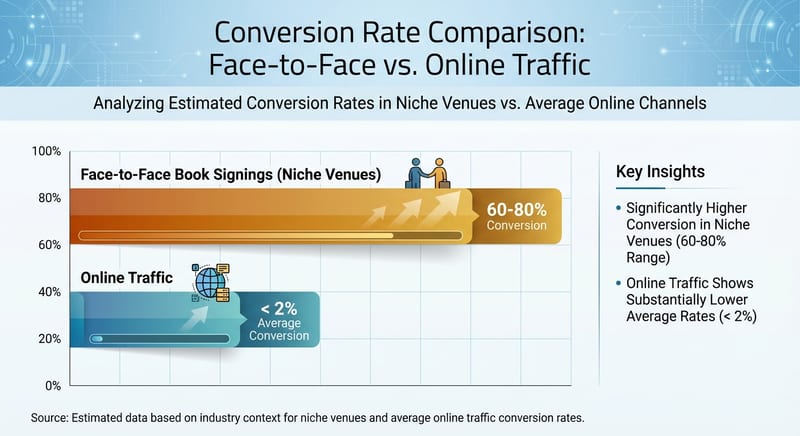
Digital dominance does not negate physical presence. In fact, as digital spaces become saturated, physical 'unconventional' spaces offer high-conversion opportunities. The Writers Alliance of Gainesville highlights a growing trend of authors bypassing bookstores for farmers markets, local boutiques, and coffee shops. These venues have zero competition compared to the thousands of spines on a Barnes & Noble shelf.
When selling in person, you are not just selling a book; you are selling an interaction. The conversion rate of a face-to-face pitch is exponentially higher than a digital ad. Furthermore, these sales can be processed through your direct sales POS (Point of Sale) system, capturing the customer's email immediately for future digital retargeting.
Conclusion: The Sovereign Imperative
The transition to 2026 is defined by autonomy. The tools now exist to manage the entire publishing lifecycle—from metadata to mailbox—without a middleman taking the lion's share of the profit. While the learning curve for direct sales infrastructure is steeper than simply uploading a file to KDP, the view from the top is ownership.
Authors who cling to the wholesale model will find their margins squeezed by rising ad costs and shrinking organic reach. Those who build their own platforms, cultivate their own lists, and control their own supply chains will find themselves not just surviving, but thriving in a market that rewards sovereignty.