The Post-Platform Pivot: Book Marketing Strategies for the 2026 Landscape

2026 marks the end of the 'Hustle Era.' With Amazon relaxing DRM and social bans looming, authors must pivot to hybrid distribution and sustainable, low-volume
Market Stagnation: The Reality of Physical Retail
To understand the marketing imperative of 2026, one must first confront the macroeconomic reality: the explosive growth of the early 2020s has cooled. The market has matured into a state of 'stable stagnation.' According to Publishers Weekly data for 2025, the print market is no longer expanding rapidly, but rather holding a defensive line. This signals that 'growth' can no longer come from rising tides lifting all boats; it must come from market share conquest.
The implication for authors is that inventory management and supply chain resilience are now marketing problems. You cannot market a book that isn't on the shelf, and with supply chains still fragile, the 'Just-in-Time' model is failing. The rebound in Children's fiction suggests that buyers are prioritizing physical artifacts for younger generations while adult fiction stagnates, forcing adult genre authors to fight harder for physical shelf space.
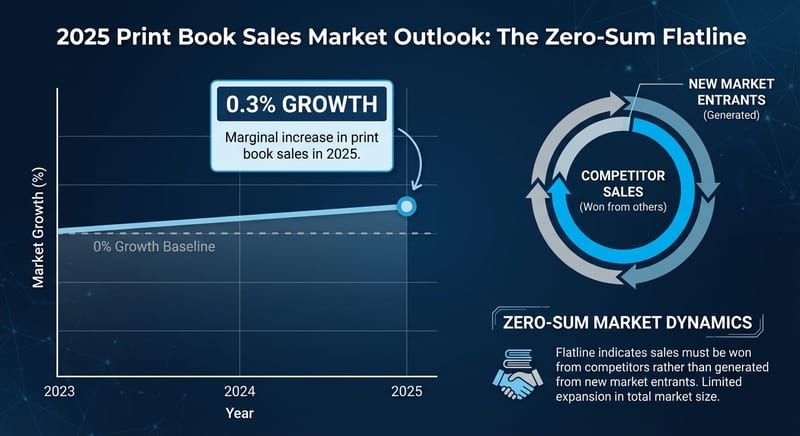
This statistic is the bedrock of 2026 strategy. In a flat market (0.3% growth), aggressive 'spray and pray' advertising burns cash without capturing new readers. The winning strategy shifts to retention and higher revenue per customer, rather than volume acquisition.
The Nuance: The 'Let Them Theory' Effect
While the aggregate market is flat, specific pockets are booming. The success of titles like Mel Robbins' The Let Them Theory demonstrates that non-fiction which offers psychological relief is outperforming narrative fiction. The nuance here is 'utility.' In a high-stress economic environment, books that serve a function (self-help, education) are viewed as essential purchases, while entertainment is discretionary.
Marketing copy must therefore pivot from 'This is a great story' to 'This will solve X problem.' Even fiction must be framed through the lens of emotional utility—escapism, catharsis, or community belonging.
The Technocratic Shift: Amazon DRM and Open Ecosystems
For fifteen years, the 'Kindle ecosystem' was a fortress. However, January 2026 marked a pivotal shift with Amazon's rollback of DRM restrictions. By allowing easier EPUB/PDF downloads that mirror other retailers, Amazon has effectively acknowledged the dominance of the 'interoperable reader.' This is not altruism; it is a response to the growing direct sales movement where readers demand ownership of their files.
This creates a massive marketing opportunity for 'Sovereign Authors.' Previously, selling direct files (via Shopify or Bookvault) came with the friction of 'sideloading'—a technical hurdle that killed conversion rates for non-tech-savvy readers. With the barriers lowered, authors can now market 'Direct Editions' (cheaper, higher royalty) to Kindle users without the customer support nightmare.
The Nuance: Data Ownership vs. Convenience
The nuance lies in the 'Send to Kindle' infrastructure. The modern author must provide a 'one-click' experience that bypasses the Amazon store but utilizes the Amazon device. This requires using delivery services (like BookFunnel) that integrate with the new DRM-free standards.
The marketing angle is 'portability.' Your value proposition to the reader is: 'Buy it once, read it anywhere, forever.' This resonates with a consumer base increasingly wary of digital subscriptions where content can disappear.
The Regulatory Cliff: Social Bans and the YA Crisis
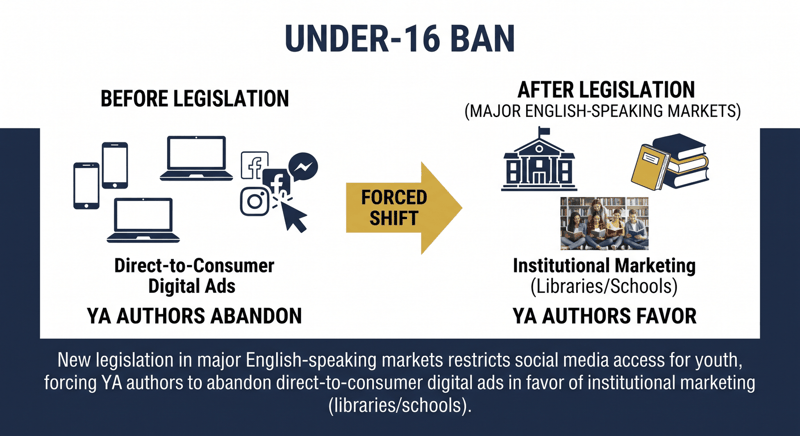
Digital marketing has always relied on unrestricted access to youth demographics. That era is ending. With Australia banning social media for under-16s and other nations considering similar legislation, the primary discovery engine for Young Adult (YA) fiction—TikTok and Instagram—is being severed for its target audience.
This is an extinction-level event for authors who rely solely on 'BookTok' trends to reach teenagers. If your audience cannot legally log in to the platform where you advertise, your funnel is broken. This necessitates a pivot back to 'Institutional Gatekeepers'—librarians, teachers, and physical bookstore displays.
The Nuance: The Return of the Librarian
When algorithms are legislated out of existence, humans regain power. The 'influencer' of 2026 for the YA market is not a TikTok star; it is the school librarian. Marketing packets must shift from 15-second video hooks to 'Educator Guides' and 'Reading Group Discussion Questions.'
This requires a completely different skillset: B2B (Business to Business) marketing. You are not selling to the reader; you are selling to the purchaser (the school district). The cycle is slower, but the volume—class sets of 30 books—is higher.
"We are seeing a return to 'hand-selling' as the primary driver of youth fiction. The algorithm can no longer reach them, so the bookseller must. - Self Publishing Advice Center"
The Hybrid Leverage: Grassroots to Big Five
The dream of 'getting picked up' by a publisher has evolved into 'getting leveraged up.' The case of Elinor Florence illustrates the modern trajectory. Her independent success with Finding Flora wasn't just luck; it was a grassroots campaign utilizing pharmacy chains and local 'buy local' movements that generated enough data to justify a 3-book deal with Simon & Schuster.
Florence's strategy utilized 'non-traditional retail.' Instead of fighting for space in Indigo or Barnes & Noble, she targeted pharmacies and gift shops. These venues have less competition and higher foot traffic from older demographics who are less likely to be influenced by digital ads. This 'Blue Ocean' retail strategy builds the sales velocity required to get a traditional publisher's attention.
- Pharmacy Chains: High traffic, low competition, eager for low-cost impulse buy items (paperbacks).
- Gift Shops: Willing to take books on consignment if they match the regional aesthetic.
- Hybrid Deals: Using this sales data to negotiate 'print-only' deals while retaining ebook rights.
The Year of Ease: Sustainability as Strategy
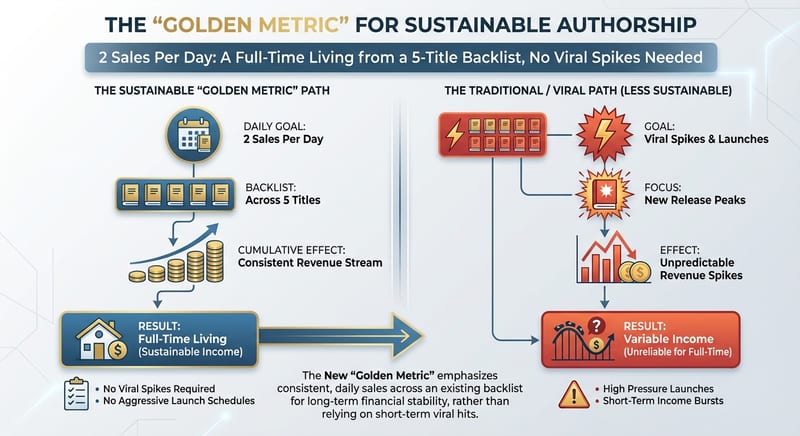
Perhaps the most profound shift in 2026 is cultural. The 'Hustle Culture' of 2020—launching every 30 days, posting 5 times a day—has resulted in mass burnout. The industry is adopting a new mantra: The Year of Ease. This is not about laziness; it is about mathematical sustainability.
The strategy replaces the 'Launch Spike' (making $10,000 in one week, then zero for months) with the 'Daily Drip.' The goal is to build automated systems—backlist ads, auto-responder emails, SEO-optimized blog posts—that deliver a consistent baseline of sales. It is the move from being a 'hunter' (active hustle) to a 'farmer' (passive harvest).
The Nuance: Audible + TikTok Integration
Ease requires leverage. The new Audible and TikTok partnership is a prime example of platform leverage. By featuring 'Best of BookTok' lists directly inside the Audible app, Amazon is automating discovery for romance and dark academia genres.
Authors do not need to dance on camera; they need to ensure their audiobook metadata (keywords, categories) aligns with current TikTok tropes. If your metadata is accurate, the integration does the marketing work for you. This is the essence of the 'Year of Ease': doing the technical work once to reap the algorithmic rewards indefinitely.