The Tenant Trap: Why 2026 is the Year of Direct Sales and Data Sovereignty

A definitive guide to escaping Amazon exclusivity. We analyze the 30% shift to direct sales, the rise of 'Agentic Commerce,' and the premiumization of the physi
The End of Retailer Dependency
For the past decade, the 'indie' author playbook was dangerously simple: upload to Amazon, buy ads, and pray to the algorithm. In 2026, this model is showing signs of systemic failure. The volatility of retailer algorithms, combined with rising ad costs, has turned exclusivity into a liability. We are witnessing a structural shift where smart authors are treating Amazon not as a partner, but as a discovery engine—a top-of-funnel lead generator for their own storefronts.
This is not merely about higher royalties; it is about survival. As noted by Miblart's 2026 Trend Report, relying on a single retailer exposes an author's entire income stream to policy changes and 'ban hammer' risks. The sophisticated author is now building a diversified ecosystem where the primary transaction happens on their own domain.
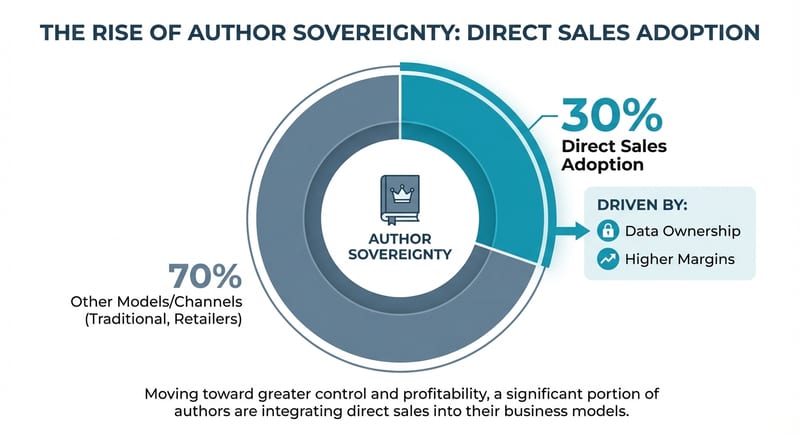
This statistic is the canary in the coal mine. While 83% remain dependent, the top earners are aggressively moving away. They are leveraging the retailer's massive traffic to acquire readers, but using 'content upgrades' and reader magnets to migrate those readers onto an owned email list, eventually converting them into direct customers. The goal is to invert the funnel: Amazon gets the $0.99 sale; your Shopify store gets the $50 bundle.
Nuance: The Direct Sales Margin Architecture
The argument for direct sales is often reduced to 'keeping 95% instead of 70%.' While true, the deeper nuance is the decoupling of format and price. On Amazon, you are capped by market expectations (e.g., $4.99 for an ebook). On your own site, you are selling an experience. You can bundle the ebook, the audiobook, and a digital workbook for $25. This creates an Average Order Value (AOV) that makes paid advertising sustainable in a way that $2.99 royalties never will.
Furthermore, 'Direct' allows for the sale of formats Amazon cannot process, such as signed bookplates, special editions with sprayed edges, or digital box sets of 10+ books. This is the 'Premiumization' of the indie market.
From SEO to Agentic Commerce
Search Engine Optimization (SEO) as we knew it is dead. It is being replaced by Generative Engine Optimization (GEO) and 'Agentic Commerce.' Readers are no longer typing keywords into a search bar; they are conversing with AI agents. As Joanna Penn predicts, the future involves AI purchasing agents buying books on behalf of human users based on vague prompts like 'Get me the best five sci-fi novels about colonization from the last year.'
If your book's metadata is not optimized for these Large Language Models (LLMs), you are invisible. The battleground has shifted from ranking for keywords to establishing 'Entity Authority.' You need the AI to recognize your book as the definitive answer to a query. This requires broad mentions across authoritative domains—Wikipedia, major media, and trusted review sites—which the AI uses to verify relevance.
"“We are moving to a world where the AI is the gatekeeper. If the model hasn't ingested your data from a trusted source, you simply don't exist to the end user.”"
Nuance: The Authenticity Counter-Signal
As AI floods the market with 'slop' content, a counter-trend is emerging: the craving for verified humanity. Marketing in 2026 must lean heavily into the 'Artisan' narrative. Readers want to see the messy process, the hand-written notes, and the face behind the text. This is why 'live selling' and behind-the-scenes content are outperforming polished, corporate-style book trailers.
This 'Human Connection' is the only moat against AI saturation. An AI can write a book, but it cannot sign a copy, host a live Q&A, or share a personal struggle. Your marketing must pivot from selling the content to selling the connection.
- Verification: Use 'Human Made' badges on your site and marketing materials.
- Transparency: Show your drafting process to prove human authorship.
- Community: Move fans off social media into private communities (Circle/Discord) where algorithms cannot throttle your reach.
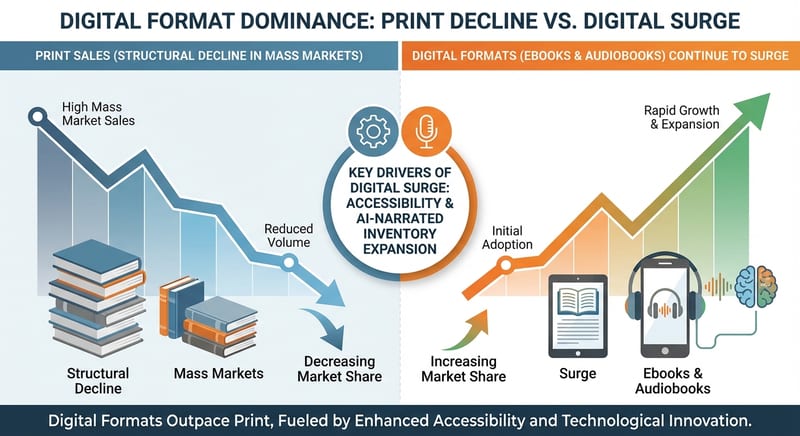
This 30% figure represents the 'early majority' crossing the chasm. Tools like Shopify, BookVault, and Kickstarter have lowered the technical barrier, making direct-to-consumer (DTC) viable for non-technical authors. The authors in this cohort are insulated from the next Amazon commission cut because they own their customer list.
The Multi-Format Ecosystem
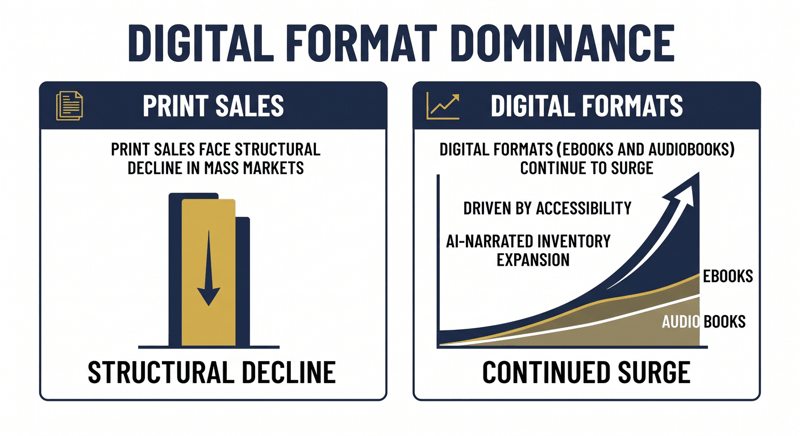
The single-format release is a wasted opportunity. 2026 is the era of the 'Simultaneous Multi-Modal Launch.' With AI tools reducing the cost of audiobook production and translation, authors are expected to launch in ebook, print, and audio simultaneously. AutomateEd highlights that while print sales fluctuate, the digital combo of Ebook + Audio is the growth engine.
This strategy captures every type of consumer immediately. The commuter buys the audio; the collector buys the hardcover; the budget reader buys the ebook. By staggering these releases or bundling them, you maximize the Lifetime Value (LTV) of a single IP asset.
Nuance: The Library Surge
A hidden revenue stream for 2026 is the library market. With changes to exclusivity rules (like Amazon's KDP Select) allowing more flexibility, and platforms like Draft2Digital enhancing library distribution, authors are seeing a surge in 'Cost Per Checkout' revenue. Libraries are desperate for content to feed their digital apps (Libby/OverDrive). This is high-margin, low-maintenance income that builds long-term discoverability.
According to PublishDrive's predictions, this sector is set to expand as libraries shift budgets from physical stacks to digital licenses to meet patron demand.
Strategic Focus: The Death of Hustle Culture
The 2020s 'hustle culture' of being on every platform—TikTok, Instagram, YouTube, Threads—is unsustainable. The trend for 2026 is 'Strategic Focus.' Successful authors are picking ONE discovery platform (e.g., YouTube) and ONE relationship platform (e.g., Email). This allows for depth over breadth.
Miblart's data reinforces that Email Marketing remains the highest ROI activity, vastly outperforming social media algorithms that throttle organic reach. The smart money is on building an owned list, not a rented following.
Nuance: Backlist Revival
Finally, the most profitable asset is the one you have already written. 'Revival Architecture' involves using AI tools to refresh the metadata, covers, and blurbs of backlist titles. A book published in 2020 is 'dead' to the algorithm unless it is refreshed. By treating the backlist as an active portfolio, authors can generate passive income that funds the production of new work.
This is the ultimate efficiency hack. Instead of writing a new book from scratch, you spend 10 hours refreshing an old one to double its conversion rate.