Pubby Alternatives: 7 Better Platforms for Self-Published Authors (2026)

Data-driven comparison of 7 Pubby alternatives for self-published authors in 2026, covering Read and Rate, BookSirens, Booksprout, NetGalley, Hidden Gems, Reeds
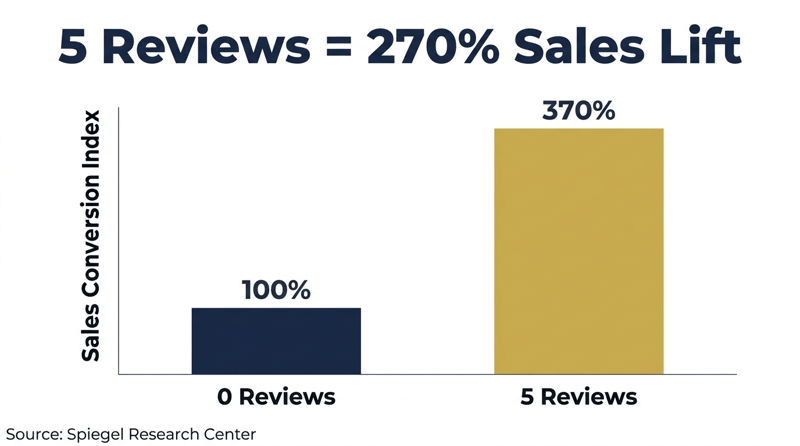
Only 1 to 2 percent of Amazon buyers post reviews on their own, which is why the review gap eats most self-published authors alive. Platforms like Pubby were designed to bridge that gap, but 2026 has not been kind to the original review exchange model. Reports on Trustpilot and the KDP Community forums describe books stuck in review queues for weeks, automatic monthly charges against accounts that never delivered the promised reviews, and snap balances that mysteriously disappear. If any of that sounds familiar, you are not alone, and you have better options.
Why Authors Are Looking for Pubby Alternatives in 2026
Pubby launched as a book review marketplace where authors earn internal currency called snaps by reviewing other authors, then spend those snaps to request reviews for their own books. The promise was simple: for a monthly fee, you get unlimited reviews from other authors who understand the craft. For a while, it worked.
Recent reports from authors paint a different picture. Public complaints on Trustpilot describe books stuck looking for reviewers for weeks at a time, a buggy dashboard that loses credit for reviews already posted, and monthly billing that continues even when the service stops delivering. On the KDP Community forum, longtime users have moved on to other platforms, citing inconsistent quality and support. Monthly pricing that started around 20 dollars has climbed to 29 dollars, or roughly 250 dollars per year, which puts it in the same price range as platforms that deliver more consistent results.
How We Evaluated Each Pubby Alternative
Not every platform fits every author. A debut romance writer needs different tools than a nonfiction author launching their fourth book. To keep this comparison honest, we evaluated each Pubby alternative against six criteria that actually move the needle on launch day and beyond.
- Reviewer quality: Do real readers post thoughtful, genre-appropriate reviews, or is it a volume game?
- Pricing transparency: Flat subscription, per-download, or a hidden blend? What does 30 reviews actually cost?
- Platform coverage: Amazon only, or can reviews flow to Goodreads, Apple Books, Barnes and Noble, and Kobo?
- Amazon compliance risk: Does the platform encourage or discourage behavior that could trigger Amazon review removal?
- Turnaround time: How quickly do you realistically get your first 10 reviews after listing a book?
- Author community: Is there a learning layer, or is it transactional?
1. Read and Rate: Best All-in-One Platform for Indie Authors
Read and Rate is built specifically for the problems Pubby users keep describing. It combines a community of vetted reviewers with a suite of tools that Pubby never offered: automatically watermarked PDF files for piracy protection, book biometrics for cover and blurb testing, file conversion, UGC video creation, and a private author community where indie authors exchange tips and learn together.
- Multi-platform reviews: Reviewers can post to Amazon, Goodreads, Apple Books, Barnes and Noble, Kobo, and more. You are not locked into Amazon.
- Watermarked PDFs: Every file downloaded by a reviewer is automatically watermarked, which protects your manuscript from piracy without you touching a thing.
- Private comments: Reviewers can send private feedback visible only to you, which is gold for catching typos, continuity errors, or cover issues before launch.
- Book biometrics: Test cover variants and blurb copy against real reader data before you commit, not after your launch fails.
- Community hub: Private exchange platform where indie authors trade launch tactics, split-test results, and keep each other sharp.
Pricing starts with a 14 day trial, then runs between 9.99 and 19.99 dollars per month depending on your volume. That is roughly half of Pubby current monthly price, for a platform that actually solves the review velocity problem while also giving you the tools to protect and promote the book itself. If you want a single platform that replaces Pubby plus a handful of other indie tools, this is the one.
Start your free Read and Rate trial
2. BookSirens: Best Per-Download ARC Platform
BookSirens is the most predictable pay-for-performance option on this list. You upload your ARC, set a cap on how much you are willing to spend, and only pay for each reader who actually downloads your book. There is no subscription fatigue and no snap-chase grinding.
- Promote Plan: 10 dollars per ARC plus 2 dollars per reader who downloads. Cap it at whatever your budget allows.
- Author Plan: 100 dollars per year, flat. Unlimited ARCs under two pen names, no per-reader fees. Works well if you publish 3 or more books per year.
- Review conversion: BookSirens reports that roughly 75 percent of readers who download a book post a review, which is dramatically higher than industry average.
- Average rating: As of January 2026, the average review from BookSirens readers sits at 4.1 out of 5 across all books.
The trade off is Amazon-centric distribution. Reviews go primarily to Amazon and Goodreads. If you want coverage on Apple Books, Kobo, or Barnes and Noble, you will need a second platform to fill the gap. BookSirens also vets authors, so your first application may take a few days to approve.
3. Booksprout: Best for Deadline-Based ARC Campaigns
Booksprout launched in 2018 and built its reputation on forcing ARC readers to meet a deadline. Where BookSirens chases a specific number of reviews, Booksprout chases reviews by a specific date, which is a useful distinction if you have a hard launch schedule or pre-order campaign tied to your marketing.
- Pros: Deadline enforcement keeps ARC readers accountable, tiered monthly subscription scales with your catalog, clean reviewer dashboard.
- Pros: Strong pipeline for recurring genre readers who enjoy being early, especially in romance and thriller.
- Cons: Review volume per campaign tends to be lower than BookSirens for the same spend.
- Cons: Free tier is extremely limited. Realistically you need a paid plan for meaningful results.
Choose Booksprout if your books launch on a fixed date and you need reviews posted within a defined window. Pair it with another platform if you want volume.
4. NetGalley: Best for Traditional and Industry Reviews
NetGalley is the oldest and most established name on this list, trusted by librarians, booksellers, bookstagrammers, and professional reviewers at outlets like Kirkus, Publishers Weekly, and BookPage. For self-published authors who care about traditional industry credibility, NetGalley remains unmatched.
The catch is cost and competition. NetGalley itself does not accept individual indie authors directly. You either pay a co-op fee through an approved third party like BookSirens or Victory Editing (around 50 dollars per month or a few hundred per title) or you join via an indie-friendly listing service. Once your book is live, you are competing with traditionally published titles for attention.
- Best for: Nonfiction, literary fiction, and genres where industry reviews shape library orders or bookstore placement
- Typical results: 5 to 25 reviews per 30-day listing depending on cover, blurb, and genre
- Review destination: NetGalley feedback, Goodreads, and optionally Amazon once readers verify purchase
If you want visibility beyond Amazon and your book has nonfiction authority, literary merit, or strong professional appeal, NetGalley earns its place in your mix. If you are a romance or SFF indie chasing volume on Amazon, a per-download service will usually outperform it.
5. Hidden Gems: Best for Genre Fiction at Volume
Hidden Gems is a genre-focused ARC service run by a small team with deep ties to romance, mystery, and science fiction communities. Reviewers sign up to read specific subgenres, so your ARC lands in front of readers who already love what you write.
Pricing is transparent and volume-friendly: about 1.75 dollars per confirmed download, with no monthly subscription. A typical campaign delivers 40 to 100 ARC copies to verified readers, and Hidden Gems reports a solid review-back rate compared to broader platforms. Authors in romance and SFF report review-back rates of 25 to 40 percent, which beats most mainstream ARC sites.
The trade off: Hidden Gems is strongest in romance (contemporary, paranormal, dark, historical), mystery, thriller, cozy, and science fiction. If you write literary fiction, memoir, or highly niche nonfiction, the reader pool thins fast. Apply only if your genre is on their active list.
6. Reedsy Discovery: Best for Editorial Reviews and Featured Placement
Reedsy Discovery is a hybrid review and promotion platform where vetted reviewers write detailed editorial reviews that can earn your book a star rating and featured placement in Reedsy newsletters.
Pricing sits at 50 dollars per submission as of 2026, with no guarantee of a review. A 4 or 5 star editorial review can be quoted in your Amazon A-plus content, on your landing page, and in social ads. That kind of social proof rarely comes from ARC platforms.
Use Reedsy Discovery when you want one or two high-credibility blurbs, not review volume. Pair it with a volume platform like Read and Rate or Hidden Gems to cover both ends of the stack.
7. Voracious Readers Only: Best for Organic Fan Building
Voracious Readers Only takes a different angle. Instead of focusing purely on review volume, it helps indie authors grow newsletter subscribers and long-term readers. You submit a free or discounted copy, readers opt in, and many join your email list directly.
- What you gain: Newsletter subscribers, Goodreads ratings, organic word-of-mouth
- What you give up: Guaranteed Amazon review counts (reviews are a byproduct, not the core promise)
- Pricing: Tiered plans starting around 29 dollars per month at time of writing
Voracious Readers Only rewards patience. Authors building a series or a long-term audience report stronger book two and book three launches because early readers already know them. If you think past the first launch, this platform compounds.
How Pubby Alternatives Compare on Pricing
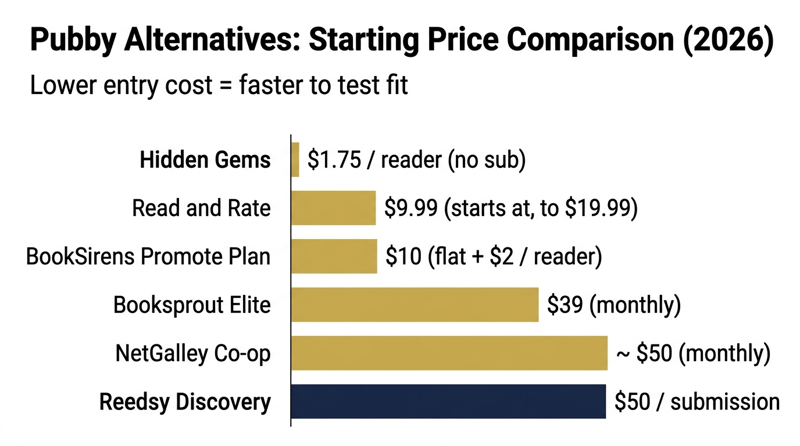
Price is the first filter most indie authors apply. The cheapest platform is not always the best value, but understanding the cost structure helps you pick the right tool for your stage.
- Lowest monthly cost: Read and Rate trial (free for 14 days), then 9.99 to 19.99 dollars per month
- Per-ARC pricing: BookSirens (10 dollars plus 2 dollars per reader), Hidden Gems (1.75 dollars per confirmed download)
- Flat monthly subscription: Booksprout (starting around 9 dollars, Elite at 39 dollars), Voracious Readers Only (29 dollars and up)
- Per-submission fees: Reedsy Discovery (50 dollars per submission)
- Co-op access: NetGalley via third-party (around 50 dollars per month or a few hundred per title)
If you are launching your first book, start with a per-ARC service or a low-cost monthly plan. Once your backlist grows, a platform like Read and Rate that bundles reviews, watermarking, UGC videos, and community becomes more economical than stacking four separate tools.
How to Choose the Right Pubby Alternative
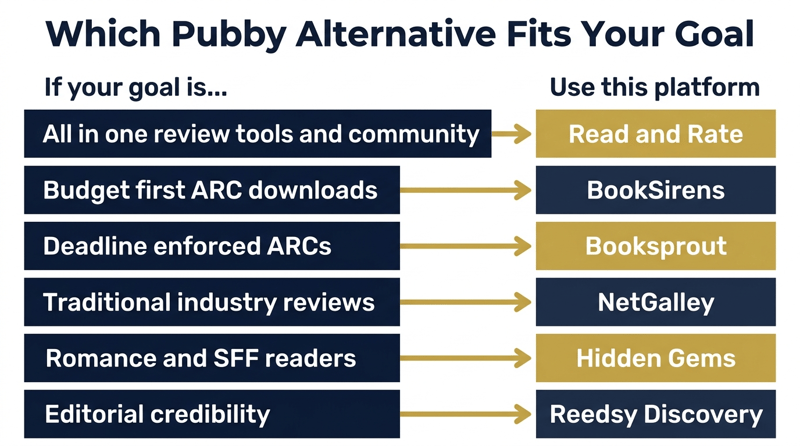
Match the platform to your goal, not to hype. Here is a simple decision path based on the most common goals indie authors bring to review platforms.
- You want an all in one platform with community, tools, and multi-platform reviews: Read and Rate
- You want predictable per-ARC pricing on Amazon: BookSirens
- You need reviews before a fixed launch date: Booksprout
- You write literary fiction or serious nonfiction and want industry credibility: NetGalley
- You write romance, mystery, thriller, or SFF and want volume: Hidden Gems
- You want one or two high-quality editorial reviews to quote: Reedsy Discovery
- You care more about long-term newsletter growth than first launch reviews: Voracious Readers Only
Most serious indie authors end up using two platforms at once: one volume source and one editorial or newsletter source. The combination fills different parts of the review and marketing stack.
A Multi-Platform Review Strategy That Actually Works
Single-platform strategies break when Amazon changes its review policy, when a service has an outage, or when your genre falls out of favor on a specific site. A multi-platform approach reduces risk and compounds results.
- Pre-launch (8 to 4 weeks out): Open an ARC campaign on BookSirens or Hidden Gems to seed 30 to 60 ARCs with deadlines
- Launch week: Activate Read and Rate community reviewers who post to Amazon, Goodreads, Apple Books, Kobo, and TikTok at once
- Post-launch (weeks 2 to 6): Submit to Reedsy Discovery for an editorial review you can quote, and keep Voracious Readers Only running to build your newsletter list
This stacked approach turns one book launch into a 90 day review engine. Total monthly spend usually lands between 30 and 80 dollars, far less than running Amazon Ads without reviews to back them up.
The reason stacking works is simple. Amazon algorithms reward steady, diverse review velocity, not one giant spike. A few new reviews every week for 8 weeks outperforms 40 reviews in three days, even though the totals look the same.
Common Mistakes Authors Make When Switching from Pubby
Switching platforms is an opportunity to reset bad habits. The authors who struggle with Pubby alternatives usually make the same four mistakes regardless of which platform they choose.
- Chasing volume before quality: 50 thoughtful 4 and 5 star reviews outperform 200 hasty 3 star reviews in both algorithm boost and reader trust
- Ignoring cover and blurb: Even the best ARC service cannot fix a cover that signals the wrong genre. Fix covers and blurbs first, then run reviews
- Skipping the ARC reader agreement: Professional ARC services require readers to confirm they received a free copy in the review. This keeps you safe on Amazon
- Violating Amazon review policies: Paying for reviews, trading reviews one for one, or soliciting family reviews can get your book pulled. Stick to platforms that enforce Amazon TOS
Frequently Asked Questions About Pubby Alternatives
The Bottom Line on Pubby Alternatives in 2026
Pubby solved a real problem: indie authors need reviews, and organic reviews come slowly. But the review exchange model has not kept up with Amazon policy, reviewer quality expectations, or the multi-platform reality of 2026 reading.
The platforms in this list each do one thing well. Read and Rate bundles reviews, watermarking, UGC videos, and author community. BookSirens and Hidden Gems deliver volume ARCs on a predictable budget. Booksprout enforces deadlines. NetGalley opens industry doors. Reedsy Discovery delivers quotable editorial reviews. Voracious Readers Only builds your newsletter so your next launch starts stronger than this one.
Pick one platform that matches your current book and goal. Run it for a full launch cycle, measure reviews, rankings, and newsletter signups, then decide whether to stack a second tool. That discipline separates indie authors who grow a sustainable catalog from those who burn out chasing every new service.