How to Get an ISBN for a Self-Published Book (2026 Guide)
Free KDP ISBN or your own from Bowker? Compare 2026 ISBN prices in the US, UK, Canada and Australia, plus the imprint and distribution rules that matter.
Every format of your book needs its own ISBN, and that is where the confusion starts. Amazon's own KDP help page on ISBNs and imprints spells it out: paperback and hardcover each require one, the same number cannot be reused across formats or new editions, and only ebooks and low-content books can skip it. Multiply that by the number of titles you expect to publish and the arithmetic changes which option makes sense.
The decision is smaller than it looks and cheaper to get right than to fix. An ISBN is not copyright, it does not protect your work, and it does not affect your royalties. What it does decide is who is listed as the publisher of your book in every database that bookstores, libraries, and distributors consult, and whether you can move that book to another platform without republishing it. This guide walks through what it costs in 2026, what the free options really give you, how many you need, and the exact steps to buy and assign one without triggering the mismatch errors that block a KDP listing.
What is an ISBN and do you actually need one?
An ISBN (International Standard Book Number) is a 13-digit identifier that pins down one specific edition of a book in one specific format. The official US agency, Bowker, describes it as the number that identifies the publisher as well as the title, edition, and format, so a hardback, a paperback, an EPUB, and an audiobook of the same manuscript are four different products and need four different numbers. Bowker also states plainly that the ISBN conveys no legal or copyright protection.
Whether you need one depends on the format. On KDP, a Kindle ebook is identified by an ASIN, Amazon's own number, and KDP says outright that you do not need an ISBN for ebooks. Print is different. KDP will not publish a paperback or hardcover without one, and IngramSpark, Barnes and Noble Press, and any bookstore ordering system require one too. If you only ever publish Kindle ebooks, you can stop reading here. If you publish print, or you want your ebook in library catalogues and on retailers outside Amazon, keep going.
What does an ISBN cost in 2026?
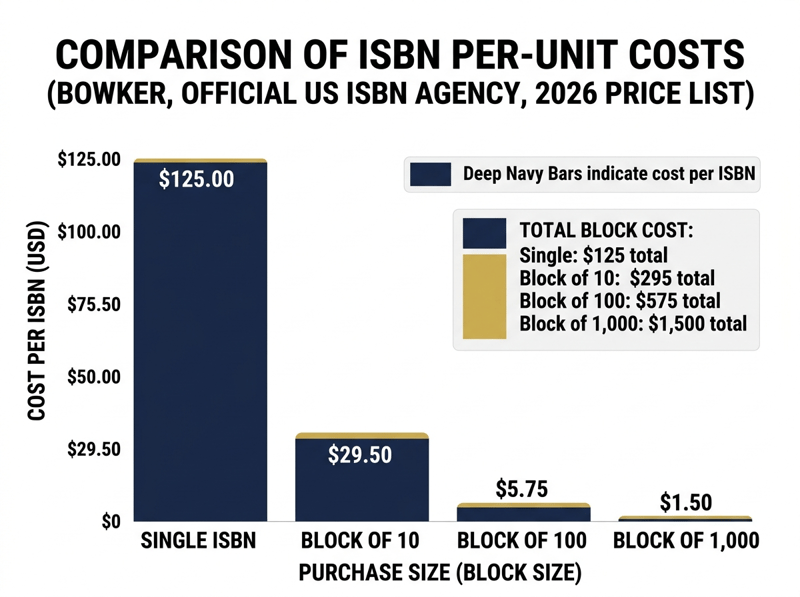
Prices depend entirely on where you live, because each country has one designated agency. In the United States, Bowker sells a single ISBN for $125, a block of 10 for $295, a block of 100 for $575, and a block of 1,000 for $1,500, per its current price list. The unit price falls from $125 to $29.50 to $5.75 as the block grows, which is why Bowker itself labels the ten pack its best seller and notes that most books average two to three ISBNs to cover all formats.
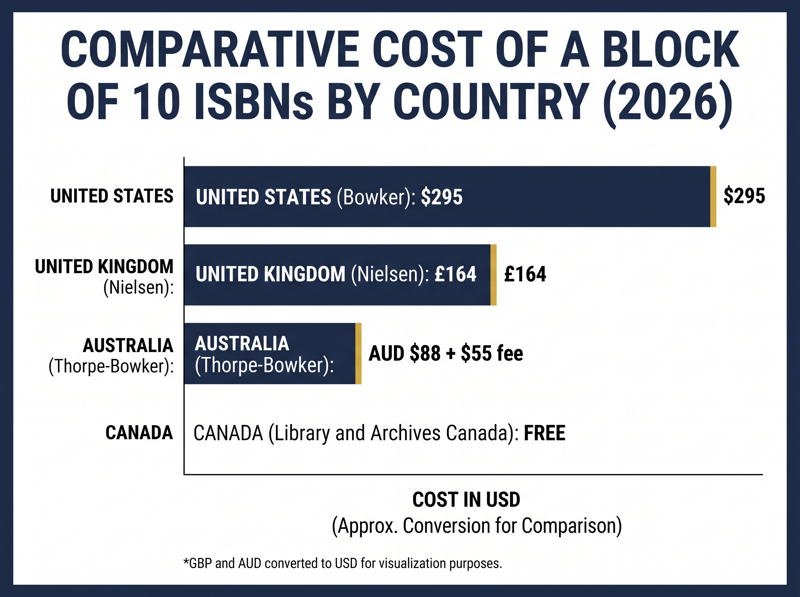
CountryAgency1 ISBN10 ISBNs100 ISBNsUnited StatesBowker (myidentifiers.com)$125$295$575United KingdomNielsen ISBN Store£89£164£369CanadaLibrary and Archives CanadaFreeFreeFreeAustraliaThorpe-Bowker (myidentifiers.com.au)AUD $44AUD $88AUD $480
US and Australian figures come from the agencies' own price pages. UK figures are the Nielsen tiers as reported in Books.by's January 2026 UK ISBN guide, so check the Nielsen store before you buy. Australia adds a one-time $55 new publisher setup fee on your first order, per Thorpe-Bowker's price page. Canada is the outlier: Library and Archives Canada issues ISBNs free to self-publishers physically located in Canada, on the condition that the book is made available in Canada and a legal deposit copy is provided.
One important rule sits underneath every price above. Bowker and IngramSpark both warn that an ISBN obtained from anyone other than the official agency for your country may not identify you as the publisher at all. Third-party resellers who split a 1,000 block and sell you single numbers cheaply are registering those numbers under their own publisher prefix, not yours. You get a number that works at the checkout, and the reseller is listed as your publisher in Books in Print forever.
Free KDP ISBN vs your own ISBN: what actually changes?
KDP gives you two choices at upload, and Amazon's Get an ISBN page lays out the trade-off in a single table. Take the free KDP ISBN and Amazon registers it with Bowker on your behalf, using your book details, under the imprint "Independently published." That is the publisher name that appears on your Amazon detail page and in every database that pulls from Bowker. The number can only be used on KDP; Amazon states it cannot be used to publish outside KDP.
Buy your own and you register an imprint name, your business or brand, and that name appears as publisher everywhere. The same number can be used to publish the identical edition on IngramSpark, a local printer, or any other service. The catch is precision. KDP checks your title, author name, and imprint against what is on file with the ISBN agency, and if they do not match, you cannot publish. Amazon's note on this is specific: the fields are case sensitive, a trailing space in the imprint name will cause a mismatch, and placeholders like "unknown" are rejected.
FactorFree KDP ISBNYour own ISBNCost$0$125 single, $29.50 each in a block of 10 (US)Publisher of record"Independently published"Your imprint nameWhere it can be usedKDP onlyKDP, IngramSpark, any printer or retailerFormats coveredPaperback and hardcover onlyAny format, including ebook and audioLow-content booksNot eligibleEligibleMetadata controlAmazon registers it for youYou register and edit the recordRisk at uploadNoneMismatch errors if details differ from the agency record
What about IngramSpark's free ISBN?
IngramSpark offers free ISBNs to US customers during title setup, and its free ISBN page is unusually candid about the terms. The imprint on a free IngramSpark ISBN is "Indy Pub," IngramSpark's own name for self-publishers. The number can only be associated with your title on IngramSpark, not on KDP, Blurb, BookBaby, or anywhere else. Any title using a free ISBN must be placed in IngramSpark's wholesale distribution program with pricing set for at least one market, and the number cannot be transferred to another account.
There is a second consequence that matters if you use both platforms, which many authors do to reach bookstores through Ingram while keeping Amazon on KDP. A free KDP ISBN and a free IngramSpark ISBN are two different numbers for the same paperback, and IngramSpark warns that listing the same book under different ISBNs across distributors confuses retailers and readers. If you later decide you want to own the number, IngramSpark says you must set the book up again as a new or revised title with a purchased ISBN. One owned ISBN across both platforms avoids all of that. Our IngramSpark vs KDP Print comparison covers the rest of the dual-platform setup.
IngramSpark also frames this as part of a catalog integrity initiative: it requires that ISBNs be valid and properly acquired from the designated agency for the publisher's country, and it lists Bowker for the US, Nielsen for the UK and Ireland, Thorpe-Bowker for Australia, and Raja Rammohan Roy for India by name. That is the same warning Bowker gives about resellers, coming from the other side of the supply chain.
How many ISBNs do you need?
Count formats, then multiply by titles, then add a margin for future editions. Bowker's guidance is that any variation of a book requires its own number, and Library and Archives Canada says the same: each format and edition must have its own ISBN. A revised edition with substantive changes needs a new one. A reprint with typo fixes does not. A different trim size of the same paperback does, because a retailer needs to know which physical object they are ordering.
- One novel, paperback only, Amazon only: 1 ISBN, and the free KDP option covers it||One novel, paperback and hardcover on KDP plus IngramSpark: 2 ISBNs, owned, so both platforms carry the same numbers||One nonfiction title in paperback, hardcover, EPUB for wide retailers, and audiobook: 4 ISBNs||A three-book series in paperback and ebook, distributed wide: 6 ISBNs, with the ten pack leaving room for a box set and one revised edition||A small press or a prolific author planning 10 or more titles: the 100 block, at $5.75 each in the US
ISBNs never expire, so buying ahead carries no penalty beyond the cash. That is why the single ISBN is almost never the right purchase. At $125 for one and $295 for ten, the second ISBN you ever need turns the ten pack into the cheaper path, and most authors need a second one the moment they add a hardcover or move a book onto a second printer.
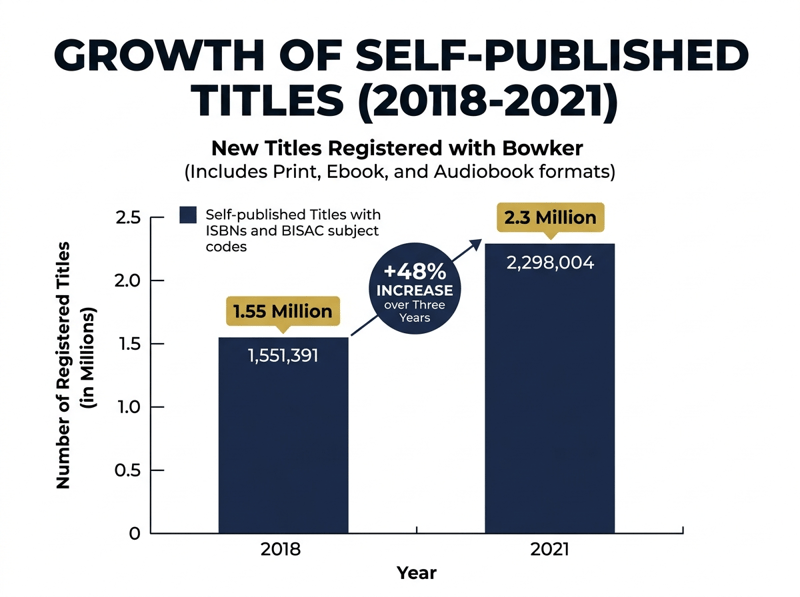
The scale is worth seeing. Bowker data reported by Publishers Weekly counted 2,298,004 new self-published titles with both ISBNs and subject codes in 2021, against 1,551,391 in 2018, with fiction the largest category at 335,428 registrations. Every one of those numbers is a book competing for the same shelf space in the same databases, and an accurate, complete ISBN record is the minimum requirement for showing up in them at all.
How do you get an ISBN, step by step?
The process takes under an hour at every agency. What takes longer is undoing a rushed imprint name or a mismatched title, so slow down at steps two and four.
- Find your country's agency. Bowker for the US and its territories, Nielsen for the UK and Ireland, Library and Archives Canada for Canada (BAnQ for French-only publishers), Thorpe-Bowker for Australia. For anywhere else, the International ISBN Agency keeps the official list, and Bowker will not sell to publishers located outside the US||Register a publisher account and choose your imprint name. This becomes the publisher of record on every book you assign, so pick something you will still want in ten years, check it is not already in use, and keep it short. It does not need to be a registered company||Buy the block. In the US, ten for $295 is the default for anyone planning more than one format or title. Numbers appear in your dashboard immediately after payment at Bowker and Thorpe-Bowker; Canada issues within roughly ten business days||Assign one ISBN per format and complete the title record. Enter title, subtitle, author, format, trim size, page count, price, publication date, description, and subject codes. This record feeds Books in Print and the trade databases retailers search||Enter the identical details in KDP or IngramSpark. Copy and paste title, author, and imprint from the agency record. Choose "Add your own ISBN" in KDP's paperback or hardcover content section||Add the barcode to your print cover, or let the platform place one for you. See the next section||Keep a spreadsheet of which number is assigned to which format and edition, because you will need it for every retailer, library, and review platform you list on
If you are already published on KDP with a free ISBN and now want your own, you cannot swap the number on the existing listing. Amazon treats an ISBN change as a new edition, so you would set up the book again with the purchased ISBN and unpublish or link the old one. That is the single biggest reason to decide before your first upload rather than after.
Do you need to buy a barcode too?
Usually not. KDP's barcode help page says that if you upload a print-ready cover without a barcode, or use Cover Creator, Amazon adds one to the back cover at no cost, and covers with images or text in the barcode location are rejected. If you do supply your own, it must be 100 percent black on a solid white background, at least 1.4 by 0.8 inches, positioned at least a quarter inch from the spine and trim, and must encode the exact ISBN on the listing. Amazon states that its own placed barcodes are guaranteed to meet manufacturing requirements, which is a strong hint about which option to take.
Bowker sells barcode bundles, for example one ISBN plus one barcode for $150 instead of $125, and Thorpe-Bowker does the same. Library and Archives Canada does not provide barcodes at all and points publishers to their printer or designer. If you are publishing only through KDP and IngramSpark, the free platform-generated barcode is fine. Buy a barcode file only if you are printing offset copies for bookstore or event sales and your designer needs a vector to place.
Which ISBN option should you choose?
Strip away the opinions and the decision comes down to three questions. Will this book ever exist anywhere other than Amazon? Will you publish more than one format or more than one title? Do you care what publisher name appears on the listing? Answer no to all three and the free KDP ISBN is the correct choice; it costs nothing and does everything you need. Answer yes to any one of them and buy your own, in a block, before your first upload.
- Choose the free KDP ISBN if: one paperback, Amazon only, no plans for IngramSpark or bookstores, and "Independently published" on the detail page does not bother you||Choose the free IngramSpark ISBN if: you are US-based, will sell through Ingram's wholesale channel only, and accept "Indy Pub" as your publisher of record||Choose your own ISBN if: you publish on both KDP and IngramSpark, want your imprint name, plan a series or multiple formats, or want the option to move printers later||Choose the 100 block if: you are running an imprint for several authors or expect ten or more titles over the next few years
Whichever path you take, going wide changes the rest of your setup, not just the identifier. Our guide to Kindle Unlimited versus going wide covers the exclusivity question, and the breakdown of what KDP actually pays per sale shows why the ISBN cost is a rounding error against the royalty decisions that follow it. If you have not settled on your metadata yet, the KDP categories guide is the place to fix that before you register the title record, since the subject codes you enter at the agency should match the positioning you use on Amazon.
Frequently asked questions
The ISBN is the least of it, but it is the first of it
An ISBN is a small purchase that fixes your book's identity in every system that sells, lends, or catalogues it. Get the imprint right, buy the block, copy the record exactly, and you will never think about it again. What you will think about, every week, is whether that identity is attached to a listing readers trust, and that comes down to reviews on whichever platforms your ISBN takes you to.
That is where owning your ISBN pays off a second time. A book listed on Amazon, Kobo, Apple Books, and Barnes and Noble under one number needs reviews in more than one place, and most review services only feed Amazon. Read and Rate lets you choose which platforms you want reviews on, so readers who pick your book can post to the stores where you actually sell. Every download is watermarked to the reader who took it, and each reviewer leaves you a private comment only you can see. Our guides to getting Amazon reviews and protecting your files cover the details; the free trial below covers the rest.