Amazon Review Rules for Authors: What Changed and How to Stay Safe (2026)
The 2026 state of Amazon review enforcement for indie authors: the FTC fake review rule, Amazon crackdowns, what is banned, what is still allowed, and how to bu
What changed in review enforcement for 2026?
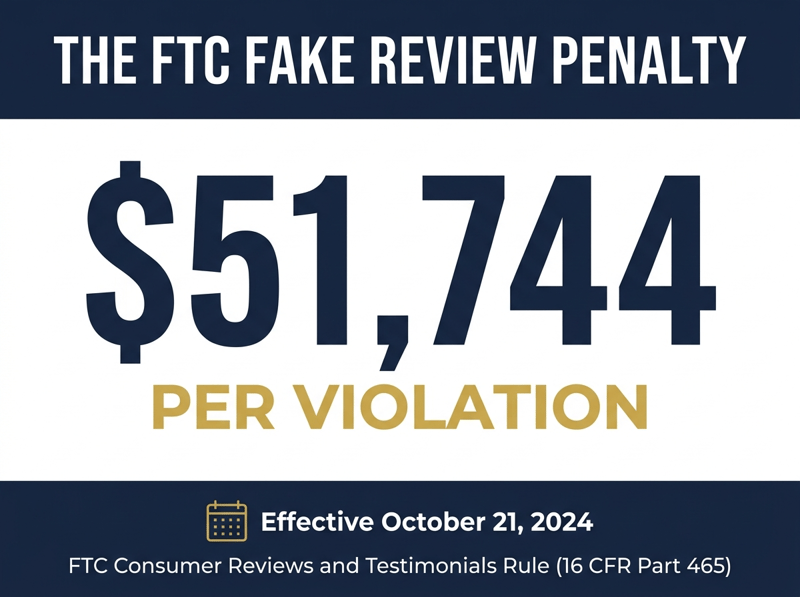
Two forces reshaped the review landscape that indie authors operate in. The first is regulatory. In August 2024 the Federal Trade Commission finalized a rule banning fake reviews and testimonials, codified as 16 CFR Part 465. It took effect on October 21, 2024, and it gave the FTC something it never had before: the power to seek civil penalties of up to $51,744 per violation against businesses and individuals who buy, sell, or fabricate consumer reviews. An author selling books is a business under this rule. So is a review service.
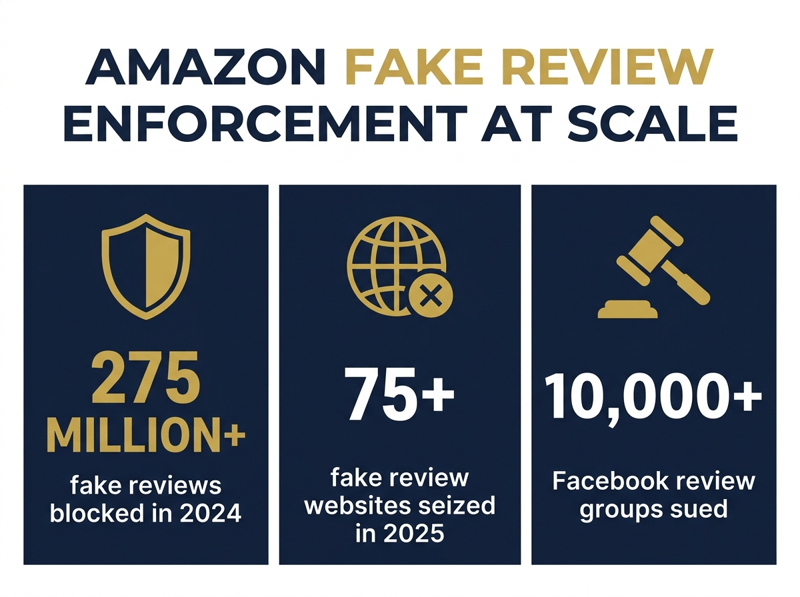
The second force is Amazon itself. According to Amazon's own policy reporting, the company proactively blocked more than 275 million suspected fake reviews in 2024 alone. In 2025 it won a court order seizing control of more than 75 websites that sold fake five star reviews, its largest domain seizure action to date. Amazon has also sued the administrators of more than 10,000 Facebook groups that coordinated incentivized reviews, and in June 2025 the UK Competition and Markets Authority secured binding commitments from Amazon to tighten review monitoring and suspend sellers involved in manipulation. The direction of travel is unmistakable: detection keeps improving, and penalties are now real money.
What does the FTC fake review rule prohibit?
The rule is written for all consumer products, and books are consumer products. The FTC's official questions and answers guide spells out the practices that now carry penalty exposure. These are the ones that matter most for authors:
- Buying or selling fake reviews, including reviews written by people who never read the book or reviews generated by AI and passed off as real reader opinions.||Paying for reviews that are conditioned on being positive, whether the payment is cash, gift cards, free products beyond the review copy itself, or entry into a giveaway.||Insider reviews without disclosure: reviews from the author's employees, immediate family, or business partners that hide the relationship.||Review suppression: threatening or intimidating reviewers to remove negative reviews, or knowingly displaying only positive reviews while hiding negative ones.||Buying fake indicators of social media influence, such as bot followers, to inflate perceived credibility.
What are Amazon's review rules for authors in 2026?
Amazon's rules predate the FTC rule and in several places go further. The controlling document is the Amazon Community Guidelines, which govern every customer review on the store. Amazon removes reviews from anyone it judges to have a financial interest in the product or a close personal relationship with the seller, and repeat violations can end in review privileges being revoked, listings suppressed, or the associated KDP account being closed.
- No reviews from family members, close friends, employees, or anyone with a financial stake in the book's success.||No review swaps: reviewing a peer's book in exchange for a review of yours violates the guidelines even if both reviews are honest.||No compensation for a customer review: cash, gift cards, discounts on other products, or any future benefit conditioned on reviewing.||No requiring a review in exchange for a free advance copy. You may provide the copy and ask; you may not make the review a condition of receiving it.||No attempts to influence the content of a review, including asking a reviewer to change or remove a rating.
The scale of enforcement is what changed the risk calculation. Blocking 275 million suspected fake reviews in a single year means Amazon's detection models are scoring every review against purchase history, reviewer networks, device fingerprints, and timing patterns. Reviews that arrive in coordinated bursts from accounts with no purchase history are exactly what those models are trained to catch. Launch weeks built on artificial velocity now routinely see 30 to 60 percent of their reviews stripped, as we covered in our guide to getting Amazon book reviews the compliant way.
What can authors still do to get reviews?
The good news: the core review strategy that professional indie authors have always used remains fully legal and fully within Amazon's rules. Books kept an explicit carve-out that most product categories lost years ago. Authors and publishers may distribute free advance reader copies, and readers who receive them may post customer reviews, provided the review is not required and the author does not attempt to influence what it says.
- Send free ARCs to readers, book bloggers, and review communities, and ask for an honest review with no strings attached.||Ask organically: a request at the back of the book, in your newsletter, or on social media is fine as long as it does not offer anything in return.||Use paid editorial reviews from services like Kirkus or BookLife for your Editorial Reviews section and marketing copy. They are clearly labeled as editorial content and never appear as customer reviews.||Run price promotions and giveaways to widen readership, as long as entry is never conditioned on leaving a review.||Route the same ARC reader to multiple platforms: Goodreads, BookBub, Apple Books, Kobo, and Barnes and Noble all accept reviews that Amazon's stricter filters might remove.
Why do paid review shortcuts backfire?
The fake review economy that authors are tempted by is precisely what enforcement is dismantling. The network Amazon dismantled in its 2025 domain seizure operated like a menu: fake five star reviews for your own listing, fake negative reviews for a competitor, and replacement seller accounts for anyone already banned. Buying from a menu like that no longer risks only the reviews themselves. It creates a paper trail connecting the buyer to a federally prohibited transaction, at $51,744 of exposure per violation.
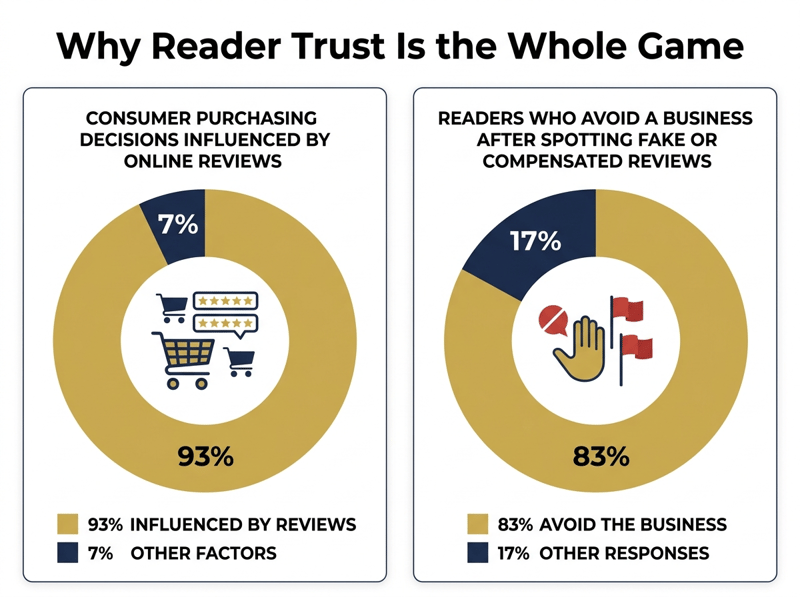
Beyond the legal exposure, shortcuts fail on pure economics. A stripped review wave leaves a book with a suspicious rating pattern and a flagged history. A suspended KDP account takes the author's entire backlist down with it. And the reader side of the equation is just as unforgiving. Research compiled by Capital One Shopping shows reviews influence 93 percent of purchasing decisions, and industry survey data indicates that 83 percent of review readers will avoid a business after discovering fake or compensated reviews. Readers who feel tricked do not just skip one book; they remember the author's name.
How do you build a compliant review pipeline?
Compliance is not a constraint on growth; it is the growth strategy. Every rule above punishes artificial velocity and rewards genuine reader relationships, which is exactly the asset an indie author can build and a review farm cannot fake. Here is the pipeline that holds up:
- Build a permanent ARC team from real readers in your genre, recruited through your newsletter, your back matter, and vetted review communities. Aim for 30 to 50 active members before launch.||Distribute watermarked review copies so you know exactly which copy went to which reader, which deters piracy and keeps your distribution records clean.||Ask for honest reviews with a clear disclosure line, and never follow up with pressure about the rating.||Spread every reviewer across 3 to 5 platforms so a single platform's filter cannot erase your launch. Our guide to ARC book reviews covers the routing playbook in detail.||Track review velocity and rating distribution weekly, the same way you track sales. Our breakdown of book biometrics shows which numbers actually predict a healthy launch.||Keep records: who received a copy, when, on what platform they reviewed. If a platform ever questions your reviews, documentation is your defense.
Authors comparing review platforms should apply the same compliance lens. Any service that promises a guaranteed number of reviews, sells packages of five star ratings, or runs author-to-author swap circles is now a legal liability, not a marketing tool. We compared the major platforms through exactly this lens in our Pubby alternatives review.
Frequently asked questions
Can authors pay for book reviews on Amazon? Not for customer reviews. Paying for a customer review violates both Amazon's Community Guidelines and the FTC rule. Paid editorial reviews from recognized services are different: they can appear in the Editorial Reviews section of your listing and in marketing material, clearly attributed, but never as customer reviews.
Can my family and friends review my book? No. Amazon treats close personal relationships as a conflict of interest and removes those reviews when detected. Under the FTC rule, undisclosed insider reviews are a named violation. Ask them to spread the word instead; word of mouth is legal everywhere.
Are free advance copies still allowed under the FTC rule? Yes. Providing a free copy of the book itself is not a prohibited incentive, as long as the review is not required, the author does not dictate the content or the rating, and the reviewer discloses receiving the copy. This is the carve-out the entire ARC system runs on.
What should I do if Amazon removes legitimate reviews of my book? It happens, especially at launch. Do not ask reviewers to repost, which can look like manipulation. Keep collecting reviews steadily, keep your distribution documented, and make sure the same readers reviewed you on other platforms so the removal does not zero out your social proof.
Where Read & Rate fits in a compliant review strategy
Read & Rate was designed around the rules this article describes, not around loopholes. Reviewers are vetted community members who choose your book because it fits their reading taste. Every review copy downloads as an automatically watermarked PDF, so you always know which copy went to which reader. Reviewers select the platforms where they post, including Goodreads, BookBub, Apple Books, Kobo, and Barnes and Noble alongside Amazon, which builds the multi-platform spread that survives filter sweeps. And reviewers can leave a private comment only you can see, so honest developmental feedback reaches you without becoming a public low rating.
Nothing on the platform requires a review, guarantees a rating, or compensates reviewers for their opinion. That is the point. In an enforcement era, the only review pipeline worth owning is one you could show to Amazon or the FTC without flinching.