2026 Book Marketing Forecast: The Age of Sovereign Authors & Agentic AI

The era of algorithm chasing is over. 2026 demands a shift to direct sales, Generative Engine Optimization (GEO), and agentic AI workflows.
The Rise of the Sovereign Author
For the last decade, book marketing was synonymous with "retailer optimization." Authors spent their energy decoding Amazon's A9 algorithm or purchasing ads to drive traffic to a platform they did not own. As we move into 2026, this model is becoming a liability. The concept of the "Sovereign Author" represents a fundamental shift in business architecture: moving the transactional center of gravity from third-party marketplaces to owned infrastructure.
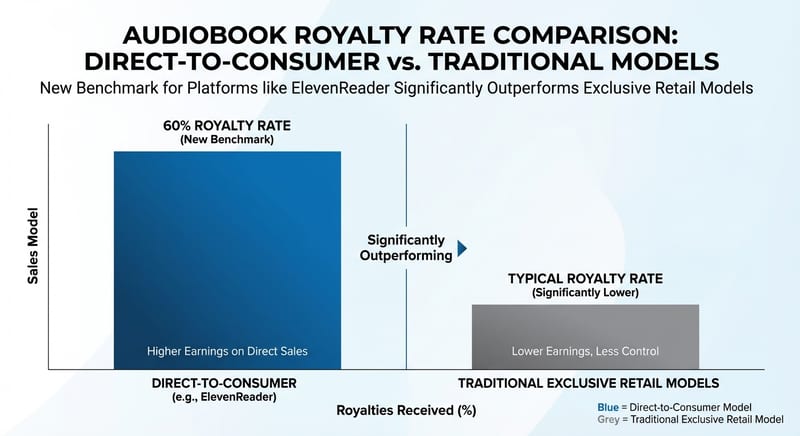
This is not merely about margin, though the economics are compelling. It is about data resilience. When a reader purchases a book on a major retailer, the author receives a royalty check but zero customer data. In an era where AI agents rely on deep contextual data to personalize marketing, flying blind is a death sentence. Direct sales channels, built on platforms like Shopify or Kickstarter, allow authors to capture the email, browsing history, and purchase intent of every reader.
Leading industry voices, such as Joanna Penn, have argued that this independence is the only hedge against platform volatility. If an algorithm change can wipe out 40% of your visibility overnight, you do not have a business; you have a dependency. 2026 is the year authors must treat their direct store as their flagship, and retailers merely as distribution outposts.
Technical Nuance: The API-First Mindset
The transition to sovereignty requires more than a "Buy Now" button; it demands an API-first mindset. A sovereign author's website must act as a hub that connects inventory, email marketing (CRM), and fulfillment automatically. The days of manually mailing signed copies are over for those seeking scale. The new standard involves integrating print-on-demand services directly into the author's e-commerce backend.
Furthermore, this infrastructure must be ready for "social commerce." We are seeing a trend where transactions happen natively within social apps or reading communities. If your book's metadata and purchase links are trapped inside a "walled garden" retailer, they cannot be easily ported to these new, fluid sales environments.
- Customer Ledger Ownership: You must possess the hard data of who bought what and when.
- Dynamic Bundling: The ability to upsell audiobooks and digital courses alongside physical copies, a feature restricted on traditional retailers.
- Pixel Sovereignty: Utilizing server-side tracking to understand reader behavior without relying on third-party cookies.
Generative Engine Optimization (GEO)
Traditional Search Engine Optimization (SEO) focused on keywords and backlinks to rank ten blue links on a page. That era is sunsetting. As readers increasingly turn to AI assistants like ChatGPT, Claude, or Perplexity to ask, "What is the best sci-fi novel about political intrigue?", the goal post has moved. We are entering the age of Generative Engine Optimization (GEO).
GEO is not about tricking an algorithm; it is about establishing "Entity Authority." Large Language Models (LLMs) function on probability and association. To sell books in 2026, an author's name and book title must be strongly associated with specific concepts, genres, and reputable sources in the model's training data. If the AI doesn't "know" you are the authority on a subject, it will never recommend you, no matter how good your keywords are.
This requires a shift in how authors create digital footprints. It is no longer enough to have a blog. Authors must ensure their work is cited in authoritative databases, discussed on high-trust forums, and structured in a way that is easily parsed by machines. The new "gatekeeper" is the inference engine.
Tactical Nuance: Structured Data & Knowledge Graphs
To succeed in GEO, authors must speak the language of the machine: Schema markup and JSON-LD. Your author website is not just a brochure for humans; it is a data feed for AI. Every book page should be wrapped in rigorous structured data that explicitly tells web crawlers the ISBN, genre, author, and review aggregate.
By defining these relationships clearly in the code of your site, you increase the probability that an LLM will correctly retrieve your book details during a conversational query. Ambiguity is the enemy of citation. If an AI cannot distinguish your book from a similarly titled one, it will default to the more authoritative entity.
The Trust Protocol: Value-First Marketing
As AI-generated content floods the internet, the cost of creating mediocre text has dropped to zero. Consequently, consumer skepticism is at an all-time high. In 2026, "content" is a commodity, but "trust" is a premium asset. Marketing strategies that rely on hype, aggressive funnels, or impersonal automation will face diminishing returns. The antidote is what industry analysts call the Trust Protocol.
This strategy dictates that authors must function less like salespeople and more like trusted guides. The most effective marketing channel is no longer the interruption ad, but the educational deep dive. Whether through Substack newsletters or long-form video essays, authors must prove their value before asking for the transaction. The goal is to build a "parasocial" relationship so strong that it transcends the noise of AI-generated sludge.
"In an age of infinite content, the only scarcity is attention. Attention is granted only to those who have earned trust through consistent value. - Marketing Insights 2026"
This shift requires a change in metrics. Instead of measuring "impressions," authors should measure "engagement depth." A thousand passive followers are worthless compared to one hundred readers who open every email because they trust the sender's curation. This is the '1,000 True Fans' theory weaponized for the AI age.
Agentic AI & The Automated Workflow
We have moved beyond "Generative AI" (creating text/images) to "Agentic AI" (performing actions). In 2026, successful authors will employ autonomous agents to handle the operational friction of the book business. These are not simple chatbots; they are software entities capable of executing multi-step workflows—from analyzing ad performance to scheduling social posts based on peak engagement times.
The "Agentic Author" utilizes these tools to regain time for writing. Imagine an AI agent that monitors your direct sales inventory, triggers a re-order with your printer when stock is low, and simultaneously alerts your VIP email list that a restock is imminent. This level of automation, previously available only to enterprise retailers, is now accessible to the independent creator.
Operational Nuance: The Human-in-the-Loop
While agents can handle logic and logistics, they cannot replicate empathy. The danger of Agentic AI is over-automation, leading to the "Uncanny Valley" of customer service where interactions feel sterile. The most sophisticated implementation involves "Human-in-the-Loop" (HITL) systems. The AI prepares the draft, the analysis, or the response, but the author provides the final sign-off.
For example, an AI agent might flag a negative review and draft three potential responses based on best practices for conflict resolution. However, the author must choose the tone and hit send. This hybrid approach leverages the speed of silicon with the judgment of carbon.
CRM 3.0: Predictive Reader Engagement
The final pillar of the 2026 strategy is the evolution of Customer Relationship Management (CRM). As noted in trends regarding future CRM support, static email lists are obsolete. Modern systems utilize predictive analytics to anticipate reader needs. Instead of blasting a newsletter to everyone, AI-driven CRMs segment audiences based on reading speed, genre preference, and past interaction.
This allows for hyper-personalized journeys. If a reader finishes Book 1 of a trilogy (detected via digital reading data or purchase timing), the system can automatically trigger a discount offer for Book 2 exactly when they are most likely to buy. This is not marketing; it is service.