The End of Algorithmic Dependency: Definitive Book Marketing Trends for 2026

A definitive white paper on the shift from algorithmic reliance to author sovereignty. We analyze the rise of Direct Sales, Generative Engine Optimization (GEO)
The Pivot to Author Sovereignty: Direct Sales as the Primary Engine
For over a decade, the 'indie' author strategy was synonymous with Amazon exclusivity. That era has concluded. The dominant trend for 2026 is 'Author Sovereignty'—a structural shift where authors own the transaction, the customer data, and the platform. This is not merely about higher royalties; it is a survival mechanism against the rising costs of paid ads and the opacity of retailer algorithms. Platforms like Shopify and Kickstarter are no longer experimental outliers; they are foundational infrastructure for the modern career author.
The economic logic is irrefutable. While Amazon remains a volume driver, it effectively rents readers to authors. The shift to direct sales allows for the curation of 'super-fans'—the vital 1,000 true fans who purchase high-ticket items. This necessitates a change in product strategy. You cannot build a direct sales empire on $2.99 ebooks alone. The market has responded with a resurgence in physical, collectible formats designed specifically for this channel.
This statistic, highlighted in Miblart's 2026 trend analysis, underscores a critical tactical pivot. The hardcover is no longer just a format; it is a premium product tier. Authors are utilizing special editions—featuring sprayed edges, gold foil, and exclusive illustrations—to drive Average Order Value (AOV) significantly higher than what is possible on third-party retailers. This 'premiumization' of the physical book is the financial backbone of the sovereignty movement.
Inventory Logistics and Fulfillment friction
The nuance often missed in the 'go direct' enthusiasm is the logistical burden. Managing inventory for a global readership is a distinct skill set from writing. However, 2026 has seen the maturation of 'print-on-demand dropshipping' specifically for direct sellers. Authors are no longer required to turn their garages into warehouses. The integration of services like BookVault with Shopify has automated the fulfillment pipeline, allowing authors to sell premium quality without the capital risk of large offset print runs.
Yet, a friction point remains: the customer expectation of 'Amazon-speed' shipping. Authors thriving in this space are countering this not with speed, but with experience. They position the waiting period as part of the bespoke nature of the product, often bundling immediate digital deliverables (ebooks/audio) to satisfy the instant gratification impulse while the physical artifact ships.
- Bundle Strategy: Always include the digital file with the physical purchase to reduce 'shipping anxiety.'
- Exclusive Metadata: Use direct channels to sell versions of the book (extended epilogues, director's cuts) that Amazon TOS would restrict.
- Data Ownership: The email address collected at purchase is 10x more valuable than the royalty itself.
From SEO to GEO: Generative Engine Optimization
Traditional Search Engine Optimization (SEO) is dying a slow death. In 2026, the battle for discoverability has moved to 'Generative Engine Optimization' (GEO). Readers are increasingly turning to AI interfaces like ChatGPT, Perplexity, and Claude to ask, 'What should I read after Fourth Wing?' rather than scrolling through pages of Google search results. If your book is not part of the Large Language Model's (LLM) training data or cited by the sources it prioritizes, you are invisible.
This shift demands a fundamental rethinking of metadata and online presence. As noted by The Creative Penn, GEO focuses on 'brand mentions' and authoritative citations rather than keyword stuffing. The goal is to be recognized by the AI as an entity, not just a string of text. This requires authors to secure placements in the high-authority domains that feed these models—Wikipedia, major media outlets, and reputable review sites.
The Rise of Agentic Commerce
We are approaching the horizon of 'Agentic Commerce,' where AI agents act as purchasers on behalf of human users. Imagine a reader telling their personal AI, 'Buy the best three books on Roman history released this month.' The AI will execute this transaction based on data aggregation, not an Amazon best-seller list. Optimizing for this future means ensuring your book's data is structured, accessible, and highly rated across the entire web, not just on a single retailer.
This is the ultimate 'winner takes all' mechanic. An AI agent doesn't browse page 2 of the search results. It selects the optimal answer. Consequently, the 'midlist' of discoverability may evaporate, leaving only those with strong, verifiable digital footprints.
"“Discovery is shifting from search bars to conversation windows. If the AI doesn't know you exist, the reader never will.”"
AI Integration: Efficiency vs. Authenticity
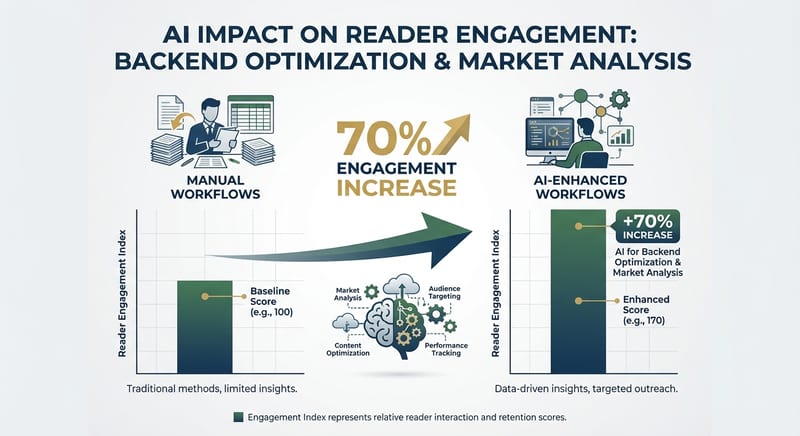
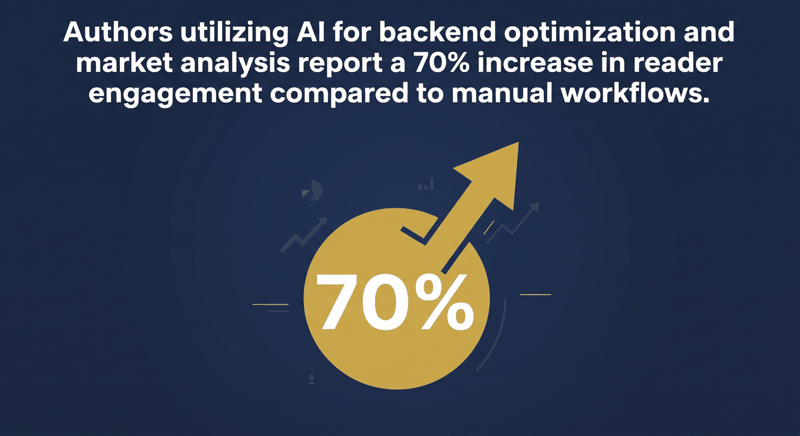
The application of AI in book marketing has matured from experimental toy to industrial necessity. We are seeing a bifurcation in usage: backend efficiency versus frontend authenticity. Successful authors in 2026 are using AI aggressively to handle the 'invisible' work—data analysis, keyword research, and ad optimization—while rigorously protecting the human element of their public-facing content.
Tools that analyze reader sentiment and automate social scheduling are creating massive leverage for solo authors. According to Manuscript Report, the integration of AI into marketing workflows is no longer optional for those seeking to compete at scale. The ability to process vast amounts of market data to identify under-served niches is the new competitive advantage.
The Personalization at Scale Paradox
The technical nuance here lies in 'Personalization at Scale.' We are seeing marketing stacks that dynamically alter email content and landing pages based on the specific behavior of the user, powered by AI. However, this comes with a risk: the 'Uncanny Valley' of marketing. When communication feels synthetically personal, trust evaporates instantly. The most sophisticated marketers use AI to segment their audience, but write the actual copy themselves.
The winning formula is AI-driven targeting coupled with radically human messaging. It is about using the machine to find the right person, so you can speak to them like a human being.
The 'Artisan Author' Counter-Movement
In reaction to the flood of AI-generated content, a powerful counter-trend has emerged: the 'Artisan Author.' As the cost of generating mediocre text drops to zero, the value of authentic, verifiable human connection skyrockets. Trust is the new currency. Readers are flocking to authors who offer transparency, behind-the-scenes access, and in-person experiences.
This trend is manifesting in the revival of live selling and physical events. Authors are using platforms like TikTok Live and Kickstarter not just to transact, but to perform. The book is becoming a souvenir of a relationship. Written Word Media identifies this as a shift toward 'Trust and Experience,' where the community around the book is as valuable as the text itself.
The Return of the Event
We are witnessing a return to 'retail politics' in publishing. Conventions, library talks, and reader retreats are seeing record attendance. In a digital world saturated with synthetic media, physical presence acts as a verification of humanity. For the high-end marketer, this means allocating budget not just to Facebook ads, but to travel and event production.
This is the '1,000 True Fans' model on steroids. A smaller audience, deeply connected and highly monetized through in-person experiences and direct-sold premium goods, is proving more stable than a massive, loose audience on a rented platform.
- Transparency: Explicitly state 'Human Made' in your marketing materials.
- Live Selling: Utilize livestream shopping events for limited edition drops.
- Community: Move conversations from public feeds to private communities (Circle, Discord) where algorithms cannot interfere.
The Audiobook Explosion and Global Rights
The format war is over, and audio has won. However, the barrier to entry—cost—has been demolished. In 2026, we are seeing the mass adoption of 'AI-Assisted' narration, which has opened the audiobook market to the midlist and backlist catalog. While human narration remains the gold standard for frontlist titles, AI narration allows authors to monetize their deep backlist that previously didn't justify the $3,000+ investment per title.
Simultaneously, this technology is democratizing global rights. Authors are now retaining translation rights and using AI tools to produce 'first pass' translations for editing, or using AI-dubbing for audiobooks in German, Spanish, and French. This allows indie authors to compete in global markets previously reserved for major publishing houses.
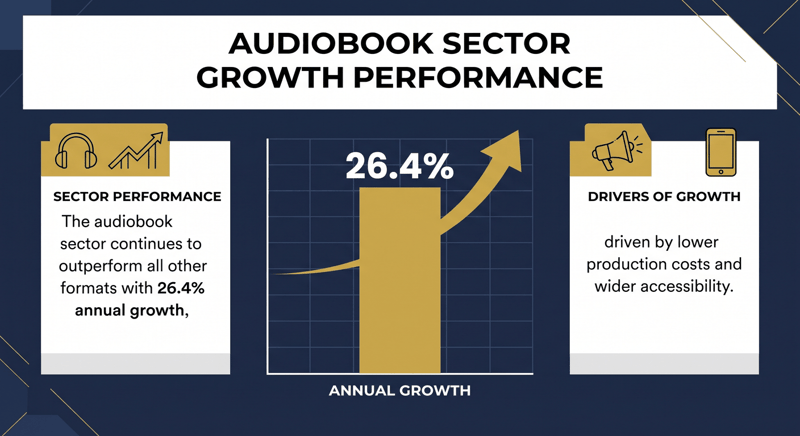
This growth, cited by market analysts, is not just about more listeners; it's about more inventory. The ability to produce audio content for under $100 implies that every book, no matter how niche, can and should have an audio component. The 'read-through' rate on audio series is proving to be exceptionally high, making it a critical format for series retention.
Backlist Revival and Series Economics
Finally, 2026 sees a strategic return to the backlist. With the frontlist becoming increasingly crowded and expensive to launch, smart money is flowing into 'Revival Architecture'—updating metadata, covers, and formats for existing IP. The most stable income in the industry belongs to authors with deep backlists (25+ books), where median earnings stabilize around sustainable figures without the need for constant launch hype.
The strategy is simple: use AI to refresh the packaging and GEO to refresh the discoverability. A book published five years ago is new to a reader who just found it today. By treating the backlist as an active asset class rather than a passive archive, authors are compounding their returns significantly.